NQ Week Ahead (Aug 17–21, 2026): The Breakout Meets FOMC Minutes, Walmart and OPEX
NQ enters the week holding above the 2026 high-volume node, roughly 3% below all-time highs. FOMC minutes, Walmart earnings and monthly OPEX will test whether the breakout is real. The full level map and calendar inside.
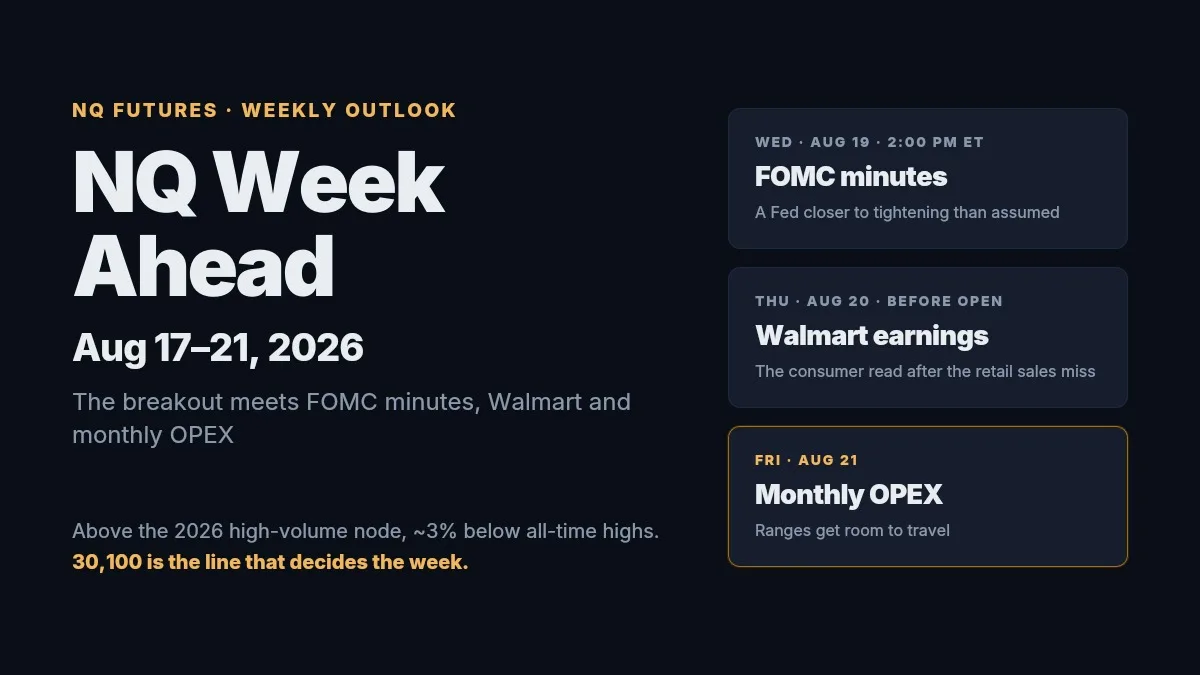
This is the first entry in what will become a weekly series here: where the market stands, what's on the calendar, and the levels I'm working with going into the week.
NQ enters this week in its most interesting position of the year. After four months of rotating inside the same balance, price has finally accepted above the 2026 high-volume node — and instead of giving it straight back, it held that ground into the weekly close. The index now sits roughly 3% below its all-time highs, with FOMC minutes, Walmart earnings and a monthly options expiration all packed into the next four sessions.
There is no single obvious catalyst this week on the scale of a CPI or NFP print. Which makes the question simple: do buyers defend the breakout, or does the market get pulled back into the range it just escaped?
Where the Market Stands
Thursday delivered the technical event of the summer — high-volume acceptance above the node that had capped NQ since spring. Just as important was what didn't happen on Friday: no immediate rejection. Price printed an inside day above the breakout area, quietly rebalancing Thursday's expansion candle while dip buyers kept absorbing supply.
Context matters. The S&P 500 has been printing fresh records for weeks (another all-time closing high on Thursday at 7,798.99), while NQ has been the laggard, still working back toward its own highs. The recent strength is really a story of technology leadership returning and that relative-strength gap starting to close.
The structure currently supports the bulls on several fronts: acceptance above the 2026 HVN, Friday's inside bar holding the breakout, the 5-day SMA acting as support after the recent 5D/50D cross, and daily Bollinger Bands beginning to widen. That last point is worth underlining — bands expanding right as price leaves a major volume shelf is often the early signature of a market moving from balance into trend.
The Macro Backdrop in Two Minutes
The sequence that carried us here started with a weak July jobs report: payrolls fell 23K against expectations near +80K, with a combined 103K of downward revisions to prior months. Then CPI came in without any sign of re-acceleration (core easing to 2.5% YoY), and PPI was flat on the month — 4.7% YoY versus 5.5% previously. By late last week, markets were pricing roughly a two-in-three chance that the Fed holds rates in September.
To be clear, the Fed itself has not turned dovish. Cleveland's Hammack still argues rates should go higher; Richmond's Barkin calls another hike an "open question." What changed is that the data bought the Fed room to wait — and long-duration tech responds to that immediately.
Leadership has also broadened. AI infrastructure names delivered strong guidance (CoreWeave's backlog alone now exceeds $100B), memory and semis followed, and — the newer development — software joined in, with the sector index up around 25% quarter-to-date and Workday jumping on takeover reports. A rally carried by rotation across AI infra, semis, mega-caps and software is structurally healthier than one leaning on a single name.
The risks haven't gone anywhere, though. The Iran/Hormuz standoff keeps oil elevated — energy is still running +14.7% YoY inside CPI, gasoline +24.6% — and Friday's surprise drop in retail sales (−0.6%) was the first soft note on the US consumer. Equities rallied despite the geopolitics, which itself says something about underlying demand. But oil feeding back into inflation expectations and yields remains the main transmission channel to watch.
The Level Map
Everything this week keys off 30,100 — Friday's point of control and the prior week's value-area high rolled into one. As long as buyers keep accepting price above it, the breakout structure stays mechanical.
Upside roadmap:
30,100 hold → 30,175 → 30,283 (last week's high) → 30,420 → 30,510 → 30,600 (weekly expected move) → 30,700 → 30,920 → 31,000
Sustained acceptance above 31,000 would put a genuine all-time-high retest properly in play.
Downside roadmap:
30,100 lost → 30,000 → 29,900 → 29,870 (prior-week POC) → 29,800 → 29,685 (weekly expected move low) → 29,535 (prior-week VAL)
Losing 30,100 alone is not a structural failure — a rotation back into Thursday's imbalance would still be a normal retest. The line that matters is 29,870: acceptance below the prior-week POC would be the first real evidence that buyers are losing the breakout. And a break of 29,535 would mean value has failed to migrate higher, putting price back inside the four-month balance it just left. Failed breakouts of that size tend to unwind fast, because late longs are trapped above — in that scenario the map opens toward 29,000 and the rising 20-day SMA.
Base case stays constructive while 29,870 holds. But 2026 has repeatedly punished anyone married to one scenario. The job isn't to predict which path plays out — it's to recognize quickly when the market switches regimes.
The Calendar (All Times ET)
Monday was the light session — Empire State manufacturing and NAHB housing sentiment. The real weight is loaded from midweek on:
- Tuesday: housing starts, import prices, industrial production and capacity utilization in the morning. Home Depot reports before the open — the first big consumer read after Friday's retail sales miss.
- Wednesday: the dense day. Analog Devices, Target, TJX and Lowe's before the open; FOMC minutes at 2:00 PM; a 20-year Treasury auction keeping the long end honest.
- Thursday: weekly jobless claims and the Philly Fed survey at 8:30 AM; Walmart, Alibaba and John Deere before the open. Walmart is the single most important earnings print of the week for the consumer picture.
- Friday: flash PMIs at 9:45 AM — and monthly OPEX.
OPEX and the Volatility Question
The VIX is sitting in the mid-14s, which means the options market is pricing a fairly calm environment despite elevated geopolitical and macro risk. That calm is partly manufactured: large options positions and the dealer hedging flows around them have been suppressing intraday ranges for weeks.
Friday's monthly expiration removes a chunk of that positioning. OPEX doesn't have to produce fireworks on the day itself — but once price is no longer pinned to heavily traded strikes, any headline (an Iran escalation, a yield spike, a bad tech reaction) has more room to travel. For an intraday trader that's not a threat; it's a regime note. Ranges can expand, and the character of moves at key levels can change with them.
This is exactly why I've been building gamma-regime tagging into my own journal — reversals at key levels behave measurably differently in positive versus negative gamma environments, and weeks around OPEX are where that distinction earns its keep.
How I'm Trading It
My approach doesn't change just because the calendar is loud. I trade reversals at prepared levels, and the map above is the preparation. What changes is exposure around scheduled risk: I won't be holding anything into the FOMC minutes release on Wednesday, and Friday afternoon around expiry is a reduced-expectations environment for me. If the tape turns into strike-pinning chop, a no-trade day is a result — not a failure.
The single most useful tell this week is behavior at 30,100. Responsive buying on the first touches keeps the bullish structure intact and mechanical. Hesitation, followed by acceptance below, flips the entire map — and I'd rather recognize that in the first hour than argue with it all week.
Beyond This Week
Two dates are already casting a shadow over everything above: Nvidia earnings on August 26 and Jackson Hole on August 27–29. Positioning into both starts now. The bigger question for NQ hasn't changed all summer: can broadened tech leadership generate enough sustained demand to carry the index back into price discovery — or does the relative-strength gap with ES stay open?
We'll know a lot more by Friday's close.
Nothing here is financial advice. This is my own weekly preparation, published as-is — levels are references, not signals.
Educational content, not investment advice. Futures trading involves substantial risk of loss. Examples are for illustration only. Read the full Risk Disclosure.
Read next
NQ Week Ahead (Sep 28–Oct 2, 2026): PCE, Micron, Payrolls and a Breakout Under Test
NQ broke out of a five-week range last week and settled Friday at 30,889, inside the value it built on the way up. Oil, core PCE, Micron and September payrolls now test the breakout, in that order.
NQ Week Ahead (Sep 21–25, 2026): Flash PMI, Costco, Xi in Washington and a 10-Year at 5%
The Fed hiked, NQ printed a lower low at 29,053 and closed the week back at the prior value area high. This week has no tier-1 release, so the 10-year yield, Wednesday's flash PMI and Thursday's Xi visit decide whether last week's failed breakdown gets resolved.
NQ Week Ahead (Sep 14–18, 2026): FOMC, the Dot Plot and Quarterly Expiration
Four weeks in a range under 900 points wide, moving averages stacked, and a Fed hike about 90% priced for Wednesday. Where last week's map held, the levels I've marked on December, and how the European session lines up around FOMC and Friday's expiration.