Best Loser Wins Review — The Book My Trade Data Agrees With
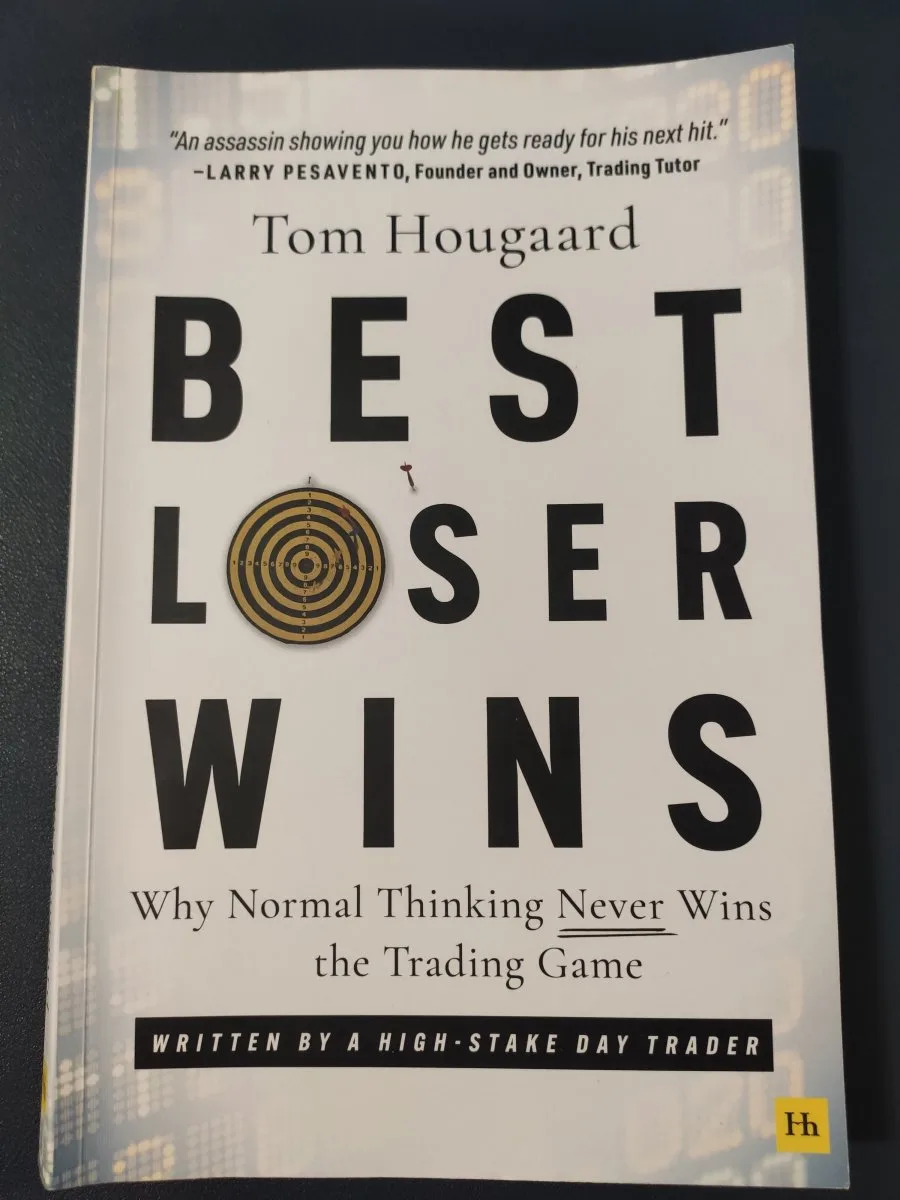
Hougaard's argument is uncomfortable: most traders don't lose because they're wrong too often — they lose because of what they do when they're wrong. My review after measuring that exact thing in my own trade data, and why this book is the natural companion to Tendler's The Mental Game of Trading.
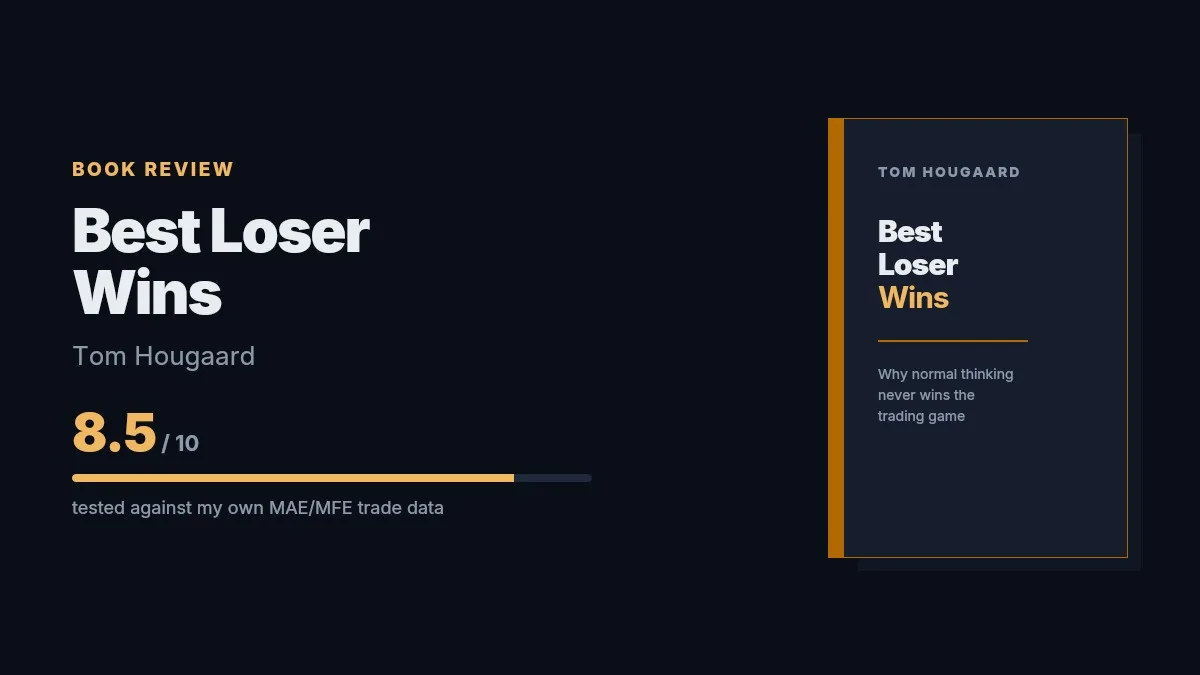
There's a number in my journal I watch more closely than my win rate: the size of my average losing trade against the size of my average winner. Tom Hougaard wrote an entire book about why that one ratio — not entries, not indicators, not a better strategy — decides who is still trading in five years.
Best Loser Wins is not a strategy book. Hougaard barely discusses setups. His argument is blunter than that: the market doesn't beat most traders. Most traders beat themselves, and they do it in the same predictable way — they take small wins quickly to feel relief, and they sit in losses to avoid the pain of being wrong. The few who win consistently have trained themselves to do the opposite. The person who is best at losing wins. He means the title literally.
I came to this book as a trader who already had the losing part mechanically solved — every trade I take has a hard stop attached before it's live. What I didn't expect was how much the book had to say about what happens in my head after the stop fills. That's where it earned its place on this list.
What the book actually argues
Hougaard spent years inside a broker before trading full-time, and the book opens with what he saw from that side of the glass: the retail accounts he watched were, on the whole, right more often than they were wrong — and still lost money. The losses were simply bigger than the wins. Not a knowledge problem. Not a strategy problem. A behavior problem, and the same behavior in almost every account.
His explanation is that normal human wiring — grab the sure small gain, avoid the realized loss, feel bad about being wrong — is precisely the wiring that loses at this game. Hence the subtitle: why normal thinking never wins. You can't arrive at consistent trading by being a sensible person with a good strategy. You have to retrain a set of reflexes that served you well everywhere else in life.
He writes from his own desk, not a lecture hall. Hougaard is a day trader of index markets who broadcasts his trades to an audience in real time and shows his losing days as openly as his winning ones. That matters for how the book reads: nothing in it is a lab theory. It's the voice of someone who has lost a lot of money in public, kept trading, and wants to tell you what changed.
Normal thinking, inverted
The spine of the book is a set of reversals. Here is the shape of it, in my words — what the average trader does on the left, what Hougaard asks you to do on the right:
The first row is the most famous and the most controversial part of the book — adding to winners rather than losers — and I'll come back to it, because it's also the part I've had to adapt most carefully to the way I trade.
What this book looks like in my data
I measure every trade's maximum adverse excursion and maximum favorable excursion: how far it went against me and how far it went in my favor before the exit. That dataset is Hougaard's thesis, quantified. When I look at my worst weeks, the entries aren't what's different. What's different is that a handful of trades were managed by a version of me who didn't want to be wrong.
The mechanical half of "losing well" I've handed to the platform. Every entry goes in through an ATM with a hard stop attached, and a target or a trailing stop takes the exit decision away from me on the way up. I don't get to hold a loser — the platform won't let me. But a stop-loss can't stop you from wanting to make it back. That's the part Hougaard writes about better than anyone I've read: the loss itself is cheap. The next three decisions after it are where the month gets decided.
The re-entry itch. My personal version of what he describes is the trade after the stop-out. The level gets tested, I'm stopped by a handful of points, price reverses exactly where I said it would — and the pull to get back in on a worse entry is physical. Reading a trader with decades more experience describe the same pull, and then describe losing days in public without flinching, did something that no amount of "control your emotions" ever did. It made the feeling normal. Normal is much easier to sit through than shameful.
Patience as a position. My playbook needs roughly one qualifying trade a week to hit its monthly target. Hougaard's relentless point that most of the session is not an opportunity is, for me, the permission slip behind every no-trade day I log. I track those days as real data, not as blanks — and the book is part of why I started.
Transparency. There's also a reason this book is on my list at all. Hougaard trades in front of people and shows the red days. That's the standard I'm holding this site and the channel to — the MAE/MFE stats, the losing sessions, the evaluation accounts that didn't make it. If you've wondered why I publish the bad weeks, this book is part of the answer.
Where I adapt it
Adding to winners. Scaling into a position that's already working is central to how Hougaard trades. I do it too — but rarely, and only on selected trades. I trade evaluation accounts at a prop firm with a trailing drawdown, and on that structure a bad add can cost an evaluation, not just a trade. So adding is an option I take when the trade, the level, and the cushion I've built in the account all line up — not a habit, and not my bread and butter. The principle I've kept in full: don't fight evidence, press when you're right. The frequency I've dialed down to fit the risk structure I actually trade under.
That's a pattern with this book generally: the thinking transfers, the specifics need translating. Keep that in mind if your capital, instrument, or drawdown rules look nothing like his.
What it won't do for you
A review that's all praise is an ad. The other side:
Where it delivers
- The clearest argument I've read for why losses, not entries, decide results — and it matches my data
- Radical openness about his own losses; the credibility is earned, not claimed
- Reframes losing from failure into a trainable skill
- Fast read — you'll finish it in a weekend
- The patience message alone is worth the price
Where it doesn't
- Repetitive — the same idea arrives from many angles
- A mindset book, not a method: it tells you what to believe, not how to build the routine
- His risk structure (own capital, own rules) doesn't map 1:1 onto prop-firm drawdown limits
- Light on structure — anecdote carries most of it
The second point is the real limitation. Hougaard will convince you that your relationship with losing is the problem. He won't hand you a system for fixing it. You close the book agreeing with him and not entirely sure what to do on Monday morning.
Read it with Tendler
Which is why I don't think this book should be read alone. If Jared Tendler's The Mental Game of Trading is the how — the system I used to map my own patterns and eventually built into my journal software — Best Loser Wins is the why. Hougaard convinces you that losing is the skill. Tendler shows you how to train it. Read in that order, the two fit together almost suspiciously well.
If you only read one, read Tendler. If you read both, read Hougaard first, over a weekend, and let it set the frame before you start the work.
Verdict
Verdict
A short, blunt, unusually honest book about the one thing that actually separates winning and losing traders — and it says the same thing my own trade data says. It loses points for repetition and for being a frame rather than a method. Pair it with Tendler for the method.
Read it in a weekend. Then open your own journal and look at the losing trades — the size of them, and what you did in the hour after each one. If Hougaard is right about you, the numbers will say so before you do.
Educational content, not investment advice. Futures trading involves substantial risk of loss. Examples are for illustration only. Read the full Risk Disclosure.