The Mental Game of Trading Review — I Use This Book Every Trading Day
Most trading psychology advice boils down to "control your emotions." Tendler's book does the opposite — it treats emotion as data. My review after building my entire daily journaling routine around this system, and why it's one of the best trading books I've ever read.
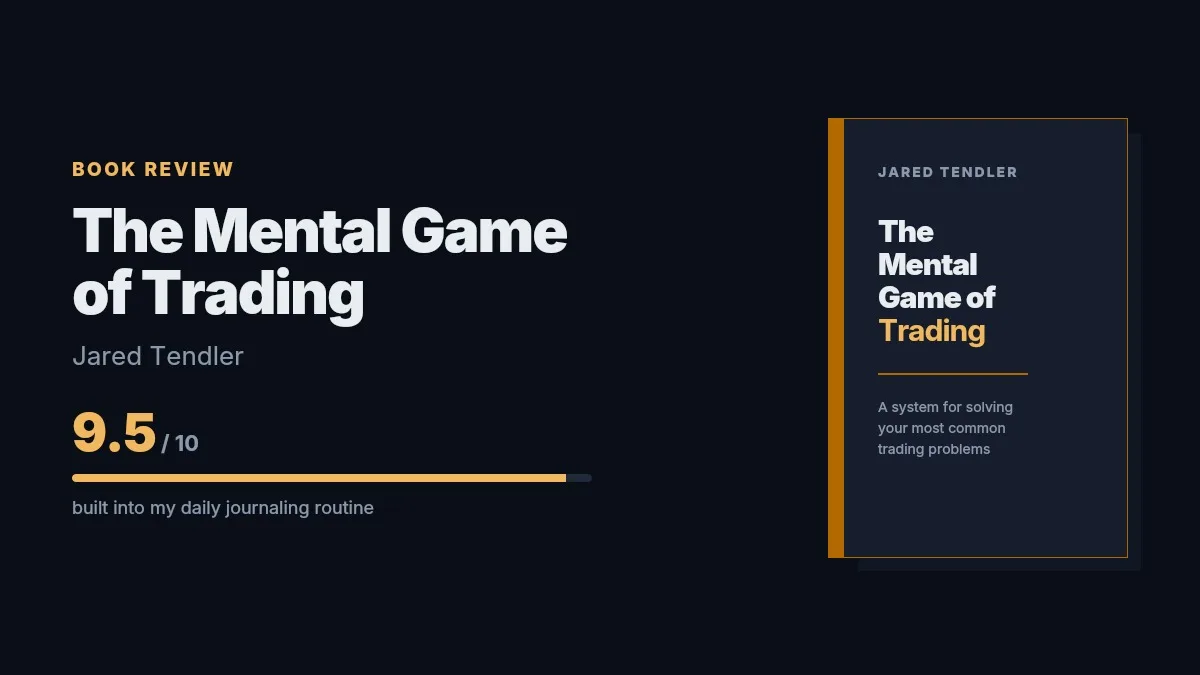
I don't reread many trading books. This one sits open next to my journal.
Most trading psychology content is useless in the exact moment it matters. "Stay disciplined." "Control your emotions." "Stick to the plan." All true — and all completely worthless at 9:32 ET, when NQ just took out your stop by a handful of points and then reversed precisely where you said it would. Advice written for calm minds doesn't survive contact with a live market.
The Mental Game of Trading by Jared Tendler is the first book I've read that treats that moment — not the calm before it — as the thing to engineer for. And I'm not saying this as a reviewer who read it once and moved on. Tendler's framework is wired into my daily routine: it shaped how I journal, how I prepare for every session, and it became the backbone of the psychology module I built into my own trading journal software. This is a review from inside the system.
Short version up front: this is one of the best trading books I've ever read, and easily the most useful one on psychology. Now let me earn that claim.
What this book actually is (and isn't)
Tendler is a performance coach who came to trading through golf and professional poker, and it shows — in a good way. His core position is the opposite of the usual advice: emotions like fear, anger, greed, and overconfidence are not character flaws to suppress. They're signals pointing at flawed assumptions you actually hold.
Revenge trading, in this view, isn't a discipline problem. It's what happens when a hidden belief like "a loss means I did something wrong" collides with a normal, statistically inevitable losing trade. You can't willpower your way past a belief you don't know you have. You have to find it, name it, and correct it — and the emotion is what shows you where to dig.
So this is a diagnostic manual, not a motivational one. The book is organized around the problems themselves — greed, fear, tilt, overconfidence and its collapse, discipline — and for each one it walks through how it shows up in trading, what typically causes it underneath, and how to correct it at the root instead of managing the symptom.
The system: map your pattern, raise your floor
Stripped to its skeleton, the method has three moving parts that feed each other:
Map your pattern
Collect data on your own reactions the way you collect data on the market: triggers, early physical and verbal signals, escalation levels. After a few weeks you have a map — and the point of the map is catching the emotion at a 3/10, when you can still think, instead of an 8/10, when you can't.
Think in ranges, not peaks
Your performance is a range: your best trading, your average, and your worst. The lever that changes your results isn't a better best day — it's deleting the worst version of your worst day. The whole range moves forward from the back end. The worked version of that range, with a hypothetical A / B / C grid and the arithmetic of a month, is in the A-to-C game analysis post.
Correct in real time
Recognition plus a short interruption routine plus an injected corrective thought — one you wrote in advance, aimed at your specific flawed logic. Not "calm down." A precise sentence written by the calm version of you, for the tilted version of you.
None of this is complicated. All of it is work — which is exactly why it functions when clever-sounding advice doesn't. More on that in the honest section below.
How I use it every trading day
This is the part a normal review can't give you. I trade NQ futures on a key-level reversal playbook, and Tendler's system runs through my entire session workflow:

Pre-session. My journal template includes my personal early-warning markers — the specific behaviors that historically show up right before my worst trading. For me it's things like the urge to shorten my process, glancing at open P&L mid-trade, or "making it back" language creeping into my notes. I review them before the open the same way I review my levels. Two minutes, every day.
In-session. When a marker fires, the routine is mechanical: hands off the mouse, one breath, read the correction statement written into my trading plan. It costs seconds. It has saved me from re-entries without a setup more times than I can count. One concrete pattern from my own map: after a stop-out on a key-level trade that then works without me, my FOMO doesn't arrive as a feeling first — it arrives as a behavior. I start hunting a faster chart for "any" entry. That behavior sits on my map at the exact intensity where it appears, and because it's mapped, I catch it before it costs money.
Post-session and weekly. Every session gets a quick performance grade next to the trade data, and my Sunday review looks at the week's distribution, not individual days. A side effect I didn't expect: my no-trade days often grade as my best performance. The system captures disciplined filtering as a result — not as an absence of one.
Built into my tools. I liked the framework enough that I wrote software around it. The psychology module in my own trading journal is essentially Tendler's mapping system turned into a database schema — triggers, signals, intensity levels, corrections, tracked over time next to the actual trades. That is probably the most honest endorsement I can give a book: I turned it into infrastructure.
What it won't do for you
A review that's all praise is an ad. Here's the other side, honestly:
Where it delivers
- A genuinely usable real-time protocol, not just theory
- Root-cause approach — fixes the belief, not the symptom
- Framework converts directly into a journaling routine
- Treats you like a performer, not a patient
- Survives contact with live trading — I test it daily
Where it doesn't
- It's work — weeks of self-data collection, not a weekend read
- Gives you zero edge; it only improves execution of one
- Big overlap if you've read The Mental Game of Poker
- Workbook-style structure drags a little as pure reading
The first point deserves emphasis. The value of this book is maybe 20% reading and 80% doing. If you won't journal — actually journal, daily, for weeks — the framework becomes shelf development. It has no passive mode.
The second point matters even more. This book will not make a losing strategy profitable. Flawless execution of negative expectancy is just losing money with discipline. Read it after you have a tested playbook, not instead of building one.
Verdict
Verdict
One of the best trading books I've ever read, and the only psychology book that survived contact with my live trading and became part of my daily infrastructure. The half point comes off for the overlap with Tendler's poker book — if you've read that one, a chunk of the framework will feel familiar.
A review can only tell you so much about a book whose value lives in the doing. My honest recommendation: read it with a pen, expect to work, and give the mapping process at least a month of real sessions before you judge it. Mine paid for itself inside the first week — one prevented revenge trade covered the price of the book many times over.
Educational content, not investment advice. Futures trading involves substantial risk of loss. Examples are for illustration only. Read the full Risk Disclosure.