NQ vs MNQ: Tick Value, Point Value and What a 20-Point Move Actually Costs
Same index, same tick size, 10× the dollar value. What one tick, one point and a full stop cost on NQ vs MNQ — and why margin is not the number that decides which contract you should trade.
Two traders take the same trade: same level, same entry, same 40-point stop. One clicked NQ, the other MNQ. The stop gets hit. The first is down $800, the second $80. Nothing about the trade was different — only the contract. On a typical 25K prop evaluation with a $1,000 drawdown, that one click is the difference between an account that can absorb twelve such stops and one that ends on the first.
Two contracts, one index
NQ is the E-mini Nasdaq-100 futures contract on CME. MNQ is the Micro E-mini Nasdaq-100, launched in 2019 as exactly one tenth of it. Both track the same index, trade the same hours, print the same price and move in the same increments. If NQ is at 25,000.25, MNQ is at 25,000.25.
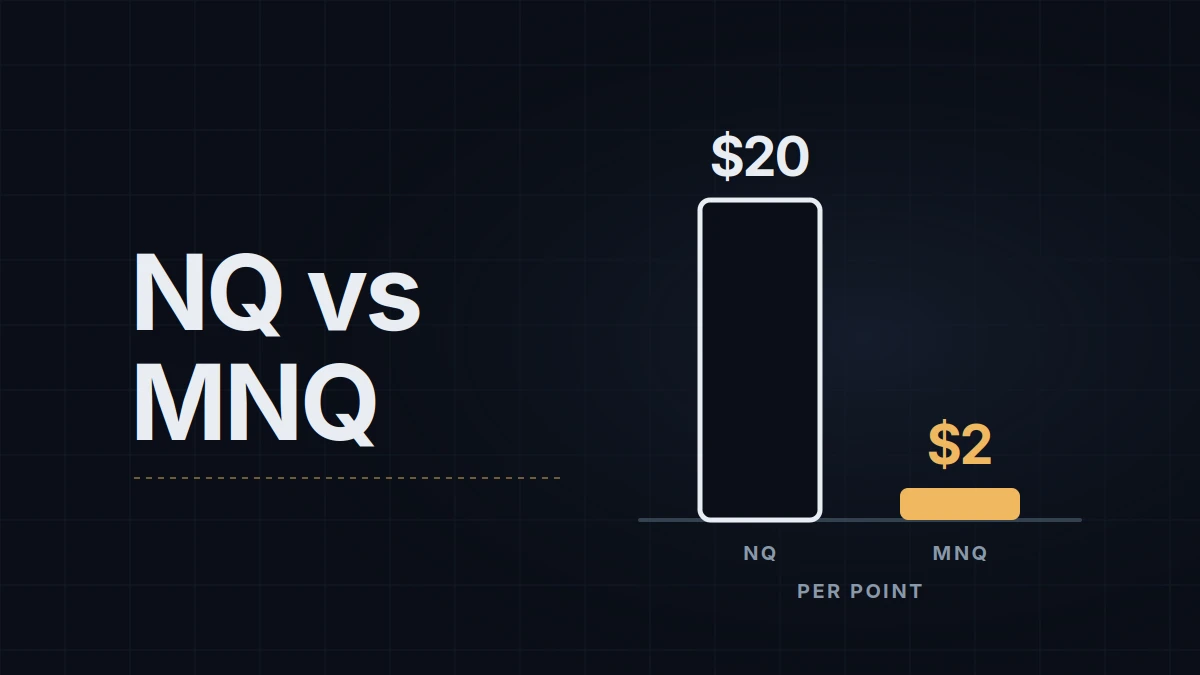
What differs is the multiplier — how many dollars one index point is worth:
- NQ: $20 per point
- MNQ: $2 per point
The smallest price increment on both is one tick = 0.25 index points, four ticks to a point. So one tick is worth $5.00 on NQ and $0.50 on MNQ.
That's the whole definition: three numbers per contract. The one that gets mixed up most often is the tick — "MNQ tick value is $2" is wrong. $2 is the point. The tick is $0.50.
The table to keep next to the chart
| NQ | MNQ | |
|---|---|---|
| Contract | E-mini Nasdaq-100 | Micro E-mini Nasdaq-100 |
| Multiplier (per index point) | $20 | $2 |
| Tick size | 0.25 pt | 0.25 pt |
| Tick value | $5.00 | $0.50 |
| 1 point (4 ticks) | $20 | $2 |
| 10-point move | $200 | $20 |
| 20-point move | $400 | $40 |
| 50-point move | $1,000 | $100 |
| 100-point move | $2,000 | $200 |
| Notional value at index 31,000 | ~$620,000 | ~$62,000 |
| Day-trade margin (Tradovate, at time of writing) | $500 | $50 |
| Initial / overnight margin (CME, changes with volatility) | ~$46,500 | ~$4,650 |
Every dollar figure scales exactly 10:1 — no rounding, no surprises. The margin rows are the ones that mislead beginners; they get their own section below.
Why 20 points, specifically
Because 20 points is what NQ does while you're deciding. It's the most volatile of the major US index futures: a 20-point move takes seconds at the US open and minutes at almost any other hour, and daily ranges of several hundred points are normal.
More importantly, 20 points is roughly the size of the pullback a correct trade goes through before it works. Anyone who logs MAE — maximum adverse excursion, how far price went against a trade before it turned — sees the same pattern on NQ: entries at a well-marked level routinely get pushed 20 to 50 points into the red and still finish as winners — ordinary noise, not a broken setup.
The noise is the same on both contracts. The bill isn't. A 20-to-50-point pullback is $40–$100 of open drawdown per MNQ and $400–$1,000 per NQ. A stop tight enough to avoid the noise on NQ is a stop inside the noise — and it gets hit by noise.
Margin is not risk
Most first-year mistakes start here, so it's worth separating three numbers that sound alike.
Day-trade (intraday) margin is what a broker holds per contract while a position is open during the session. Tradovate lists $500 for NQ and $50 for MNQ at the time of writing. It's a deposit, not a price — it says nothing about what the trade can lose.
Initial (overnight) margin is what CME requires to hold a position through the close. It's an order of magnitude larger, changes with volatility, and applies the moment you're not flat at the close.
Risk is the stop distance multiplied by the point value. That's the only one of the three that matters for whether you're still trading next week.
Low margin is what makes NQ accessible. It doesn't make it affordable. A trader with $2,000 can open an NQ position on $500 of margin; a single 40-point stop is 40% of the account. The margin table said yes. The arithmetic said no.
On a prop-firm account the margin row barely matters: the firm caps contracts and the drawdown does the rest.
Is 10 MNQ the same as 1 NQ?
In price exposure — yes, exactly. Ten micros and one mini gain and lose the same dollars on every tick.
In three other ways — no:
- Costs. Commissions and exchange fees are charged per contract, and a micro is not priced at one tenth of a mini. A round trip on 10 MNQ typically costs two to three times what a round trip on 1 NQ costs. Check the fee schedule of your broker or prop firm — at dozens of round trips a week it adds up.
- Granularity. With 10 MNQ you can take 3 contracts off at the first target and trail the rest. With 1 NQ you're all in or all out.
- Book depth. The NQ book is deeper, but for one to ten micros during European and US hours fills are a non-issue.
For a small account the granularity alone settles it. Costs are the price you pay for it.
How to choose: three lines of arithmetic
The contract decision is a sizing decision, and it takes three lines.
- Risk per contract = stop distance × point value. A 40-point stop: $800 on NQ, $80 on MNQ.
- Share of the account = risk per contract ÷ drawdown (or account size). On a $1,000 drawdown: 80% on NQ, 8% on MNQ. On a $5,000 drawdown: 16% vs 1.6%.
- Stops the account can absorb = drawdown ÷ risk per contract. One on NQ, twelve on MNQ.
A common guideline is to keep one full stop within 1–2% of the account. Evaluations with tight trailing drawdowns push that number higher whether you like it or not — which is exactly why the micro exists.
The order of operations matters. The stop comes from the setup — it goes where the trade idea is wrong, and that distance changes with the level, the volatility and the time of day. The contract comes from the account. Shrinking the stop so that a bigger contract "fits" reverses the order, and what you end up trading is a different, untested strategy under the same name.
Where I land on this
I trade the micro, and margin has nothing to do with it. On a prop evaluation it's the drawdown that ends accounts, and MNQ is the only way to keep a setup-sized stop at a single-digit share of it. My stop distance changes with the level and the conditions; the contract follows from it, never the other way round.
The rule
Educational content, not investment advice. Futures trading involves substantial risk of loss. Examples are for illustration only. Read the full Risk Disclosure.