NQ Trading Sessions Explained: Globex, European Hours and RTH
Globex opens Sunday evening and NQ trades almost around the clock, but the day splits into four windows with different volume, range and reasons to move. A session table in ET and CEST, what drives each window, and how to pick one for your schedule and your setup.
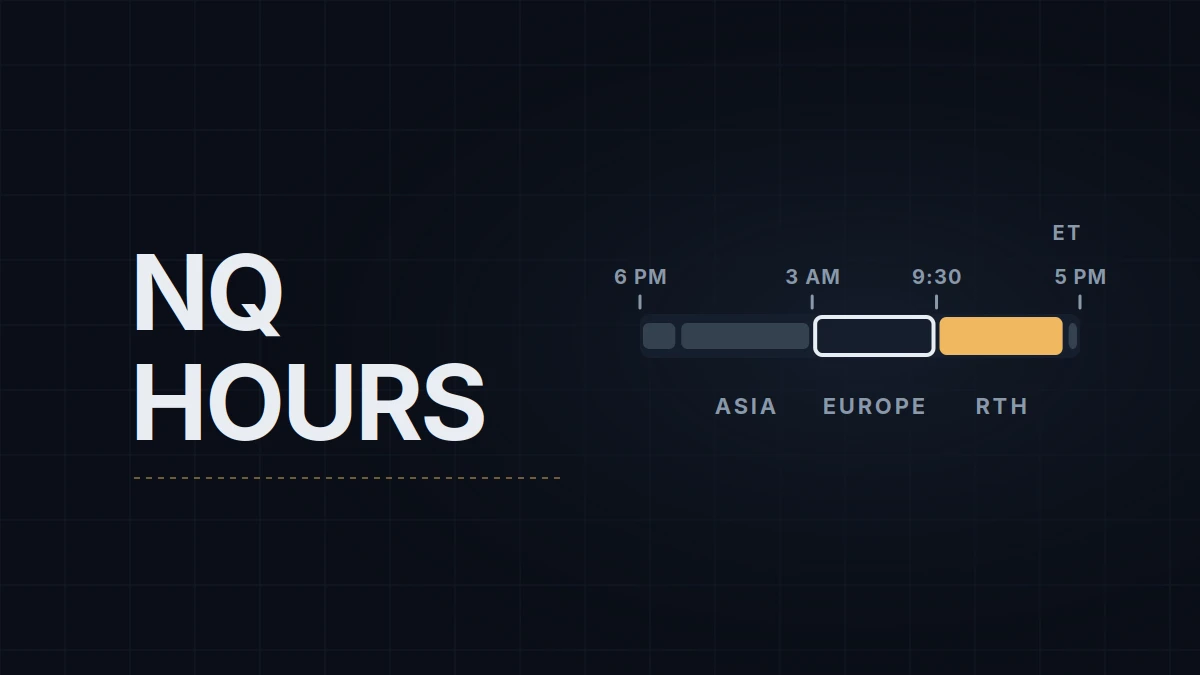
"When is the best time to trade NQ" is one of the first things people type after opening a futures account, and the short answer is dull: when you can sit at the screen without rushing, in a window that moves enough for your setup and not so much that one bad fill costs a week. Getting to a useful answer takes the map of the whole day, because E-mini Nasdaq-100 futures (NQ, and the micro contract MNQ) trade nearly 23 hours a day and behave differently in each part of it. If you're still deciding between the two contracts, the tick and point arithmetic is in NQ vs MNQ.
Times below are in ET (New York) and CEST (central Europe), six hours apart for most of the year. The exchange publishes everything in Central Time, one hour behind ET.
| Window | ET | CEST | What is going on |
|---|---|---|---|
| Globex open | Sunday 6:00 PM | Monday 00:00 | CME Globex is the electronic platform NQ trades on. The first print reprices whatever happened over the weekend against Friday's 5:00 PM ET close; gaps are common, volume is not |
| Asia | 8:00 PM – 3:00 AM | 02:00 – 09:00 | Tokyo cash opens 8:00 PM ET / 02:00 CEST, Hong Kong and Shanghai 9:30 PM ET / 03:30 CEST. Thin book, small ranges, NQ follows regional indexes and headlines |
| Europe | 3:00 AM – 8:30 AM | 09:00 – 14:30 | Frankfurt and London cash open at 3:00 AM ET / 09:00 CEST. Medium ranges, orderly rotations, European data and US pre-market earnings |
| Data hour | 8:30 AM – 9:30 AM | 14:30 – 15:30 | Most US economic releases land at 8:30 AM ET. The overnight range gets confirmed or broken here, an hour before the cash open |
| RTH | 9:30 AM – 4:15 PM | 15:30 – 22:15 | Regular trading hours: the US stock market is open 9:30 AM – 4:00 PM ET. The bulk of daily volume: a New York Fed blog post from July 2026 puts the overnight share of E-mini S&P 500 volume at about 16% for 2021 to 2025, so roughly five contracts in six trade in the day session; it gives no figure for NQ. Daily settlement is fixed at 4:00 PM ET. The 4:15 PM end is a convention, the old pit close and still where TradingView's RTH view stops |
| Late Globex, maintenance | 4:15 PM – 6:00 PM | 22:15 – 00:00 | No pause after the RTH end: NQ keeps trading until 5:00 PM ET (CME removed the old 4:15 – 4:30 PM ET halt from the June 28, 2021 trade date), then the daily maintenance break 5:00 – 6:00 PM ET. The exchange's trading date rolls over at the 6:00 PM reopen |
Everything outside RTH is ETH, extended trading hours, or "the overnight" in trader shorthand: the overnight high is the high between 6:00 PM and 9:30 AM ET, not just the Asian window's.
What moves NQ in each window
Asia is the quietest part of the day for a US index. The book is a fraction of what it is at 10:00 AM ET, so a moderate order moves price further than it would in RTH. Nikkei and Hang Seng direction and Chinese data at 9:30 PM ET / 03:30 CEST are the scheduled drivers; weekend headlines and US earnings released after the 4:00 PM close are the unscheduled ones.
Europe is where NQ starts behaving like an index again. The Frankfurt and London cash opens at 3:00 AM ET / 09:00 CEST bring two-way flow, because European institutions hedge US exposure in the most liquid US product that is awake, and that is NQ and ES. Eurozone flash releases come at 5:00 AM ET / 11:00 CEST, and on ECB days the decision at 8:15 AM ET / 14:15 CEST with the press conference half an hour later. US pre-market equity trading opens at 4:00 AM ET / 10:00 CEST, and companies reporting "before the bell" typically publish between 6:00 and 7:30 AM ET, so a large Nasdaq name's earnings move NQ hours before the cash open.
The 8:30 AM ET release is a window of its own because of what it does to the range. By 8:30 the overnight high and low have been in place for hours; CPI, PPI, non-farm payrolls, retail sales, GDP or the weekly jobless claims either confirm them or take one of them out within seconds. The week's scheduled releases are on the economic calendar, with a countdown to the next one.
RTH has its own internal clock. The opening drive from 9:30 to roughly 10:30 AM ET is the highest-volume hour of the day and carries the widest ranges; 10:00 AM ET is a second release slot (ISM surveys, consumer sentiment, job openings). Between about noon and 1:30 PM ET volume thins and price rotates inside the morning range. On FOMC days the 2:00 PM ET decision and the 2:30 PM press conference reset the afternoon, and the last minutes before 4:00 PM belong to the stock market's closing auction; the futures' daily settlement is fixed off the final 30 seconds before the close.
Which window fits your life
Two things decide this, and only you know them: when you can sit at the screen, and how much movement your setup needs.
With a US day job, the realistic windows are the pre-open hour from 8:30 to 9:30 AM ET, the first half hour of RTH if the job allows it, and the evening Asian session. The evening is the trap: it is available, but it is thin. Stops get run on little volume and a playbook built for the RTH open does not transfer; traders who make the evening work build a setup for the evening, with smaller targets and the assumption that nothing will trend.
With a European day job, RTH is your evening. The 15:30 CEST open is still inside working hours for most people, but 16:00–22:00 CEST is not. The cost is that the second half of RTH is either a trend day where you arrive late, or a rotation day inside a range the morning built without you.
Full-time in the US, the decision is mostly how much of RTH to trade. The first 90 minutes carry most of the opportunity and most of the slippage; many traders stop there, review through lunch and only return for the afternoon on scheduled-event days.
Full-time in Europe, the 09:00 to 15:30 CEST window is a complete trading day with a natural end at the US open. Ranges are smaller than in RTH, so targets are smaller, and the 8:30 AM ET release can end the session an hour early if you don't want to hold through it. I trade this window and I'm flat before the 8:30 release rather than through it; the trade-off is that I rarely see the biggest moves of the day, in exchange for orderly rotations at levels.
The second axis, movement, matters as much as the clock. A 40-point stop is tight at 9:45 AM ET and wide at 5:00 AM ET, because the range that stop lives in can be three times larger in one window than in the other. The same setup needs a different stop, and therefore a different size, in each window; the arithmetic is in Stop Belongs to the Setup, Size Belongs to Capital.
Three things that change the table
Trading hours templates. NinjaTrader 8 ships two that matter here: CME US Index Futures ETH, which treats the whole 6:00 PM to 5:00 PM ET day as one session, and CME US Index Futures RTH, which cuts it to 9:30 AM – 4:15 PM ET. The template decides where a daily bar starts and ends, so "yesterday's high" on an ETH chart includes the overnight and on an RTH chart it doesn't. Either is fine; switching between them from one day to the next is how you end up marking a level that was never a level. The setting lives in the Data Series window, covered in the NinjaTrader 8 chart setup post.
Clock changes. The six-hour gap between ET and CEST shrinks to five for a few weeks each year because the US and Europe move their clocks on different dates. In 2026 the US changes on March 8 and November 1, Europe on March 29 and October 25. From October 25 to November 1 the RTH open is at 14:30 CET, not 15:30, and every ET time in the table lands an hour earlier in European terms.
Holidays. On most US market holidays the stock market is closed but NQ trades a shortened Globex session with an early halt. Thanksgiving, Thursday November 26, 2026, is the next one, and the Friday after it is a shortened session too; CME finalizes holiday hours about two weeks ahead, so check the exchange's trading hours page before those mornings. The season's dates and early closes, from Thanksgiving to New Year's Day, are in holiday and half-day sessions on NQ.
Educational content, not investment advice. Futures trading involves substantial risk of loss. Examples are for illustration only. Read the full Risk Disclosure.