I Got Blindsided at 13:00 CEST. So I Built a Calendar.
Last Thursday Walmart's numbers hit at 13:00 CEST, right in the middle of my EU session, and I didn't have the time in my plan. So I built the calendar I wanted: every USD event that moves NQ, plus the earnings that matter, in ET and your local time.
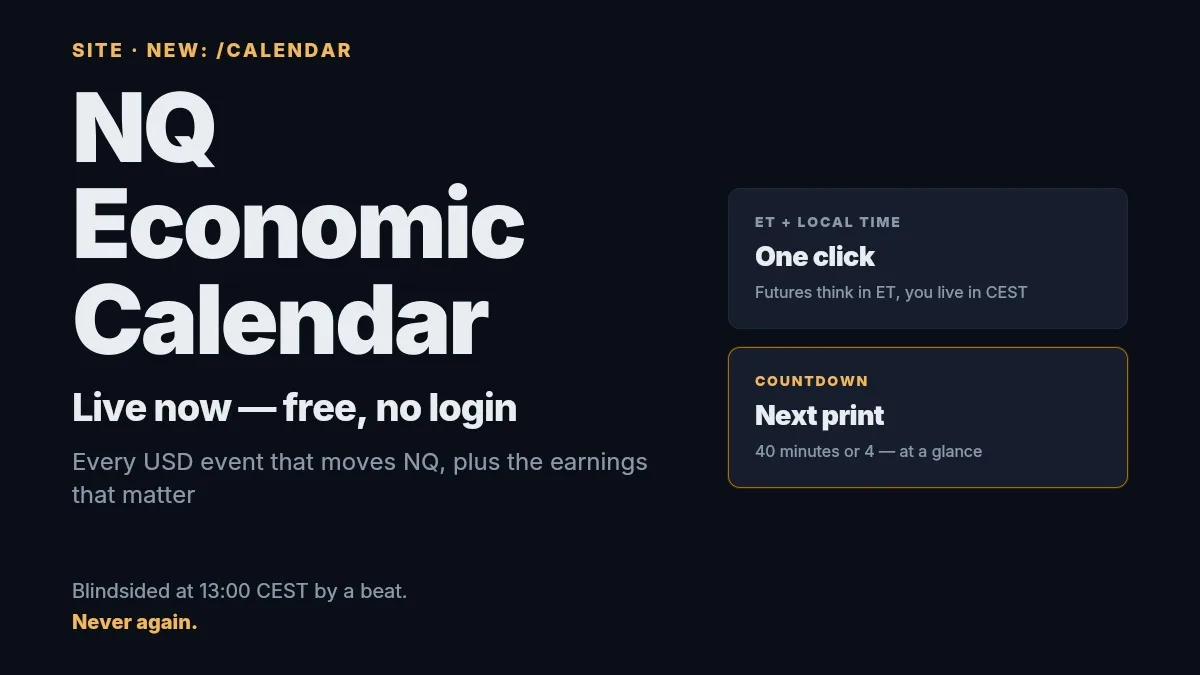
Last Thursday, Walmart reported earnings at 7:00 AM ET. That's 13:00 CEST — the middle of my EU session.
The stock beat on revenue and earnings and still dropped around 7% in premarket, close to 10% by the afternoon. NQ didn't care about Walmart's margins; it cared about the fact that a $900B company just told the market the US consumer is tired. The move rolled through the index, and I was sitting in front of a chart that suddenly stopped respecting the levels I had marked in the morning.
Here is the part that bothers me. Walmart announced the exact time a week earlier. My Week Ahead post had the earnings listed as "before the open." True, useless. "Before the open" is a four-hour window that starts before I wake up and ends after my session is half done. What I needed was one line: Thu 7:00 ET / 13:00 CEST — WMT earnings. I wrote about that session in detail here: Walmart beat its numbers and NQ dropped 200 points.
I could not have predicted the reaction — options were pricing a move under 5% either way, and nobody had -10% on a beat. But I could have predicted, with 100% certainty, that 13:00 was a volatility window and not a time to be managing a Key Level Reversal entry. Same rule I already use for FOMC at 20:00: don't trade through the event, trade after the first rotation. I just didn't have earnings on the same footing as macro data.
Now I do.
What the calendar is
wayofthetrader.com/calendar — free, no login, no email gate.
It shows one week at a time, built around what actually moves NQ:
- USD macro events, high and medium impact by default. CPI, NFP, FOMC, GDP, PCE, PMIs, jobless claims, consumer confidence, the Fed speakers who matter. The low-impact lines that make most calendars unreadable during a session are hidden — one click away if you want them.
- Earnings that move the index. A short watchlist — the mega-caps and the bellwethers heavy enough to move a 100-stock index on their own (NVDA, MSFT, AAPL, AVGO, COST, and yes, WMT) — with the release slot: before the open or after the close.
- Times in ET by default, one click to your local time. Futures traders think in ET; European traders live in CET/CEST. You shouldn't have to do the math at 08:29.
- Countdown to the next event, so you can see at a glance whether you have 40 minutes or 4 before the next print.
- Forecast and previous for every macro print, EPS estimate and actual for earnings.
Data comes from public calendar feeds, refreshed automatically every hour, and I add by hand what feeds tend to miss — Fed keynotes, Treasury auction days, anything off-schedule. If you spot an event that is wrong or missing, tell me — the whole point of this site is that the data is honest.
What it deliberately isn't
It's not a global calendar. No EUR, GBP, JPY. If you trade DAX or FX you'll want something else. This is for NQ and MNQ, which means the US calendar and the handful of earnings big enough to move a 100-stock index on their own.
It's also not a signal service. The calendar tells you when to be careful. It doesn't tell you what to do. That part stays in your trading plan.
How I use it
It replaced a line in my pre-session checklist that used to say "check the economic calendar" — which in practice meant opening two or three tabs and hoping I didn't miss anything. Now it's: open /calendar, filter to high impact, write the CEST times of anything inside 09:00–15:30 on my level sheet. Thirty seconds. Then the rule: no new entries in the last 15 minutes before a high-impact print, and no trading the first rotation after it.
This week is a good test. NVDA reports Wednesday after the close, and the new Fed Chair gives his first Jackson Hole keynote Friday morning ET — both inside or right next to my windows. I wrote up the setup for both here: Nvidia earnings and Warsh's first Jackson Hole — 48 hours that could set NQ's autumn. You'll find them on the calendar with the exact times.
What comes next: the same data, inside NinjaTrader
The calendar is the first half of a two-part project. The second half is a small NinjaTrader 8 indicator — the WotT Event Monitor — that sits in the corner of your chart and shows the next events with a countdown, pulling from this same calendar. Same data, one source of truth, no separate config to maintain. It will work in Market Replay too, so you can practice trading around news on historical days.
It's in development. If you want to know when it ships, the signup is on the tool page: WotT Event Monitor. Like the Trade Copier and Risk Manager, it will be free.
Times on the calendar are shown in ET by default. Nothing here is financial advice; it's a schedule and a description of how I use it.
Educational content, not investment advice. Futures trading involves substantial risk of loss. Examples are for illustration only. Read the full Risk Disclosure.
Read next
Nasdaq Record High: Payrolls, Nvidia and the Narrow Rally Behind NQ's New High
The Nasdaq-100 set a record close of 31,076 on October 5, 2026, after weak payrolls cut the odds of an October Fed hike and Nvidia pushed toward a $6 trillion value. Under the surface, new 52-week lows outnumbered new highs and the 10-year yield sat at its highest since 2002.
NQ Week Ahead (Oct 5–9, 2026): A Record, a 5.3% 10-Year and Three Treasury Auctions
September payrolls came in at 29,000, October hike odds fell to about 22% and NQ set a record a day after the 10-year's highest close since 2002. With the big data already out, the rest of the week belongs to the bond market: three auctions, the Fed minutes and Friday's inflation expectations.
NQ Week Ahead (Sep 28–Oct 2, 2026): PCE, Micron, Payrolls and a Breakout Under Test
NQ broke out of a five-week range last week and settled Friday at 30,889, inside the value it built on the way up. Oil, core PCE, Micron and September payrolls now test the breakout, in that order.