Holiday and Half-Day Sessions on NQ: Thanksgiving, Christmas and Why Thin Days Behave Differently
The US holiday season changes the NQ session five times between Thanksgiving and New Year's Day. The dates and early closes at the time of writing, what CME confirms and when, why half days and holiday weeks trade thinner, and the ways traders handle them.
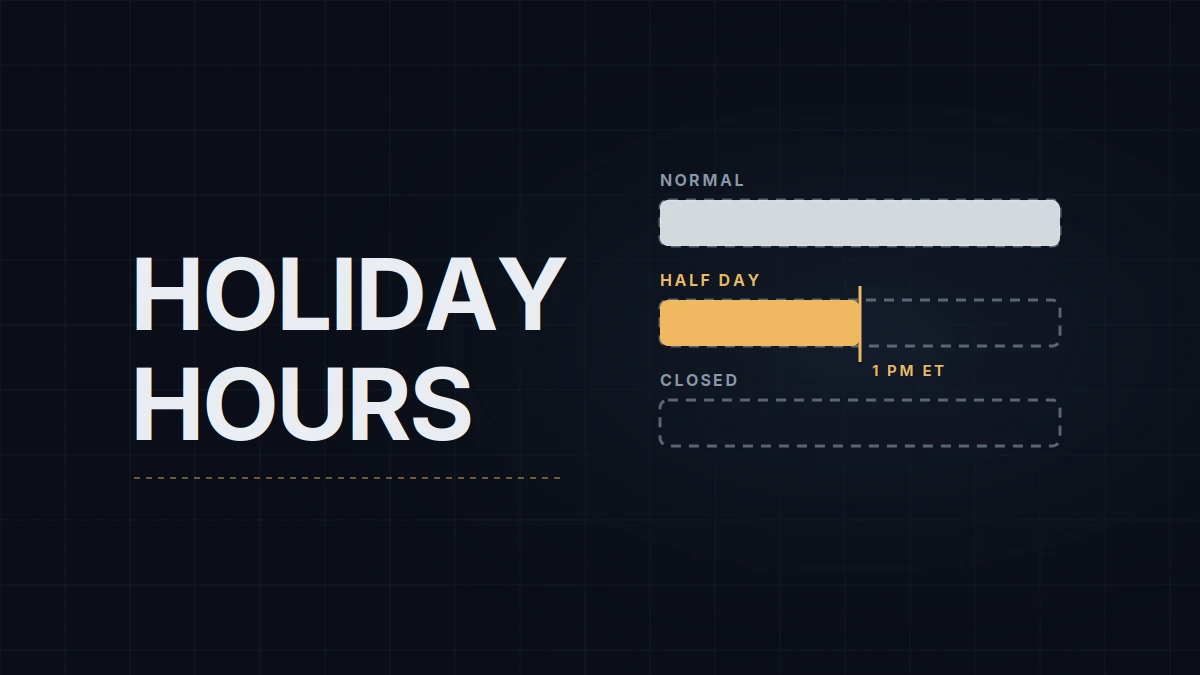
NQ holiday trading hours follow the US stock market's calendar, but not one to one. On Thanksgiving the stock market is closed all day, while NQ, the E-mini Nasdaq-100 future (contract basics), still trades a shortened session on CME Globex. On the season's two half days, the Friday after Thanksgiving and Christmas Eve, the future settles when the stocks close early and ends its own session early as well. Christmas Day and New Year's Day are closed for both. The regular schedule, with the daily break from 5:00 to 6:00 PM ET, is in NQ trading hours.
The 2026 holiday season, date by date
At the time of writing. From November 1 both the US and Europe are on standard time, so ET and CET are six hours apart.
| Date | Stock market (NYSE, Nasdaq) | NQ on CME Globex |
|---|---|---|
| Thursday, November 26 (Thanksgiving) | Closed | Trades until a halt at 1:00 PM ET / 19:00 CET, no settlement price; reopens at 6:00 PM ET for Friday's trade date |
| Friday, November 27 | Closes at 1:00 PM ET / 19:00 CET | Settles at 12:00 PM CT (1:00 PM ET); trading ends at 1:15 PM ET / 19:15 CET |
| Thursday, December 24 | Closes at 1:00 PM ET / 19:00 CET | Settles at 12:00 PM CT (1:00 PM ET); trading ends at 1:15 PM ET / 19:15 CET |
| Friday, December 25 | Closed | Closed; next session opens Sunday, December 27, at 6:00 PM ET |
| Thursday, December 31 | Normal hours | Normal settlement and the regular 5:00 PM ET close; no evening session |
| Friday, January 1, 2027 | Closed | Closed; next session opens Sunday, January 3, at 6:00 PM ET |
These are the times on CME's holiday calendar at the time of writing. CME marks the schedule as subject to change and usually finalizes holiday hours about two weeks before each holiday, so check its calendar again closer to the date. On both half days CME settles equity index futures at 12:00 PM CT, 1:00 PM ET, the minute the stock market closes, and Globex stops trading NQ fifteen minutes later. Thanksgiving Day itself produces no settlement price at all. The bond market follows its own calendar, recommended by the industry group SIFMA, and closes at 2:00 PM ET on both half days and on New Year's Eve, which matters to anyone watching the 10-year yield next to NQ.
Why thin days trade differently
Volume is the obvious difference. Russell Investments' trading desk estimates that US stock volume runs at roughly 80% of normal on the day before Thanksgiving and about 45% on the half day after it. Globally, it puts stock volume from December 23 to New Year's Day at 45% to 70% of normal, with Christmas Eve among the quietest sessions of the year, and futures and options volume in late December at about 40% below normal. None of those figures is for NQ itself, but the traders who are away are the same people.
Fewer traders means a thinner order book: fewer contracts resting at each price, so a market order of the same size walks through more price levels before it's filled. On a thin day one large order can move NQ further than it would on an ordinary morning, and a stop order can slip further for the same reason. Levels change character too. A prior-day high holds because someone defends it, and on a half day many of those someones are away, so price can drift through a level without the reaction it would get on a full day, or stall at one for no visible reason.
The half day also compresses the cash session to three and a half hours, from 9:30 AM to 1:00 PM ET, with the close and the settlement at 1:00 PM instead of 4:00 PM. A plan built around the usual afternoon doesn't fit that day, and the early halt comes whether a position is ready to close or not.
How traders handle them
The simplest choice is to skip them. A flat day is a valid result, and on a half day the opportunity is smaller than the cost of trading it badly. Traders who do trade them usually change something about the day. Size goes down while the stop stays where the setup puts it, because slippage hits the same stop harder. Hours get shorter: the opening stretch of the cash session only, flat well before the early close. Some raise the bar instead and take only the setups they'd take on any day, not the ones that look good because the chart is quiet.
Prop evaluations add one question worth answering before the holiday rather than on it: how the firm counts a half day toward any minimum-days rule, which differs from firm to firm.
I trade the European morning, and in holiday weeks that morning is Globex at its quietest, with most US desks away. A flat day there is my default, not the exception.
Educational content, not investment advice. Futures trading involves substantial risk of loss. Examples are for illustration only. Read the full Risk Disclosure.