Are Futures Prop Firms Regulated? What the CFTC and NFA Cover and Where Firms Are Moving
The evaluation you pay for is a simulated account, and US futures registration is built around real orders and customer money. What the CFTC and NFA regulate, why most prop firms sit outside it, what the My Forex Funds case did and didn't decide, and two registered brokerages launched in 2026.
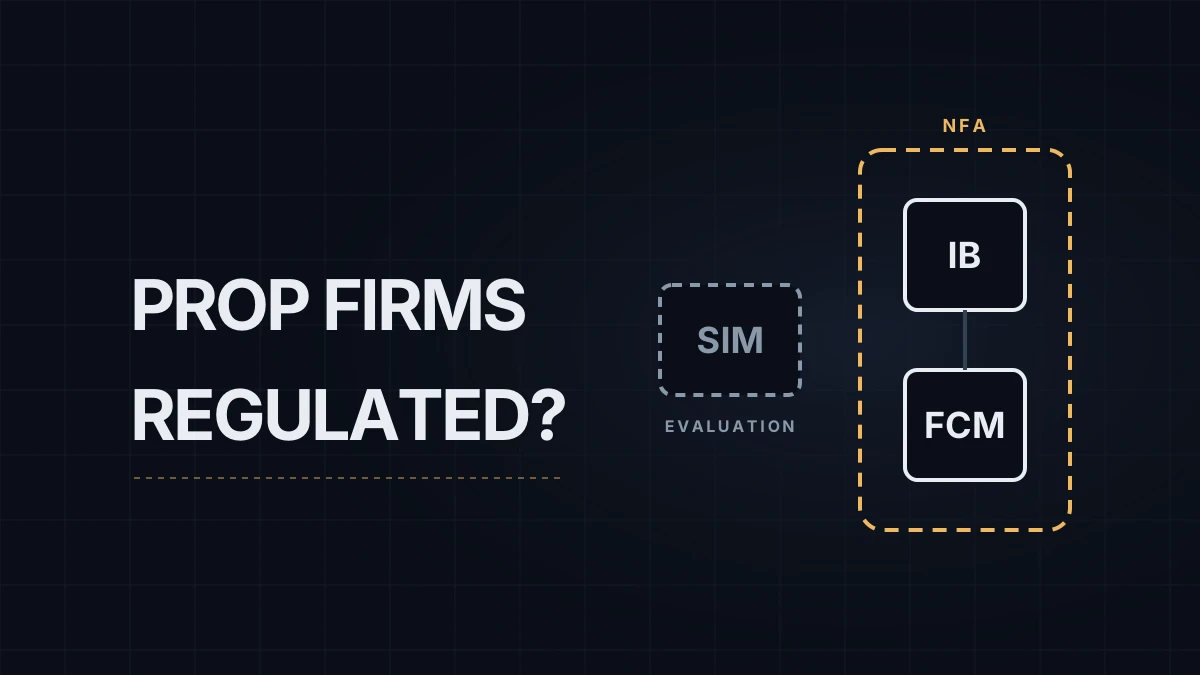
For the part you pay for, mostly not. A futures prop firm evaluation is access to a simulated account: orders fill against live CME prices but never reach the exchange, and the fee is a purchase rather than a deposit. The US registration system for futures is built around orders that reach the market and money customers hand over to support them. A simulated evaluation has neither, and most prop firms operate without registering, describing what they sell as simulated. A few have started building registered businesses next to the prop one.
How the evaluation works is in prop firm evaluations explained, and where the firm's revenue comes from is in how prop firms make money. This post is about who supervises what.
Who regulates what
The Commodity Futures Trading Commission (CFTC) is the federal regulator of US derivatives markets. The National Futures Association (NFA) is the industry's self-regulatory organization, designated by the CFTC as a registered futures association, and with few exceptions firms registered with the CFTC in the categories below must be NFA members. NFA runs the registration process on the CFTC's behalf.
| Category | What it does | Where a trader meets it |
|---|---|---|
| Futures commission merchant (FCM) | Accepts orders for futures and accepts customer money to support them | The clearing firm that holds a brokerage account |
| Introducing broker (IB) | Solicits or accepts futures orders but doesn't hold customer money | A brokerage brand that opens accounts at an FCM |
| Commodity trading advisor (CTA) | Advises others on trading futures for compensation | Paid signal and advisory services |
| Commodity pool operator (CPO) | Runs a pooled vehicle that collects money from participants to trade futures | Futures funds |
An evaluation doesn't fit neatly into any row. No customer order reaches an exchange, and no customer money supports a position. At the time of writing the CFTC hasn't published guidance on the evaluation model, and its customer education mentions prop firms only in passing: a page on forex fraud lists trading a proprietary firm's money for a share of the profits among the usual pitches. The firms describe themselves accordingly: Topstep calls its Trading Combine and Express Funded Account simulations, and Apex's site says it isn't a broker-dealer or a futures commission merchant and that activity happens in a simulated environment with virtual funds.
The case people cite
In August 2023 the CFTC sued Traders Global Group, the company behind My Forex Funds, in federal court in New Jersey. The complaint alleged fraudulent solicitation and that the firm acted as an unregistered retail foreign exchange dealer, with more than $310 million in fees from over 135,000 customers, and said the firm was the counterparty to substantially all customer trades.
The court dismissed the case in May 2025 without a ruling on any of that. The judge dismissed it with prejudice as a sanction against the CFTC, adopting a special master's finding that the agency had made false statements to the court about a large transfer it described as going to the founder, which was in fact a Canadian tax payment. The CFTC's acting chairman put out a statement criticizing the agency's own conduct, and in July 2025 the defendants were awarded about $3.1 million in legal fees and costs.
Two things follow for a futures trader. The case concerned retail forex and leveraged retail commodity transactions, not futures evaluations. And because it was decided on the CFTC's conduct, not on the merits, it settled nothing about whether the prop model needs registration.
Firms moving inside the perimeter
In 2026 two well-known futures prop brands launched registered brokerages:
- Topstep Brokerage LLC is a registered introducing broker and NFA member (NFA ID 0567079), clearing through Plus500US Financial Services, an FCM (NFA ID 0001398). It's a brokerage for traders using their own money. The prop programs sit in other Topstep companies: TopstepTrader LLC runs the simulated programs and TopstepFunded LLC runs Live Funded accounts with Topstep's capital.
- Tradeify Brokerage LLC, trading as Slay Markets, is a registered introducing broker and NFA member (NFA ID 0575972), guaranteed by NinjaTrader Clearing LLC, an FCM (NFA ID 0309379).
MyFundedFutures was reported in December 2025 to be seeking IB registration. A registration covers the registered company's business. A registered brokerage next to a prop firm doesn't by itself change how the evaluation is offered: it stays a simulated product under the firm's terms.
Where the money sits
| Money | Whose it is | What protects it |
|---|---|---|
| Evaluation and activation fees | Spent; it was a purchase | The firm's terms, including any refund policy |
| Balance on a simulated funded account | Not money: a number the firm pays out against under its rules | A contractual claim to payouts |
| Live prop account at an FCM | The firm's capital | FCM segregation protects the account holder, which is the firm; the trader holds a contract for a payout share |
| Your own brokerage account | Yours | Segregated from the FCM's own funds, but not insured |
The last row comes from NFA's own guidance: customer funds at an FCM have to be kept separate from the firm's money, and futures accounts carry no deposit insurance.
The practical check is the legal entity named in a firm's terms, looked up in NFA BASIC, the public registration database; prop firm red flags treats a firm that claims to be regulated and isn't in BASIC as a warning sign. Search by the exact company name rather than the brand, because brands collide: ApexFutures, a brokerage run by GFF Brokers, is a different company from Apex Trader Funding.
Educational content, not investment advice. Futures trading involves substantial risk of loss. Examples are for illustration only. Read the full Risk Disclosure.