How Futures Prop Firms Make Money: Evaluation Fees, Simulated Accounts and the Traders Who Go Live
Where a futures prop firm's money comes from and where it goes: evaluation fees, resets and activation fees on one side, payouts, data, platforms and marketing on the other. Why the funded account is simulated, what payout rules do for the firm, and how Topstep and Lucid handle traders who go live.
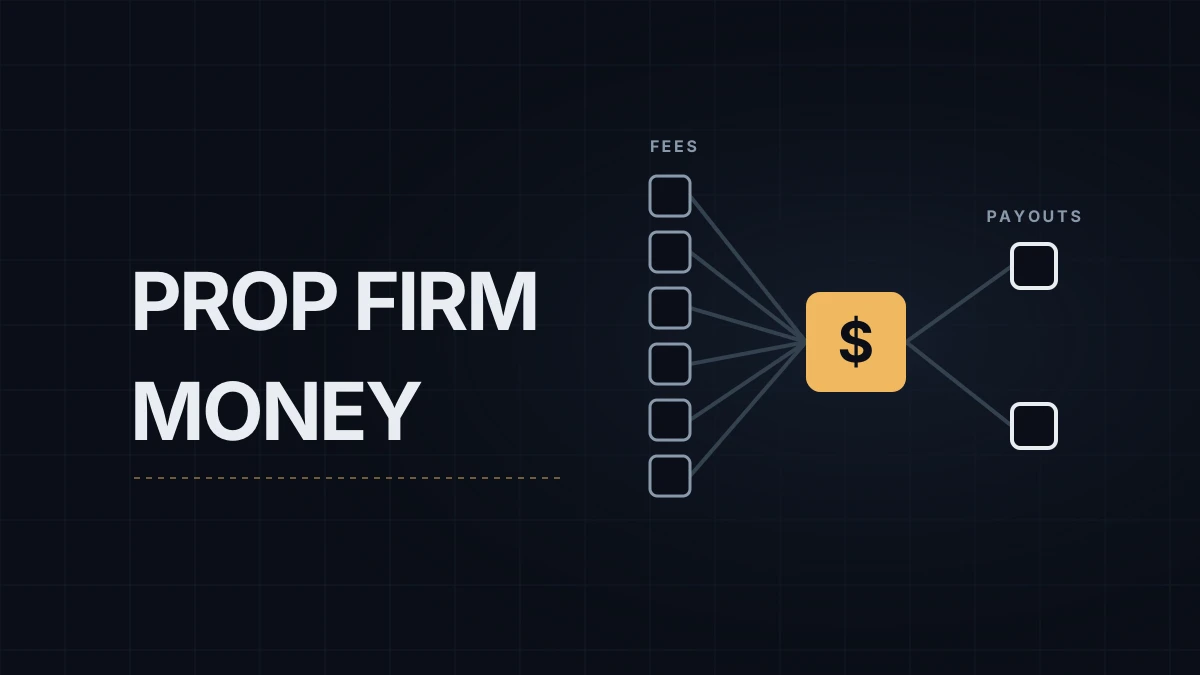
A futures prop firm gets paid before it pays out. Every customer pays a fee before a payout is even possible, and resets and, at some firms, activation fees add revenue as traders go. Money moves the other way when a funded trader requests a payout, and at most futures firms the funded account is simulated, so a payout isn't a share of profit taken from the market. It's the firm's own cash, and the fees pay for it. That's how prop firms make money: across all their customers, the fees have to cover the payouts and the cost of running the business, with something left over.
The evaluation, a paid test with a profit target and a maximum loss, is explained in the pillar. This post looks at the same product from the other side of the counter. Rules and fees below are at the time of writing, October 2026.
Money in, money out
| Flow | Direction | When it happens |
|---|---|---|
| Evaluation fee | In | At purchase: once at Lucid and Apex (Apex's fee buys 30 days of access), monthly at Topstep while the subscription runs |
| Reset | In | When the trader buys one, usually after a breach; Apex sells a new evaluation instead |
| Activation fee | In | After passing, at firms that charge one: Apex, and Topstep unless the trader bought its no-activation-fee Combine; Lucid charges none |
| Data add-ons | In | Monthly, for traders who buy market depth |
| Payouts | Out | When a funded trader meets the payout rules |
| Market data and platforms | Out | Monthly, while traders are active |
| Marketing and affiliate commissions | Out | When a referred trader buys |
| Staff, risk desk, support, payment processing | Out | Ongoing |
| Capital behind live accounts | At risk | Only for traders moved to a live account |
Everyone who buys pays the first row, and many pay some of the next three. The payout row goes to a subset: traders who pass, keep the funded account alive and then meet the payout conditions. With round, made-up numbers: if the average customer spends $300 in total on fees, the firm can afford to pay out something less than $300 per customer on average, once the other rows are paid. A single $2,000 payout uses up the entire spend of about seven average customers.
None of that requires bad faith. An insurer runs on the same arithmetic: premiums from everyone, claims paid to some, and a business that lasts only while the two stay in proportion.
Why the funded account is simulated
Topstep's help center describes its Express Funded Account as a simulated account and says Topstep "pays you real money based on your simulated trading results". The risk disclosure printed on Apex's help-center pages puts all activity on the platform in a simulated environment with virtual funds. Lucid calls its straight-to-funded LucidDirect a simulated account, and its terms of use describe the funds in simulated trading as fictitious.
Simulated means the orders never reach the exchange. A simulation on the platform provider's server (Tradovate or Rithmic, for most NinjaTrader users) fills them against live prices, which is why how a prop sim decides fills matters on a funded account. It also means a funded trader's profit has no counterparty. A $10,000 gain on a simulated account wasn't taken from anyone in the market, so if the firm pays $9,000 of it under a 90/10 profit split (the trader receives 90% of the simulated profit), the $9,000 comes out of revenue. On these accounts the firm carries no market risk. It carries the payout bill.
What payout rules do for the firm
Payout rules have two effects. They filter for traders a firm would trust with live capital, and they set a ceiling on the payout bill. On a 50K LucidFlex funded account, a payout needs five days with at least $150 of profit each, a single payout is capped at half the profit up to $2,000, and after the fifth payout the trader moves to Lucid's live review. Five maximum requests of $2,000 make $10,000, the ceiling on payout requests for that account in simulation.
The other common rules shape the same number from different directions. A consistency rule, a cap on the share of profit one day may supply, holds back a payout after an outsized day. A buffer keeps the first withdrawable dollar some distance above the starting balance. A minimum number of payout days stretches the time between payouts, and a trailing drawdown closes some accounts before they pay at all. Payout rules walks through each one from the trader's side.
The traders who go live
At some firms, a funded trader who keeps getting paid can be moved to a different kind of account: a live one, where orders go to the exchange and the firm's own capital is at stake. Topstep and Lucid both build that step so the capital at risk starts small.
At Topstep the risk team decides when a trader is ready, and the trader then either moves to the Live Funded Account or closes the Express Funded Account. Only 20% of the live starting balance can be traded at first, with a minimum of $10,000. The other 80% sits in a reserve released in four steps of 25%, each after a profit target ($3,000 on a 50K), and payouts come only from the unlocked balance, never from the reserve.
At Lucid a trader enters a live review pool after the fifth payout on a LucidFlex, LucidPro or LucidDirect account, or on other triggers such as hitting LucidDaily's maximum daily profit. A live account starts at a $0 balance with an end-of-day drawdown, $2,000 on a 50K, and every simulated account the trader holds is closed on the move. LucidMaxx, an invitation-only plan for traders Lucid's risk team selects, runs from its own evaluation through a pre-live stage to live capital.
Both designs keep the first amount at risk well below the account's headline size: a fifth of the balance at Topstep, a drawdown-sized cushion at Lucid. In both, the decision belongs to the firm, because on a live account the trader's profit and loss becomes the firm's profit and loss too.
Is the model legit?
Charging fees for simulated evaluations is the standard model in futures prop trading, and on its own it says nothing about whether a given firm is honest. The structure can be run well or badly, and the difference shows in what a trader can check before paying: rules published in full, payouts made on the schedule the help center states, rule changes applied to new accounts rather than existing ones, and a plain statement of what is simulated. The red flags post turns those into checks.
Two consequences of the model are worth knowing before you buy. The fee is a purchase, not a deposit: nothing sits in an account in your name, and Lucid's terms of use, for one, say you aren't entitled to a refund once you've started trading. And skipping the test doesn't change the economics. A straight-to-funded account collects a larger fee up front and moves the filtering into the payout rules; at Lucid, LucidDirect applies a 20% consistency rule to every payout, where a funded LucidFlex account has none. Instant funding vs evaluation compares the two routes in dollars.
I trade LucidFlex evaluations at Lucid (affiliate link). That puts me in the top rows of the table as a customer, and this site's affiliate commission in the marketing row.
Educational content, not investment advice. Futures trading involves substantial risk of loss. Examples are for illustration only. Read the full Risk Disclosure.