What a Prop Firm Evaluation Actually Is (and Why I Trade Them)
The whole product in two sentences, the money flow behind it, the parts every evaluation has (with a Lucid Flex 25K example), what the test measures and what it doesn't — and why I trade them anyway.
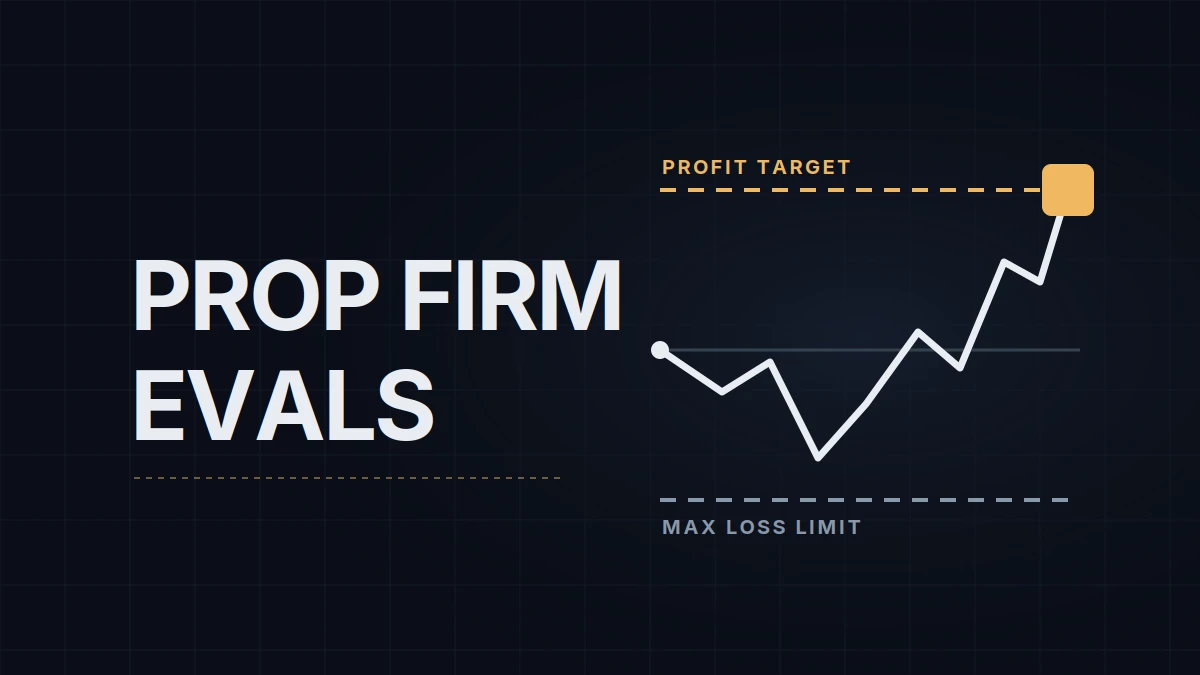
A prop firm evaluation is a paid test. You pay a fee, one-time or monthly, usually somewhere between $50 and a few hundred dollars, and the firm gives you a simulated account of a stated size, 25K, 50K, 150K, with a short rulebook: reach a profit target, never let the balance touch a maximum loss level, follow a few conduct rules. Pass, and the firm moves you to a "funded" account where you keep most of what you make, typically 80–90%, paid out on a schedule. Fail, and you can buy another attempt.
That is the whole product. The countdown banners, discount codes and leaderboards are marketing wrapped around those two sentences.
Almost everything else in this topic — drawdown types, consistency rules, payouts, trade copiers, rulebooks — hangs off the evaluation, so this is the post to start with.
Who pays whom
The firm is not lending you $50,000. It is selling you the right to earn a share of simulated profit, on the condition that you can produce that profit inside its rules. The money that pays the winners comes from the fees of everyone who bought a test, and most tests end in a breach or an abandoned account. Nobody hides this; the model only works if the rules are strict enough that most people don't pass. Read every rule with that incentive in mind and none of them will surprise you.
The word "funded" deserves the same scrutiny. At most futures prop firms the funded account is still a simulated account: the fills are simulated, the P&L is simulated, and the payout you receive is real money paid from the firm's revenue. Some firms move consistently profitable traders to live accounts after a number of payouts, usually at their own discretion. This is why funded accounts carry rules that would make no sense on real capital — payout caps, minimum profitable days, consistency checks. The firm's actual risk is not your trading. It is your withdrawals. How prop firms make money follows the fees and the payouts through the firm's books, including what changes when a trader goes live.
The anatomy of an evaluation
Every firm names things differently, but the parts are the same. The example column uses Lucid's Flex 25K because that is the account I trade; the figures are Lucid's published rules at the time of writing, and they change often.
| Part | What it means | Lucid Flex 25K (at the time of writing) |
|---|---|---|
| Account size | The nominal balance. Not money you can withdraw; it sets the target, the loss limit and the contract cap | $25,000 |
| Fee | What the test costs. One-time or monthly; discounts are constant, list price is a fiction | under $100 one-time |
| Profit target | The balance you have to reach to pass | $1,250 (5%) |
| Max loss limit | The level the balance must never touch. Static, trailing end-of-day or trailing intraday. The type matters more than the amount | $1,000, trailing EOD |
| Daily loss limit | A per-day cap that locks the account until the next session. Not every firm has one; some sell its removal as an option | optional |
| Consistency rule | Your best day may not exceed a set share of total profit, so one lucky session can't pass the test on its own | 50% during the eval, none once funded |
| Contract cap | Maximum position size; grows with account size, sometimes through a scaling plan | 2 minis / 20 micros |
| Minimum days | Sessions you must trade before a pass counts | 2 |
| Time limit | Deadline to pass. Many one-time-fee firms have none; monthly-fee firms effectively do | none |
| Conduct rules | What you may not do: some firms ban news trading, holding overnight, copying between firms or hedging across accounts | news trading allowed; check the rest |
The row people skip is the max loss limit type. A trailing limit that follows your open profit intraday can end an evaluation during a winning trade; an end-of-day trailing limit only moves at the close. The amount can be identical and the experience completely different. That row gets its own post.
Most futures firms sell this as a one-step test: reach the target once, get funded. Two-step evaluations, where a second phase repeats the exercise at a lower target, come from the forex side of the industry and are rarer in futures. "Instant funding" or "direct" accounts skip the test for a higher fee and usually a tighter drawdown. You are paying the firm to absorb the risk that you might be bad at this, which is precisely the risk the test was screening for. For someone with a track record, a direct account can be cheaper than two failed evaluations. For a first account it is a more expensive way to find out.
What the test measures
An evaluation measures one thing: whether you can reach a target without touching a loss limit, within the rules, over a small number of sessions. That is a test of risk control far more than of edge. A trader with a real edge whose strategy needs 80-point stops will fail a 25K evaluation repeatedly, because the drawdown is too small for the strategy; the fault is the fit, not the trader. A trader with no edge can pass one on a lucky week. Passing shows you can operate inside constraints. It does not show you are profitable — only the funded months show that, and even those are simulated.
Where the test earns its fee is as external discipline. The rules don't care how you feel about a trade, and neither does the max loss limit. For a trader who has never had to follow a written risk plan, an evaluation is the first time the plan is enforced by someone else.
Why I trade them
I trade Lucid (affiliate link) evaluations on NQ micros during the European session.
The main reason is capital. The alternative is funding a futures account with money I could afford to lose in a bad month, and I would rather learn on a $100 fee than on that. The fee caps the downside of a losing stretch at a known number, and the rules — the loss limit, the consistency check, the contract cap — are constraints I would have to impose on myself anyway. The firm enforces them, and the journal shows what each one costs me and what each one prevents.
The second reason is that a prop account is a proving ground, and I treat it as one. Payouts are capped, the accounts are simulated, and every one of them can be closed at the firm's discretion, so no single account is a plan. What the model does well is keep the risk small while the record grows: a fee is the most a losing month can cost, and every payout that clears goes toward building a personal account. That is the road I'm on — trading the evaluations and my own capital side by side, the prop accounts for cheap risk and enforced structure, the personal account for what stays mine. Neither replaces the other.
Before you buy one
Read the rulebook (the help-center articles, not the pricing page) and check how the max loss limit moves, whether a consistency rule survives into the funded phase, and what the firm actually promises about live accounts. Then check whether your strategy's stop fits inside the drawdown with room to spare; the arithmetic is in the NQ vs MNQ post. If the fit is bad, no discount code fixes it.
Educational content, not investment advice. Futures trading involves substantial risk of loss. Examples are for illustration only. Read the full Risk Disclosure.