Evaluation vs Instant Funding vs Live Accounts: Three Prop Firm Models Compared
Every futures prop firm sells the same thing three ways: pass a test first, pay more and skip the test, or earn a live account. The cost of each route, the rules attached to it, the pass rate at which paying to skip the evaluation stops being expensive, and who tends to pick which.
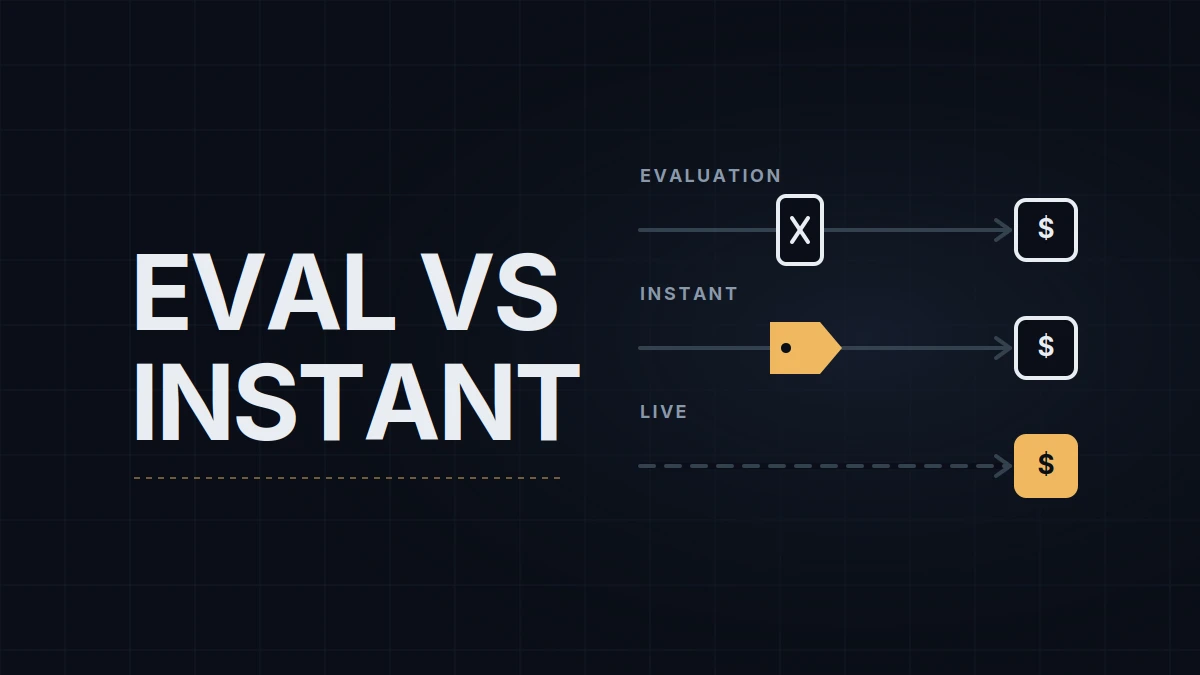
Searching "instant funding prop firm" returns two kinds of pages: the ones that sell it and the ones that warn you off it. Neither answers the question a trader has, which is how the three ways of getting a funded futures account differ in what they cost, what they demand and what happens when something goes wrong. The three ways are an evaluation, an instant-funded account, and a live account backed by the firm's own capital. What a prop firm evaluation is is covered in the pillar; this post puts the other two next to it.
Prices below are Lucid Trading's, because that is where I trade and because the firm sells all three models under one roof, so the comparison is between routes and not between firms. Every number is at the time of writing (September 2026) and changes often.
Three routes to the same account
Evaluation. You pay a one-time fee, trade a simulated account to a profit target under a drawdown rule, and on passing you receive a simulated funded account that pays real money. The test is the filter; it is cheap to buy and cheap to fail, and the funded stage that follows usually has the most relaxed rules of the three, because you already proved something.
Instant funding. You pay a higher one-time fee and receive the simulated funded account on day one. No target, no test. The firm has no evidence about you yet, so it replaces the evidence with rules: a tighter consistency rule, a daily loss limit, a payout gate expressed as a profit goal. Lucid calls this LucidDirect; Tradeify calls it Lightning; other firms use "straight to funded" or "sim funded direct".
Live account. A brokerage account with the firm's real capital, where the trades hit the exchange. Nobody sells this off the shelf. At Lucid it comes after the simulated payouts: the fifth payout on a funded account puts the trader in front of the risk team, and the move to LucidLive is their call, with a $0 starting balance, a bonus released once live profit reaches a size-dependent target, and the same 90/10 split. Topstep runs a comparable review from its Express Funded Account to a live account. The live account is the end of the road, not a route you can buy into.
What each one costs and demands
| Evaluation (LucidFlex 50K) | Instant funding (LucidDirect 50K) | Live (LucidLive) | |
|---|---|---|---|
| Price | $146 one-time, list | $545 one-time, list | Not sold; earned after up to 5 sim payouts |
| Test before payouts | Profit target $3,000, EOD trailing drawdown $2,000, 50% consistency during the eval only | None; first payout opens at a $3,000 cycle profit goal after at least 5 trading days | Already passed by definition |
| Rules once funded | No consistency rule, no daily loss limit unless you add one at checkout, EOD trailing max loss $2,000 | 20% consistency every cycle, $1,200 daily loss limit (soft: locks you out for the day), EOD trailing max loss $2,000 | Custom risk settings agreed with the firm |
| Position cap | Scaling plan from the cushion | 4 minis or 40 micros from day one | Set by the firm |
| Reset after a breach | Reset fee $90, or a new evaluation | No reset exists; a new account at full price | Cooldown, then re-qualify |
| Who carries the risk of a bad month | You, on a cheap account | You, on an expensive account | The firm, on real capital |
Two rows deserve a second look. The Direct account's first payout opens at the same $3,000 of profit that ends the Flex evaluation. You are not skipping the target, you are skipping the ability to fail it: on Flex a breach before $3,000 costs a $90 reset, on Direct it costs $545. And the Direct account carries the 20% consistency rule for as long as you hold it, where the Flex funded account has none. A $600 best day on Direct needs a $3,000 cycle behind it before the payout request is allowed.
The pass rate where instant funding breaks even
The honest comparison is cost per funded account, and that depends on how often you pass.
If you pass an evaluation with probability p, you expect 1 ÷ p attempts. The first costs the list price and each further one costs the cheaper of a reset and a new account. On the Flex 50K that is $146 for the first attempt and $90 for each retry:
| Your pass rate | Expected attempts | Expected cost to funded (Flex 50K) | Direct 50K |
|---|---|---|---|
| 50% | 2.0 | $236 | $545 |
| 33% | 3.0 | $326 | $545 |
| 25% | 4.0 | $416 | $545 |
| 20% | 5.0 | $506 | $545 |
| 15% | 6.7 | $656 | $545 |
The break-even sits just under a 20% pass rate. Below that, buying the funded account outright is cheaper. But a trader who passes one evaluation in five is a trader who breaches often, and on Direct a breach has no $90 reset; it is another $545. Run the same table for the funded stage and the instant account loses at every pass rate a struggling trader would have. The people for whom Direct is the cheaper product are the ones who rarely breach and who hate the two or three weeks of evaluation; for them the $399 difference buys time, not safety.
Where the rules bite
The consistency rule is the rule that decides most Direct payouts. Lucid's Direct runs 20% per cycle; Tradeify's Lightning runs a progressive 20%, 25% and then 30% across the first payouts, at the time of writing. Both mean the same thing: a strategy that earns its month in two big days does not fit an instant-funded account, whatever the price. The consistency rule post has the arithmetic; the short version is that the best day is the numerator and everything after it is a grind to grow the denominator.
The daily loss limit is the second difference. On Direct it is a soft breach at 50K and above (locked out for the session, account survives), while the max loss limit underneath it still ends the account. On Flex the daily limit is a checkbox at checkout, off by default, which is the single rule most Flex traders cite for choosing it.
The live account has neither problem and a different one: its rules are individual, its drawdown is real money, and a blown live account triggers a cooldown before you can requalify. At Lucid the invite-only LucidMaxx tier prices its evaluation by how many live accounts you have blown, so live is where the firm's patience starts to have a price.
Who picks which
The evaluation is the default for anyone who has not yet passed one, for anyone whose P&L is lumpy, and for anyone running several accounts, because the cost of a mistake is the smallest. The instant-funded account fits a trader with a flat equity curve and a schedule that cannot spare the evaluation weeks, who has already lived under a 20% consistency rule on another account and knows the strategy survives it. The live account is not a choice; it is what the other two lead to if you keep collecting payouts, and the long-term post covers what to do once you are there.
I trade LucidFlex evaluations and the funded accounts they turn into, on Lucid, for the reason in the second table: the cost of being wrong on a given week is a reset, and the funded rules do not fight my setup, which has good days and flat days rather than an even staircase.