Consistency Rules: How a "Good" Day Can Block Your Payout
The rule that turns a finished evaluation into an unfinished one without a single losing trade: what "largest day ÷ total profit" means, the two formulas that tell you where you stand before the session, where Lucid, Apex and Topstep apply it, and four ways traders live with it.
A consistency rule caps how much of your profit may come from a single day. The usual wording: your largest winning day cannot exceed some percentage of your total net profit at the moment you ask for something, the pass or a payout. The percentage is 50% on some accounts, 40% or 30% on others, 20% on a few. It is the rule that turns a finished evaluation into an unfinished one without a single losing trade, and after the drawdown it is the second thing to read in the rulebook before buying an evaluation.
The arithmetic
A 25K evaluation, $1,250 profit target, 50% consistency rule (the LucidFlex evaluation at the time of writing). Five days:
| Day | P&L | Total so far | Largest day ÷ total |
|---|---|---|---|
| 1 | +$700 | $700 | 100% |
| 2 | −$150 | $550 | 127% |
| 3 | +$300 | $850 | 82% |
| 4 | +$250 | $1,100 | 64% |
| 5 | +$200 | $1,300 | 54% |
The target is reached on day 5. The evaluation isn't passed, because $700 is 54% of $1,300 and the cap is 50%. Nothing was done wrong; day 1 was simply too large for the total that followed it.
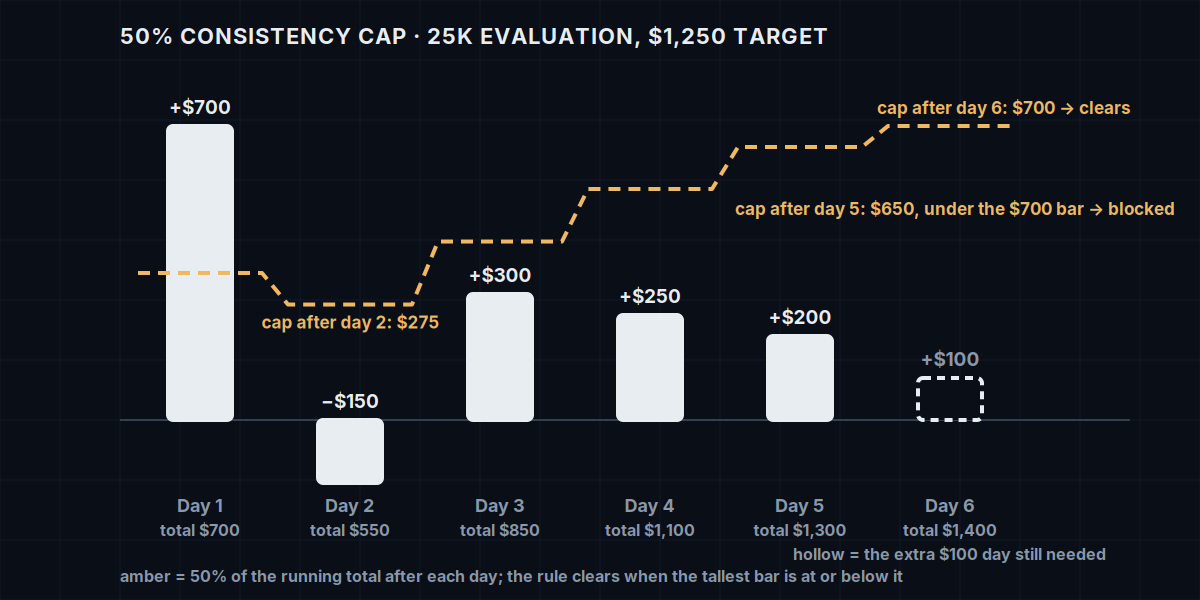
Two formulas cover every situation. The first tells you where the finish line moved:
Required total = largest day ÷ cap. $700 ÷ 0.50 = $1,400, so the account needs $100 more than the target. Under a 40% rule the same $700 day needs $1,750 of total profit; under 30%, $2,334. Losing days count against the total, so a red day after the big one makes the ratio worse, not better.
The second tells you how much room today has before it becomes a problem:
Largest new day allowed = cap ÷ (1 − cap) × total so far. Under 50% the factor is 1, so a new best day can be at most as large as everything you had before it. Under 40% the factor is 0.67; under 30%, 0.43. With $1,100 banked on a 40% account, a day that runs past $733 turns into a rule problem the moment it closes. That is a number you can write down before the session.
Where the rule lives
Firms differ on three things: which stage the rule applies to, what counts as a "day", and what the total is measured against. All of the following is at the time of writing and changes often, so treat the table as a map of the variants, not a rulebook.
| Account | Evaluation | Funded / payout | Measured against |
|---|---|---|---|
| LucidFlex | 50% | none | total net profit |
| LucidPro | none | 40% | profit since last payout |
| LucidDirect | (no evaluation) | 20% | profit since last payout |
| Apex (v4.0 performance account) | none | 50% (30% on legacy v3.0 accounts) | profit since last payout |
| Topstep Trading Combine / Express Funded | 55% | 40% on the Consistency path, none on Standard | Combine: the profit target, raised when the best day exceeds 55% of it; funded: profit in the payout window |
Three variants hide in that table. Some firms apply the rule only while you're being tested, some only when you ask for money, some at both stages; a rule that is absent from the evaluation can still be waiting at the first payout. Most firms measure per calendar day, a few per trade, which is stricter. And the denominator matters: "total net profit since the account opened" dilutes a big day over time, while "profit since the last payout" resets the clock, so each payout cycle starts with a fresh 100% on your first winning day.
What the rule doesn't do is close the account. Breaching a consistency cap delays the pass or the payout until more profit dilutes the big day. It's a pacing problem, not a survival problem, and the drawdown is still what ends accounts.
Four ways traders live with it
The first is a daily target that is small relative to the account's target. If the evaluation needs $1,250 and the plan is roughly $200 a day, the best day sits near 15–20% of the total by the time the target is hit, and the rule never enters the picture. The cost is time: more sessions in the evaluation, each with its own exposure to the drawdown.
The second is a stop rule computed from the formula above: before the session, calculate the largest day the cap allows on top of what's banked, and stop when the day gets near it. This lets you trade normally on most days and only caps the unusual one. The cost is walking away from a market that's paying, which is harder than it sounds.
The third is the windfall route: take the big day, then trade small (one micro, tight plan) until the ratio dilutes. It works on paper. The cost is the extra sessions traded for no reason other than the rule, each one able to breach the drawdown or produce another oversized day.
The fourth is choosing the account: pick a product with no rule at the stage you care about, and pay for it in whatever that product charges elsewhere, a fee, a tighter drawdown, a different payout structure. Nobody sells all of those at once.
I trade LucidFlex, where the rule applies to the evaluation and not to the funded account, and I use the first approach: a fixed daily target in points per contract, small enough against the account target that the cap holds by construction. On a day that runs well past the plan I stop trading rather than add to it, which is what I'd do anyway, so the rule costs me nothing I wasn't already paying.
Educational content, not investment advice. Futures trading involves substantial risk of loss. Examples are for illustration only. Read the full Risk Disclosure.