Prop Firm Payout Rules Explained: Minimum Days, Buffers, Profit Splits and Cycles
Passing the evaluation opens the account; four more layers decide what leaves it. Qualifying days, buffers, splits and per-request caps, and why the same $3,000 of profit on a 50K account pays $900 at one firm and $1,350 at another.
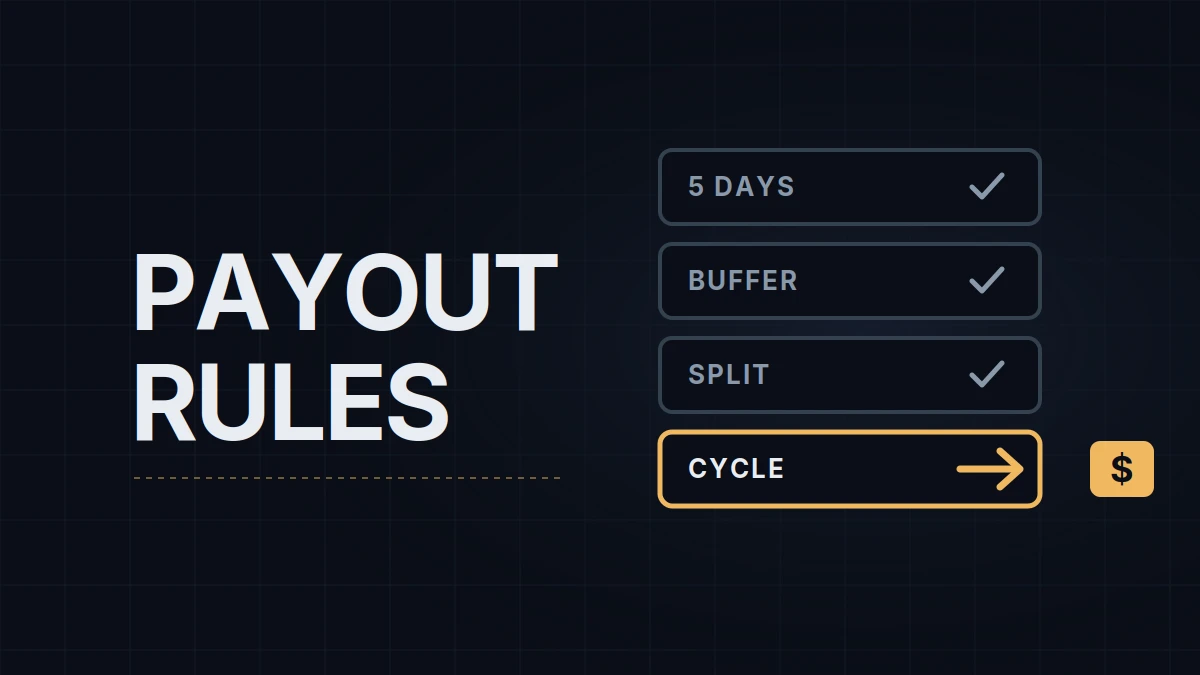
Prop firm payout rules decide how much of the profit on a funded account you can take out, and when. They are written in four layers that most people read one at a time: a minimum number of qualifying days, a buffer the balance has to stay above, a profit split, and a cycle with a cap per request. Passing the evaluation gets you an account that shows a balance. The four layers decide how much of that balance is yours.
The numbers below are the published rules of three firms at the time of writing: LucidFlex, Topstep's Express Funded Account and Apex's End-of-Day Performance Account. The numbers change a few times a year; the four layers have not changed since the futures prop model appeared.
Qualifying days
A qualifying day is a trading day that closes with net profit at or above a threshold the firm sets for the account size. A day that closes green but below the threshold is a trading day, not a qualifying day. On a 50K account the threshold is $150 at LucidFlex, $150 at Topstep (the same number at every size) and $250 on an Apex EOD account, at the time of writing. All three want five of them before the first request, none requires the days to be consecutive, and all three restart the count after every approved payout.
Five days is a floor, not a forecast. A payout every week is possible if every session clears the bar; a trader who wins three sessions out of five and clears the threshold on two of the three needs a bit more than two weeks per cycle, with no red weeks. The threshold also has an effect on how small you can trade: on a 50K Apex account, $250 is 125 points net on one MNQ contract (Micro E-mini Nasdaq-100, $2 per point), which is a strong session for a one-micro trader. In practice the daily minimum pushes small-size traders to two or three micros on the days they want counted, or to holding winners longer than they otherwise would.
Two firms offer a different clock. Topstep's Consistency path replaces five winning days with three trading days and a 40% consistency check on the cycle's profit, which sets an arithmetic floor of three contributing days anyway. LucidPro has no day count at all; it asks for a minimum profit per cycle ($500 on a 50K) and the same 40% test. Topstep also excludes the day you submit the request from the next count, and a request sent after 5:00 PM CT already belongs to the next session, so an evening request costs tomorrow's day, not today's.
Buffers
A buffer is the amount of profit the account must hold above its starting balance before any of it can be withdrawn, and must still hold after the withdrawal. The common formula is the initial maximum loss limit plus $100. A 50K account with a $2,000 max loss limit has a buffer of $2,100, so the first $2,100 of profit is not withdrawable. Apex calls it the safety net and keeps it for the lifetime of the Performance Account; LucidPro and LucidDaily call it the buffer balance and it works the same way. Add the $500 minimum request and the payout button on a 50K Apex EOD account appears at $52,600.
The point of a buffer is that a paid-out account is not one bad session away from the trailing drawdown. Without it, a trader could withdraw down to the starting balance and be sitting on the max loss limit the next morning.
Two of the three firms in this post do it without a buffer. LucidFlex states that no buffer balance has to be maintained, and caps the request instead. Topstep has no buffer, but after the first payout the maximum loss limit is set to zero permanently, which means the floor becomes the starting balance and whatever you leave in the account is the whole cushion. Topstep's own help center suggests waiting until the MLL has trailed up to zero before the first request, which is a buffer by another route: you build the cushion yourself before you take anything out.
Profit splits
The split is the share of an approved payout that reaches you. Ninety percent to the trader is the current standard: Lucid uses 90/10 on every funded account type, Topstep uses 90/10 as the default and keeps a legacy 100% on the first $10,000 for traders who joined its new dashboard before January 12, 2026. Apex pays 100% of the approved amount on its current Performance Accounts.
A split is the easiest number to compare and the least important one, because it is multiplied by a capped amount. A 100% split on a $1,500 cap pays less than a 90% split on a $2,000 cap. Fees sit next to the split: Topstep's ACH and wire methods carry a $30 charge, so a $500 request by ACH arrives as $420, while its Aeropay and Wise routes and Lucid's payouts carry no firm-side fee at the time of writing. Bank and processor fees are separate and yours.
Cycles and caps
A payout cycle is the period between two approved payouts. Everything above resets at the boundary: the day count, the consistency calculation, the profit goal where there is one. Inside a cycle, a request is limited in two ways: a cap per request, usually half of the eligible amount up to a dollar ceiling that depends on the account size and sometimes on the payout number, and a cap on the number of payouts the simulated account can produce before something else happens to it.
That second cap is the one people miss. A LucidFlex account pays out five times and the trader is then moved to a live account. An Apex EOD Performance Account closes after its sixth approved payout; a new evaluation is the way to another one. A Topstep Express Funded Account has no count, but it is a bridge to the Live Funded Account, where per-request caps disappear and five winning days per cycle remain. So the lifetime value of a 25K sim account is a finite number: five requests of at most $1,000 at LucidFlex, six requests of at most $1,000 at Apex, before the account either graduates or ends.
| At the time of writing | LucidFlex | Topstep XFA (Standard path) | Apex EOD Performance Account |
|---|---|---|---|
| Qualifying days per cycle | 5 days above the daily minimum | 5 winning days of $150+ | 5 days above the daily minimum |
| Daily minimum, 50K | $150 | $150 (all sizes) | $250 |
| Consistency test at payout | none | none (40% on the Consistency path) | largest day under 50% of cycle profit |
| Buffer | none | none; MLL set to $0 after the first payout | max loss limit + $100, for the life of the account |
| Split | 90/10 | 90/10 (legacy 100% on first $10K) | 100% |
| Minimum request | $500 | $125 | $500 |
| Cap per request, 50K | 50% of profit, up to $2,000 | 50% of balance, up to $2,000 ($3,000 on Consistency) | $1,500 on the first, rising to $3,000 by the sixth |
| Payouts per account | 5, then moved live | uncapped until the Live Funded Account | 6, then the account closes |
| Request window | any day, funds within 2 business days | CME hours, 1–3 business days of internal review plus the method's time | reviewed, then paid by ACH or Plane |
The same profit, run through the three rulebooks, shows what the layers do. A hypothetical trader on a 50K account makes $3,000 net over twelve sessions, largest day $900, seven of the twelve days above every firm's daily minimum. At LucidFlex the request is half the profit, $1,500, and 90% of it arrives: $1,350. At Topstep the request is half the balance above the start, again $1,500 and $1,350 after the split, $1,320 if it goes by ACH; what stays behind, $1,500, is now the entire distance to the floor. At Apex only the profit above the $52,100 safety net is eligible, $900, which clears the $500 minimum and the 50% test (the $900 day is 30% of the cycle), and arrives whole: $900, with $2,100 of cushion locked in the account.
What the rules change at the desk
Traders handle these rules in one of three ways. Some ignore them and request whenever the dashboard allows; the cost is a wasted cycle when a big day breaks a consistency test or a small day misses the threshold. Some trade the cycle: smaller size early in a cycle so the largest day cannot dominate, a deliberate push past the threshold on days that are already green. And some treat the request itself as a risk event, because every firm above warns that a trade taken between the request and the deduction can drop the balance below the required level and get the request denied; Lucid says the request may be denied, Apex says to trade as if the money were already gone.
My own approach is the third one with a piece of the second. The request day is a no-trade day on that account, and the cycle is planned around qualifying days rather than around the split, because the split is the one number in the rulebook that is the same for almost everyone.