25K, 50K, 100K or 150K: Choosing an Evaluation Size by Drawdown per Dollar
A bigger evaluation buys more drawdown, but not always more per dollar, and it asks for more in return: a target twice the drawdown and higher qualifying days. Four numbers to compare 25K, 50K, 100K and 150K accounts, worked through LucidFlex and Topstep rules at the time of writing.
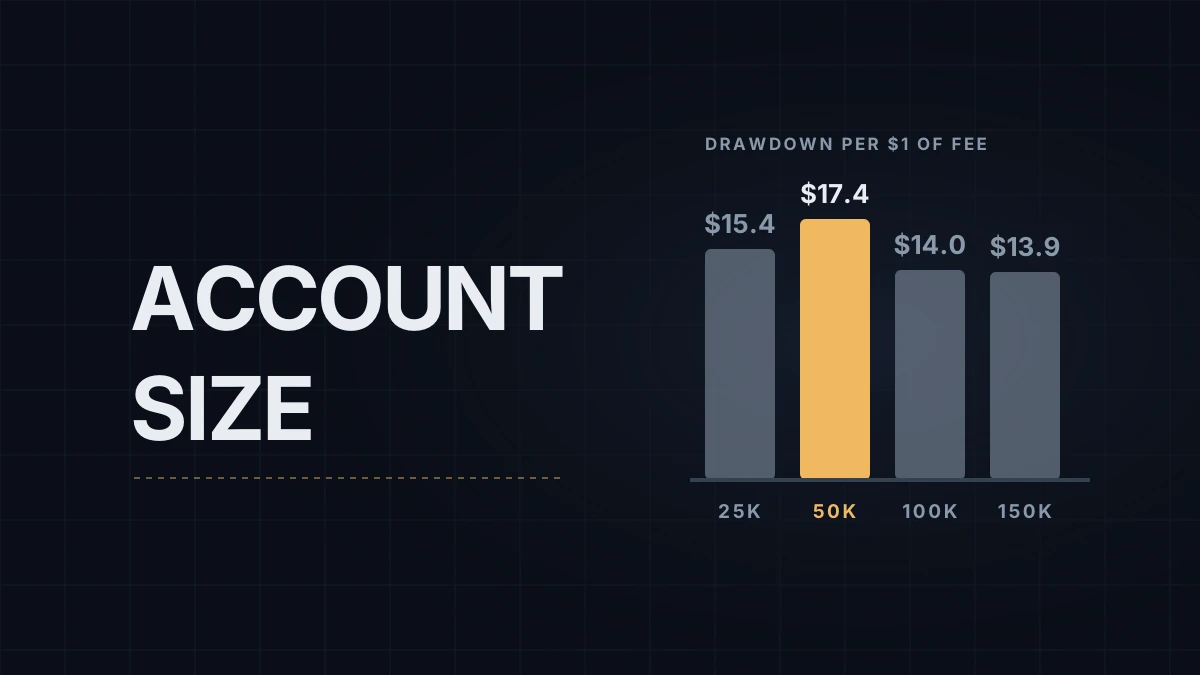
A LucidFlex 50K evaluation costs $115 and comes with a $2,000 drawdown, about $17.40 of drawdown for every dollar of fee. The 150K costs $323 for $4,500, about $13.90 per dollar. The bigger account isn't the better deal per dollar, and it asks for more in return: a profit target twice its drawdown instead of one and a half times, and qualifying days of $250 instead of $150 before a payout.
Account size is the first choice on any checkout page, and most traders make it by the headline number. The drawdown, the maximum loss limit that ends the account, is the number that matters; how it trails is covered in trailing drawdown explained, and the evaluation itself in prop firm evaluations explained.
Four numbers per size
- Drawdown per dollar of fee: how much room each dollar of the purchase buys.
- Target divided by drawdown: how far the profit target sits compared with the room you have to lose before reaching it.
- Drawdown per micro at full size: the room left for each MNQ contract, the Micro E-mini Nasdaq-100, if you trade the maximum position. One MNQ point is $2.
- Payout cap and qualifying day: what one payout can be, and what a day has to make to count toward it.
LucidFlex, at the time of writing
From Lucid's help center and store:
| 25K | 50K | 100K | 150K | |
|---|---|---|---|---|
| Evaluation fee, one-time | $65 | $115 | $215 | $323 |
| Max loss limit, end-of-day trailing | $1,000 | $2,000 | $3,000 | $4,500 |
| Drawdown per $1 of fee | $15.40 | $17.40 | $14.00 | $13.90 |
| Profit target | $1,250 | $3,000 | $6,000 | $9,000 |
| Target ÷ drawdown | 1.25 | 1.5 | 2.0 | 2.0 |
| Max size, micros | 20 | 40 | 60 | 100 |
| Drawdown per micro at max size | 25 pts | 25 pts | 25 pts | 22.5 pts |
| Max per payout | $1,000 | $2,000 | $2,500 | $3,000 |
| Qualifying day, 5 needed | $100 | $150 | $200 | $250 |
The fees are list prices for the cheapest version, with the optional daily loss limit on and the 40% consistency rule in the evaluation; turning the limit off or choosing 50% consistency costs more. There's no activation fee on passing, and on the funded account size starts lower, at 10, 20, 30 and 40 micros, and grows with profit. The qualifying days follow Lucid's regular payout rules; with the daily loss limit on, Lucid also offers on-demand payouts during the session.
The row that surprises most traders is drawdown per micro. At full size, every account up to 100K leaves the same 25 points of room per contract, and the 150K leaves less. A bigger account doesn't give a contract more room; it lets you trade more contracts with the same room.
Topstep, at the time of writing
Topstep's standard Trading Combine starts at 50K and charges monthly until it's passed; its newer Topstep Labs line also sells one-time-fee combines with a static drawdown, a 25K among them:
| 50K | 100K | 150K | |
|---|---|---|---|
| Monthly fee, Standard path | $49 | $99 | $199 |
| Activation fee on passing | $149 | $149 | $149 |
| Maximum Loss Limit, end-of-day trailing | $2,000 | $3,000 | $4,500 |
| Drawdown per $1, one month plus activation | $10.10 | $12.10 | $12.90 |
| Profit target | $3,000 | $6,000 | $9,000 |
| Target ÷ drawdown | 1.5 | 2.0 | 2.0 |
| Max size, micros | 50 | 100 | 150 |
| Drawdown per micro at max size | 20 pts | 15 pts | 15 pts |
| Payout cap, Standard path | $2,000 | $3,000 | $5,000 |
A second month on the 50K brings its ratio down to $8.10. The No Activation Fee path costs $95, $149 and $229 a month with nothing to pay on passing, which gives $21.10, $20.10 and $19.70 of drawdown per dollar for a one-month pass. Here the per-dollar picture runs the other way from Lucid's, with the larger sizes slightly cheaper per dollar of drawdown on the Standard path, because the flat $149 activation fee weighs most on the smallest account. Drawdowns also don't always scale the same way across firms: Apex Trader Funding's 150K end-of-day and intraday evaluations come with $4,000 rather than $4,500.
How many losing days fit
Take a hypothetical trader whose average losing day is $200, 50 points on two MNQ. From the starting balance, before any profit, the LucidFlex drawdown survives four such days on the 25K, nine on the 50K, 14 on the 100K and 22 on the 150K; the next one ends the account. If the same trader keeps the same two contracts, the bigger account is pure extra room, and costs more.
The qualifying day runs the other way. On two MNQ, $100 is 25 points, $150 is 37.5, $200 is 50 and $250 is 62.5. A trader who buys the 150K but keeps trading two micros needs days 2.5 times as large as on the 25K to count toward a payout, or has to size up, which spends the extra drawdown the bigger account provided. The size that fits is the one where a normal winning day at your normal size clears the qualifying bar, and a normal losing streak fits inside the drawdown with room to spare.
Three ways traders tend to choose, each with its cost:
- Smallest size while a method is untested. The cheapest attempts and the lowest qualifying day; the cost is the least room and the smallest payout cap.
- The size with the most drawdown per dollar. On LucidFlex that's the 50K; the cost is a target 1.5 times the drawdown instead of 1.25.
- Large size for a trader who already trades several contracts. A 100K or 150K matches the position size; the cost is a target twice the drawdown and, on the LucidFlex 150K and both larger Topstep sizes, less room per contract at full size.
On the LucidFlex 25K I trade, the number I plan around more than the drawdown is the $100 qualifying day, 50 points on a single micro.
Educational content, not investment advice. Futures trading involves substantial risk of loss. Examples are for illustration only. Read the full Risk Disclosure.