Trailing Drawdown Explained: EOD vs Intraday vs Static
The profit target gets the attention; the drawdown ends the accounts. Three ways prop firms measure it (intraday, end-of-day, static), the same three trades run through each, where the floor locks, and what changes in how you trade under each rule.
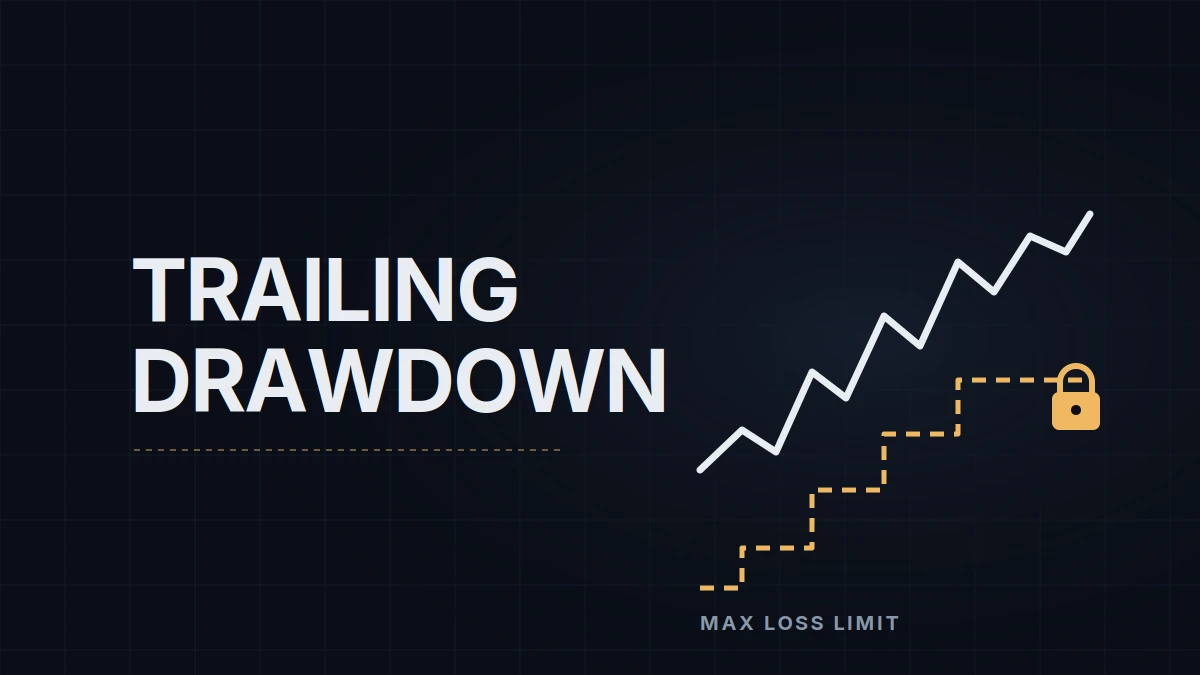
Three trades, two accounts, one rule. A trader buys a 25K evaluation with a $1,000 max loss limit. Trade one runs $750 in his favor; he holds for more and it comes all the way back to break even. Trade two loses $250. Trade three makes $150. Net for the day: minus $100. On an account that measures drawdown from the daily close, he has used $100 of his $1,000. On an account that measures it tick by tick, the same day used $850, and one ordinary losing trade tomorrow ends the evaluation.
The rule is called trailing drawdown, and the way a firm measures it says more about your odds than the profit target does. What a prop firm evaluation actually is covers the whole structure; this post is about the one rule inside it that closes most accounts.
What "trailing" means
A drawdown limit is the lowest your account is allowed to go. A static limit sits at one number for the life of the account: starting balance minus the max loss, and nothing you do moves it. A trailing limit follows your balance up. Every time the account makes a new high, the floor rises by the same amount, so it stays a fixed distance below the peak. Profit moves the floor rather than adding to your cushion.
On the 25K account with a $1,000 max loss: you start at $25,000, so the floor is $24,000. The balance climbs to $25,400 and the floor climbs to $24,400. The balance drops back to $25,100 and the floor stays at $24,400, because it never moves down. You now have $700 of room, not the $1,100 a static limit would give you at the same balance. Firms call the floor different things (Max Loss Limit, MLL, trailing threshold, drawdown level), and the number to watch is the floor.
The three ways firms measure the peak
The difference between the models is a single question: what counts as the peak?
Intraday trailing
The peak is the highest equity the account has ever shown, open positions included, updated in real time. The moment an open trade is $600 in profit, the floor moves up $600, whether or not you ever close the trade there. Give the $600 back and the floor stays where the unrealized peak put it.
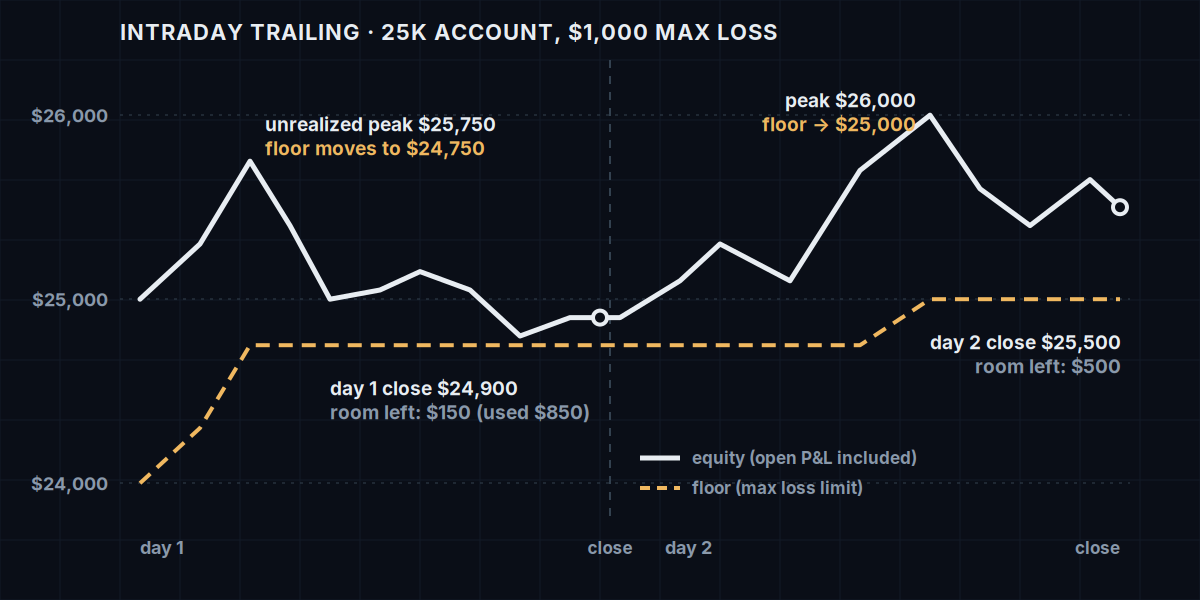
This is the model behind the opening example, and it is the strictest of the three. A winner that reverses costs you twice: once as the profit you didn't take, once as the drawdown the firm charged you for having it. At the time of writing, the classic Apex evaluation is the best-known example of intraday trailing; several firms that started there have added an end-of-day option next to it.
End-of-day trailing
The peak is the highest closing balance, recalculated once per day at the session close. What happens between closes doesn't move the floor. The $750 excursion in trade one never became a closing balance, so it never became a peak, and the day used $100.
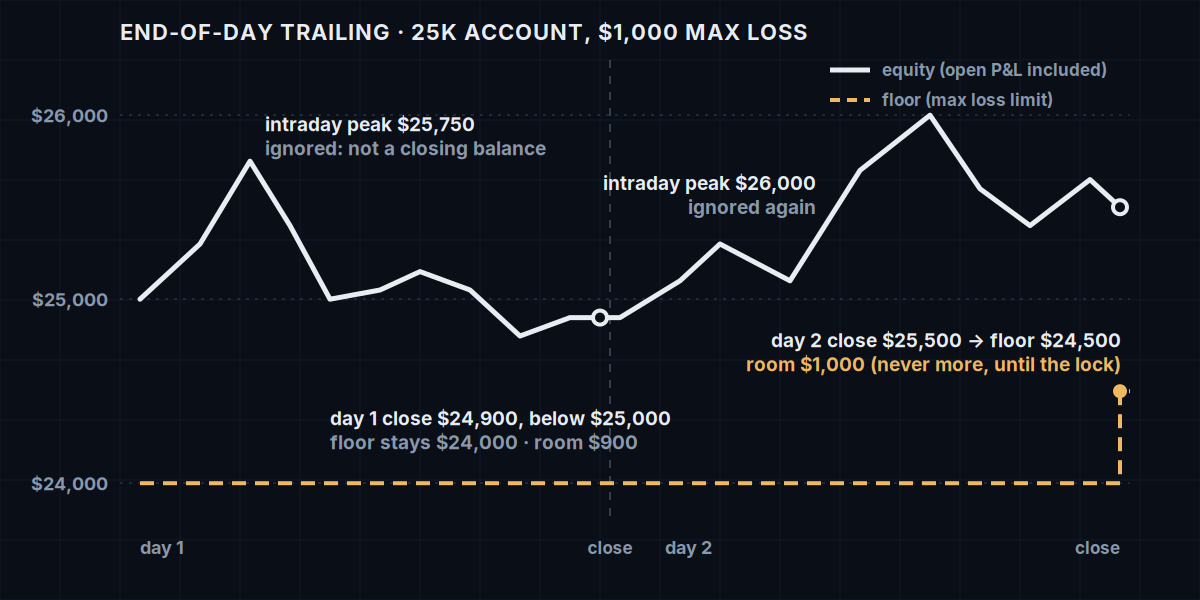
Two details in the rulebook decide how forgiving this is in practice. First, "end of day" is the firm's cutoff, not yours: for CME index futures the trading day ends at 5:00 PM ET / 23:00 CEST, and some firms take their snapshot a little earlier (Lucid uses 4:45 PM ET at the time of writing). A position still open at that moment counts at its unrealized value. Second, most firms enforce the floor in real time even though it only moves at the close: if your equity, open trades included, touches the floor at 11:00 AM, the account is closed at 11:00 AM. A few firms check only at the close. Which one you have is the difference between an open trade that's underwater and an account that's gone, so read that line of the rulebook before the first trade. At the time of writing, Lucid, Topstep and MyFundedFutures all run end-of-day trailing on evaluations.
Static
The floor is set once and never moves. Start at $25,000 with a $1,000 static drawdown and the account fails at $24,000 whether you got there from $25,000 or from $28,000. Every dollar of profit is cushion from the first day.
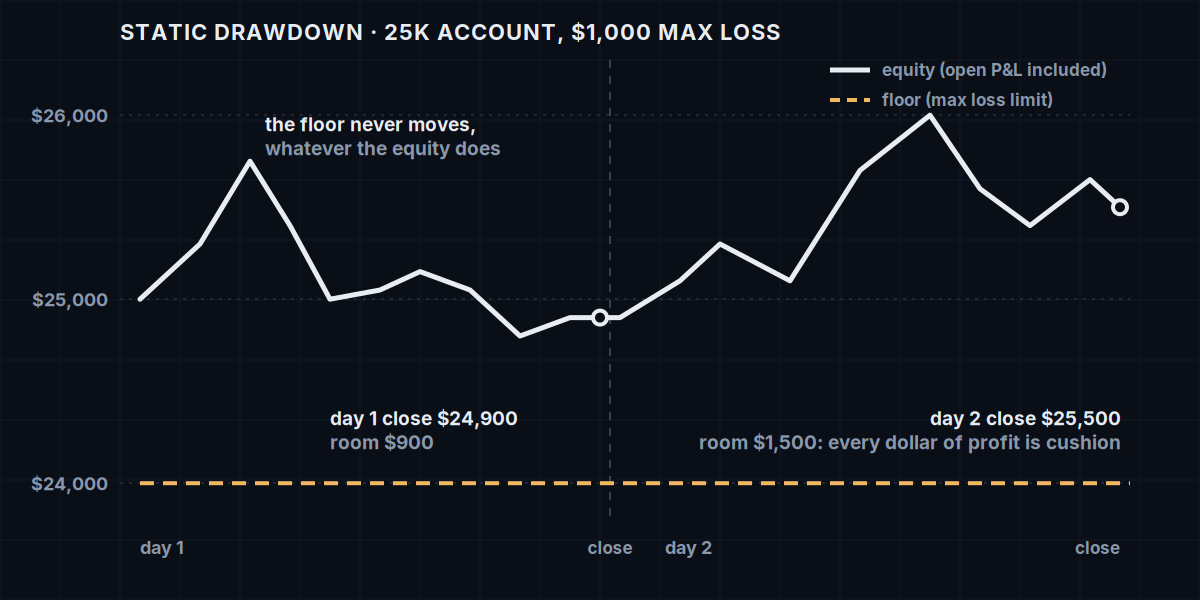
Static is rare in futures prop trading and usually costs more, either as a higher fee or as a smaller drawdown for the same account size. Some firms offer it as an option at checkout next to the trailing versions.
The lock
Almost every trailing model stops trailing at some point, and where it stops matters as much as how it trails.
The common design, at the time of writing used by Lucid, Apex, Tradeify and others, locks the floor at the starting balance plus $100 once the balance has climbed by the max loss plus $100. On the 25K/$1,000 account: the floor keeps trailing until the closing balance passes $26,100, then it freezes at $25,100 for good. From that day on the account behaves like a static one, and every dollar above $25,100 is real cushion. Topstep locks at the starting balance itself, without the $100. A less common design stops the floor at the profit target instead.
Two consequences follow. The dangerous period is the beginning, when the floor is alive and the room can never exceed $1,000 no matter how good a day you have; a $2,000 day doesn't buy you $2,000 of breathing room, it buys you the lock. And after the lock, the same account is a different instrument: the room grows with profit and a losing streak that would have ended the evaluation in week one is survivable in week four.
| Intraday trailing | End-of-day trailing | Static | |
|---|---|---|---|
| Peak measured from | highest equity, open P&L included, every tick | highest closing balance, once a day | not measured; floor is fixed |
| Floor moves | during the trade | at the close | never |
| A $600 winner given back costs | $600 of drawdown | nothing | nothing |
| Room can exceed the max loss | only after the lock | only after the lock | from day one |
| Typical at (time of writing) | Apex classic evaluation | Lucid, Topstep, MyFundedFutures | rare; a paid option at a few firms |
What changes in how you trade
Under intraday trailing, unrealized profit is real money to the firm and imaginary money to you until you close it, so the trade management that works elsewhere (wide targets, letting a winner run through pullbacks) is the thing that fails accounts. Traders who pass on this model tend to take partial profits early and trail stops tightly, and they size so that a full stop plus a normal give-back still fits in the room.
Under end-of-day trailing, intraday give-back is free and the close is the only checkpoint. The trap is the open position at the cutoff: a trade carried into the snapshot at a loss counts, and one carried at a profit raises tomorrow's floor. Flat before the firm's cutoff removes both.
Under a static drawdown, the questions above disappear and a different one appears: the fee. Static protection is usually priced in, and whether it's worth paying depends on how often your method gives back an open winner. If it rarely does, you're paying for cover you don't use.
I trade end-of-day trailing evaluations (Lucid, at the time of writing), because entries at a key level routinely see a pullback after the fill and before the move, and intraday trailing charges for that pullback on every trade. The number I keep on the screen is the floor: the balance says how the day went, the floor says how much account is left.
Educational content, not investment advice. Futures trading involves substantial risk of loss. Examples are for illustration only. Read the full Risk Disclosure.