Eval → Funded → Payout: The Typical Timeline and Where People Stall
The timeline prop firm ads show and the one the rulebooks produce are different documents. Each gate from purchase to payout, what it checks, how long it typically takes, and the four places where traders who are profitable on paper stall for weeks.
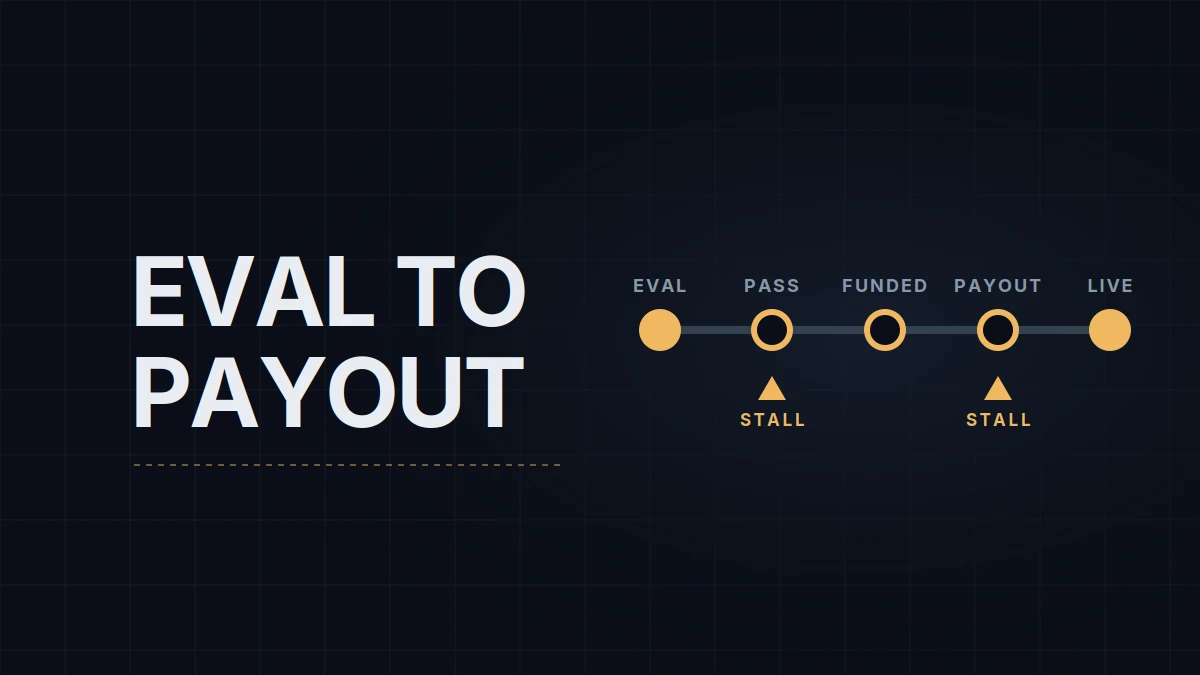
Passing an evaluation in two days is possible, and a few people do it every week. For a trader with a working method, four to eight weeks from purchase to a funded account is the usual range, and the first payout tends to arrive six to twelve weeks after the first fee, once the funded account's own gates are cleared. Industry surveys in 2026 put first-attempt pass rates somewhere between five and twenty percent depending on the firm and who is counting, and the share of buyers who ever receive a payout lower still. None of that is a verdict on the trader; most of it is the rulebook, and the rulebook is a sequence of gates.
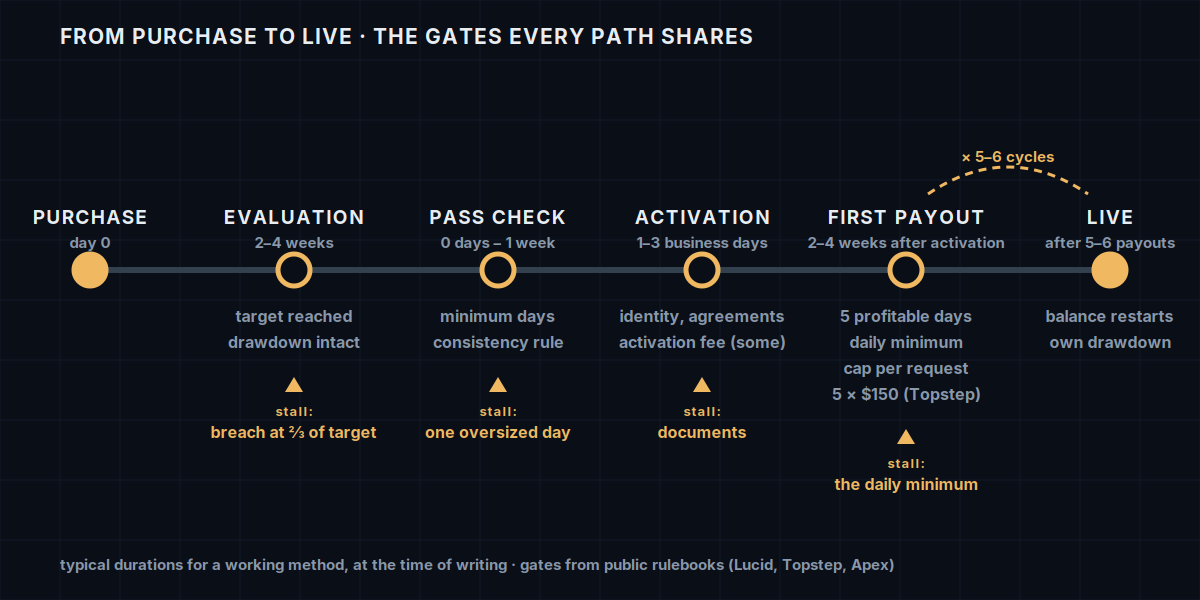
The gates below are drawn from public rulebooks, mostly Lucid's, with Topstep and Apex where they differ, all at the time of writing. If what an evaluation actually is is new to you, read that first; this post assumes the vocabulary.
Gate 1: the profit target
The evaluation ends when the account's closed balance reaches the target, $1,250 on a 25K account at Lucid, with the drawdown intact. Every other rule at this stage is a condition on how the target is reached. The typical time is where the marketing and the arithmetic disagree. A target of 5% of account size, with a method that nets a few hundred dollars a day on average and has losing days, takes two to four weeks of sessions; the two-day pass takes size that a normal losing streak would turn into a breach. Firms without a time limit, which is now most of them, let you take the slow road; firms with 30-day limits, still around, force the fast one.
Gate 2: minimum days and the consistency check
Reaching the target is not passing. Two conditions are checked at the moment you reach it. The first is a minimum number of trading days, where a firm has one: LucidFlex and Topstep's Combine have none at the time of writing beyond what the consistency cap implies, which is two, while other firms still ask for five, a day counting when at least one trade is placed. The second is the consistency rule, which caps the largest day as a share of the total: 50% on the LucidFlex evaluation, none on the LucidPro evaluation, and in Topstep's Combine the best day has to stay at or below 55% of the profit target. Consistency rules has the arithmetic; the short version is that one large day can move the finish line past the target and add a week.
Topstep used to add a third condition here, five winning days, and older guides still list it. At the time of writing that requirement lives at the payout stage instead, which is where it now costs time.
Gate 3: activation
Once the evaluation is marked passed, the funded account has to be created. At most firms that is one to three business days: identity verification, an agreement to sign, sometimes an activation fee ($149 at Topstep on its standard path; none at Lucid, which upgrades the account within minutes of the target, at the time of writing) and the account appearing in the platform. It is a short stage and a surprisingly common stall, because a mismatched document or an unsigned data agreement can hold it for a week, and the trader is not trading while it does.
Gate 4: payout eligibility
A funded account starts from the account size again, and profit made in the evaluation does not carry over. The first payout is the stage with the most conditions and the one people plan least for. At Lucid, at the time of writing, a payout requires five profitable days, each meeting a minimum daily profit ($100 on a 25K), the request is capped at half the profit and at a fixed dollar amount per request ($1,000 on a 25K), and the minimum withdrawal is $500. Topstep's Express Funded account requires five winning days of $150 or more on its standard path, or three trading days plus a 40% consistency check on its consistency path; Apex applies its own consistency rule at every payout request. The common shape across firms is five-ish qualifying days plus a cap, so the first payout is rarely less than two weeks after activation and is often four. The full breakdown of payout rules, with Lucid, Topstep and Apex side by side, is in the payout rules post.
Then there is the part nobody reads before buying: the payout stage repeats. Lucid moves a trader into its live review after the fifth payout, and the live account starts from zero with its own drawdown; Topstep's path also ends in a live account, on its risk team's call rather than after a fixed number of payouts. Every cycle has its own five days and its own cap, so "funded" describes months of gates, not one.
| Stage | What is checked | Typical duration with a working method | Where people stall |
|---|---|---|---|
| Evaluation | target reached with drawdown intact | 2–4 weeks | drawdown breach two-thirds of the way to target |
| Pass conditions | minimum days (some firms); consistency | 0 days to 1 week extra | one oversized day |
| Activation | identity, agreements, fee | minutes to 3 business days | documents; unsigned data agreement |
| First payout | qualifying profitable days (5 × $100 at Lucid 25K; 5 × $150 at Topstep); per-request cap; minimum withdrawal | 2–4 weeks after activation | the daily minimum profit; the cap |
| Payout cycle → live | repeated payouts (five at Lucid), then a live review | months | each cycle restarts the gates |
Durations at the time of writing, for the firms named; time-limited evaluations compress the first row and raise the breach rate.
Where profitable traders stall
The first stall is the drawdown, not the target. Most evaluations that fail do so between the halfway point and the target, when the account has room for exactly one normal losing streak and gets one. The drawdown post explains why the early days of an account, before the floor locks, are the fragile ones; the practical consequence is that the middle of an evaluation is where size should be smallest, and it is usually where it grows.
The second is the oversized day. A trader ahead of schedule has a large day, the consistency check moves the finish line, and the next week is spent trading small to dilute it, exposed to the drawdown for no reason other than a ratio.
The third is the reset loop. A failed evaluation can be reset for a fee, and the fee is small compared with the time already spent, so it gets paid. Two or three resets later the trader has spent more on fees than a funded account would have paid out in its first cycle, and has been trading the same method under the same pressure the whole time. The decision to reset is worth making with the fee counted as part of the cost of the account, not as a separate small thing.
The fourth is the payout stage itself: reaching funded status and then discovering the five-day minimum, the daily minimum profit and the cap. A trader who planned for "pass, then get paid" finds a second evaluation with different rules, and the disappointment costs more sessions than the rules do.
Firms differ on which of these they emphasize. Time-limited evaluations move the stall to the first row; firms with no evaluation consistency and a strict payout consistency move it to the fourth; firms with instant-funding products skip the first two rows and charge for it. Reading the rulebook as a timeline, gate by gate, before buying, is the whole of the preparation.
Where I stand: I don't count days on any account, and I don't publish my own timeline, because a timeline is one sample and this post is about the rules. What I do is treat each stage as a separate account with its own plan, since the rules change at every gate and a plan that passes an evaluation is not the plan that gets a payout.
Educational content, not investment advice. Futures trading involves substantial risk of loss. Examples are for illustration only. Read the full Risk Disclosure.