NQ Week Ahead (Aug 24–28, 2026): Nvidia, PCE and Jackson Hole With the Long Bond at 2007 Highs
Last week's downside map played out almost level by level as the 30-year yield hit its highest since 2007. Now NQ sits on prior-week value low with PCE, Nvidia earnings and Warsh's first Jackson Hole keynote packed into four days. Levels, both scenarios and the calendar inside.
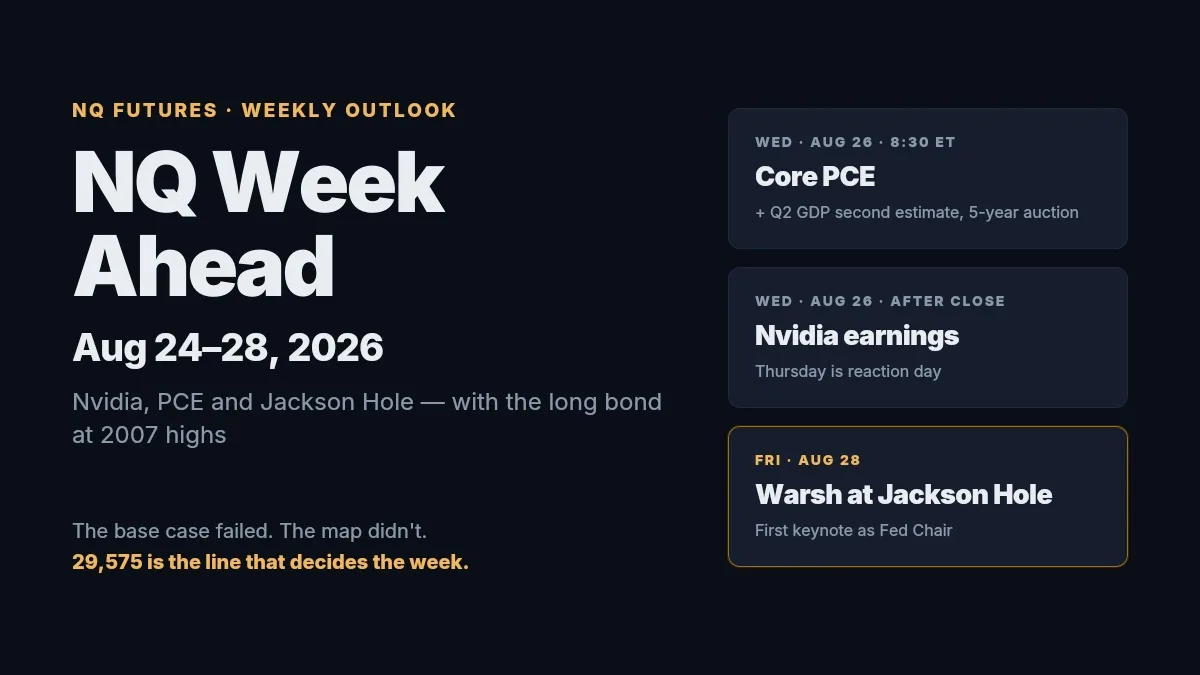
Week two of the series. Same format every Sunday: where the market stands, what's on the calendar, and the levels I'm working with going into the week.
The base case failed. The map didn't.
Last Sunday I wrote that the structure stayed constructive as long as NQ held 29,870, and that a failed breakout above the 2026 high-volume node would unwind fast because late longs were trapped above. The first half was wrong within three sessions. The second half is what actually happened — the downside roadmap from that post got traded almost level by level, all the way to the rising 20-day SMA.
That's the honest summary of the week, and it's also the point of publishing a map instead of a prediction. The scenario you lean toward is the least important part of the preparation. The references are what keep you solvent when it flips.
What Actually Happened
Monday set the trap: a push into 30,300 that couldn't hold, followed by a heavy close back under 30,100 — the level the whole bullish structure keyed off. Tuesday was continuation lower. Wednesday chopped, which mattered more than it looked, because a chop day after two red ones rebuilds liquidity and invites fresh dip buyers in. Thursday used exactly that fuel: a flush through the midweek longs, a test of the 20-day SMA, and a clean-out of the downside liquidity pocket below. Friday finally gave both sides something — an early retest of the lows for sellers, then a mean-reversion long into late morning as price started to rebalance after the liquidation.
For a summer week, that's unusually clean technical behavior. The reason it was clean is the part that matters for this week: the macro backdrop has stopped being background.
The Macro Backdrop in Two Minutes
The driver was the bond market, specifically the long end. The 30-year Treasury yield pushed as high as 5.34% — its highest since 2007 — as investors kept pricing fiscal deficits, heavy Treasury supply, higher oil and inflation that refuses to cool. Long-duration tech is the first thing that gets sold when that happens, and it did: semiconductors had their worst session Tuesday with the SOXX down around 5%, while money rotated into energy, healthcare and staples.
The inputs stacked up in one direction all week:
- Oil. Renewed Iran/Hormuz tension has Brent just under $94 after its second straight weekly gain, which feeds straight into inflation expectations and, from there, into yields.
- FOMC minutes. July's minutes were more hawkish than expected — three policymakers dissented in favor of a 25bp hike, and others said they'd considered tighter policy. The message: inflation is the priority, and risk assets shouldn't expect a backstop.
- Data refusing to cool. Jobless claims at 206K versus 210K expected. Philly Fed manufacturing jumped to 47.4 against a consensus in the mid-20s — its highest reading since 2021. Friday's flash Services PMI printed 56.8, a 20-month high, with the composite at 56.0, the strongest since April 2022. Every one of those prints is good news for the economy and bad news for the rate path.
- The Treasury's attempt to help. Wednesday's announcement that buybacks in the 10-to-30-year sectors would at least double, from $2B to $4B per operation, knocked the 30-year down nine basis points — for a day. By Thursday yields were back roughly where they started. Part of the reason: the larger operations don't even begin until September 9. The market priced the signal, then remembered there was no money behind it yet.
The cleanest way to describe the regime: soft data no longer lowers yields. Housing weakened and the long end barely noticed, because the market is focused on supply, deficits and term premium rather than on the next print. Add a growing conversation about how much debt hyperscalers are issuing to fund AI infrastructure — AI and Big Tech bond issuance reportedly passed $220B this year by mid-August, roughly double all of 2025 — and what higher financing costs do to that math, and you get the transmission chain that defined the week:
Higher oil → higher inflation expectations → higher long-end yields → pressure on long-duration tech → rotation into defensives → forced deleveraging in crowded AI and semiconductor positioning.
Nothing in that chain was one data point. It was a broad tightening of financial conditions, and NQ — still the most crowded part of the market — was the natural place for liquidity to come from.
Where the Market Stands Now
Structurally, last week was a failed auction. Buyers had their shot at migrating value above the high-volume node that has become the 2026 point of control; they couldn't build acceptance there, and once price slipped back below it, momentum flipped and the macro did the rest. The rotation into the 20-day SMA is textbook mean reversion from a failed breakout.
The bears haven't won the larger battle — but the rejection above the node is a real problem for momentum buyers. While price trades below that area, rallies are reclaims that need proving, not trends to lean on. For bulls, the first meaningful step toward regaining control is simple to state and hard to do: get back above the 2026 POC and build value there.
Three context points keep the bearish read honest:
- This wasn't isolated Nasdaq weakness. ES rotated back into its prior all-time-high breakout pivots and its own 20-day SMA. SPY and QQQ both still carry unfilled gaps below, which become live references if selling resumes.
- The VIX is still only mid-teens. That's controlled de-risking, not panic.
- It's late summer in a midterm year. Thin tape plus an election-year second half historically favors consolidation and sharp two-way rotations over clean trends.
Call it a higher-timeframe digestion phase. Bulls need to reclaim lost value; bears need continued rejection from the POC and, eventually, a break of higher-timeframe support to turn a pullback into something structural. Until one side does it, expect headline-driven volatility and failed moves in both directions.
The Level Map
The central reference this week is the prior-week value area. NQ closed the week sitting on its low, with the point of control almost exactly on top of the 2026 POC — which means the two things that matter most are stacked in the same place.
The line bulls have to hold: 29,300 (prior-week VAL). It's been tested twice and carries structure from the week of July 20. Lose it without a quick reclaim and the bullish case weakens into a deeper liquidity wash before buyers are likely to reappear.
Upside roadmap:
29,300 defended → 29,400 reclaim → 29,575 (prior-week POC, ≈ 2026 POC) → 29,680 (prior-week VAH) → 29,800 → 29,870 → 30,000–30,080 supply → 30,285 (developing call wall)
Acceptance back through 29,575 is the significant step — it puts price back inside the broader four-month balance and opens a full weekly rotation to 29,680. I'd expect 29,400–29,680 to be the competitive zone of the week, with both sides active around those volume references. Above that, treat 30,000–30,080 as a real supply shelf: there are three days of trapped overhead inventory sitting there from last week. 30,285 is the developing call wall — if momentum forces dealers to chase, it can work as both a magnet and a decision point.
Downside roadmap:
29,575 rejected → 29,280 → 29,200 lost → 29,050 → 28,850–28,700 (Aug 3 breakout origin) → 28,600 → 28,300 → untested weekly POC from July 27
The bearish trigger early in the week is rejection at 29,575: a push toward 29,670 that traps late buyers and then closes weakly back below the POC would confirm sellers are still active. From there, 29,280 is the first objective; a loss of 29,200 opens expansion, and the section below it is thin — Tuesday August 4 left very little structure through there, so the tape can accelerate toward 29,050 quickly. The 28,850–28,700 zone is where the market broke out from on August 3 and is the real test of whether this is a pullback or something more. On the cash side, that area also brings QQQ close to filling its open gap toward 700, a level that has acted as an options over/under before.
Those lower references look stretched from Friday's close. Last week looked stretched on Sunday too, and it traded beyond its weekly expected move anyway. The point of mapping them isn't to call for them — it's to already know the path if the backdrop deteriorates, so risk gets adjusted instead of improvised.
The Calendar (All Times ET)
The heavy part of the week is midweek-to-Friday, and this time the scheduled events are first-order:
- Tuesday: Consumer Confidence and new home sales at 10:00 AM, then the 2-year Treasury auction. The front end is the quieter end of the curve right now, but auction demand is the week's first read on whether supply concerns are easing.
- Wednesday: the dense day. Core PCE at 8:30 AM — the Fed's preferred inflation gauge — released alongside the second estimate of Q2 GDP and durable goods. 5-year auction in the afternoon. Then Nvidia reports after the close.
- Thursday: jobless claims at 8:30 AM, the 7-year auction, and Jackson Hole opens. It's also Nvidia reaction day in the cash session.
- Friday: Kevin Warsh's first Jackson Hole keynote as Fed Chair, Friday morning, with Chicago PMI and final Michigan sentiment as the undercard.
I broke down the Nvidia and Warsh events in detail earlier this week — the history of that podium, what the market is pricing, and my session-by-session plan — here. This post won't repeat it.
What Moves Yields Moves NQ
Everything on the calendar runs through one question: can the long end stabilize? That matters more than any single release.
What helps NQ: a softer core PCE that takes pressure off yields and gives tech room for a relief move. Clean auctions Tuesday through Thursday calming the supply story. Any de-escalation around Hormuz pushing oil lower and pulling the inflation premium out of the curve. A Fed at Jackson Hole that sounds patient rather than primed for another hike. And Nvidia guidance strong enough to restore confidence in semis after their worst week in months.
What hurts NQ: a hot PCE reinforcing sticky inflation. Weak auctions or another leg higher in the 10Y/30Y — especially if yields keep rising even on soft data, which would be the single most important warning sign on the board. Further Hormuz disruption pushing oil toward $100. Claims that run either too hot (more tightening pressure) or too cold (recession talk) — the market wants gradual cooling, not surprises in either direction. And a hawkish Warsh on top of sticky inflation, which would confirm there is little Fed support underneath risk.
None of these are independent. A hot PCE on Wednesday morning changes how the market hears Nvidia on Wednesday night, and both change the stakes of Friday's keynote.
How I'm Trading It
Nothing about my process changes because the calendar is loud. I trade reversals at prepared levels, and the map above is the preparation. What changes is exposure around scheduled risk.
Wednesday's PCE print lands inside my session window — I won't carry anything into 8:30 AM ET, and the first rotation after it is for watching, not trading. Nvidia reports after my window closes, so Thursday for me is a gap day: the market has had a full overnight to reprice, and key levels that survive the open tend to be the ones that hold. Friday's keynote is scheduled for the morning ET, which puts it squarely inside my US session — that window is flat for me by design, and I'll treat the hour after it the same way I treat the hour after a data print.
The level I care about most is 29,575. It's the prior-week POC, it's the 2026 POC, and it's the last line buyers failed at. Responsive selling on the first rotations into it keeps the bearish structure mechanical; acceptance back through it flips the map. I'd rather recognize that in the first hour than argue with it all week.
Two things I'll be tagging in the journal: the 30,285 call wall, because a week with this much positioning risk is exactly where gamma regime changes how reversals behave at levels — and the no-trade days. If Thursday or Friday turn into headline chop, sitting out is a result, not a miss. Last week was a reminder that the market is fully willing to trade outside its expected range; the goal this week is to be prepared for that, not surprised by it.
Nothing here is financial advice. This is my own weekly preparation, published as-is — levels are references, not signals.
Educational content, not investment advice. Futures trading involves substantial risk of loss. Examples are for illustration only. Read the full Risk Disclosure.
Read next
Nasdaq Record High: Payrolls, Nvidia and the Narrow Rally Behind NQ's New High
The Nasdaq-100 set a record close of 31,076 on October 5, 2026, after weak payrolls cut the odds of an October Fed hike and Nvidia pushed toward a $6 trillion value. Under the surface, new 52-week lows outnumbered new highs and the 10-year yield sat at its highest since 2002.
NQ Week Ahead (Oct 5–9, 2026): A Record, a 5.3% 10-Year and Three Treasury Auctions
September payrolls came in at 29,000, October hike odds fell to about 22% and NQ set a record a day after the 10-year's highest close since 2002. With the big data already out, the rest of the week belongs to the bond market: three auctions, the Fed minutes and Friday's inflation expectations.
NQ Week Ahead (Sep 28–Oct 2, 2026): PCE, Micron, Payrolls and a Breakout Under Test
NQ broke out of a five-week range last week and settled Friday at 30,889, inside the value it built on the way up. Oil, core PCE, Micron and September payrolls now test the breakout, in that order.