Nasdaq Record High: Payrolls, Nvidia and the Narrow Rally Behind NQ's New High
The Nasdaq-100 set a record close of 31,076 on October 5, 2026, after weak payrolls cut the odds of an October Fed hike and Nvidia pushed toward a $6 trillion value. Under the surface, new 52-week lows outnumbered new highs and the 10-year yield sat at its highest since 2002.
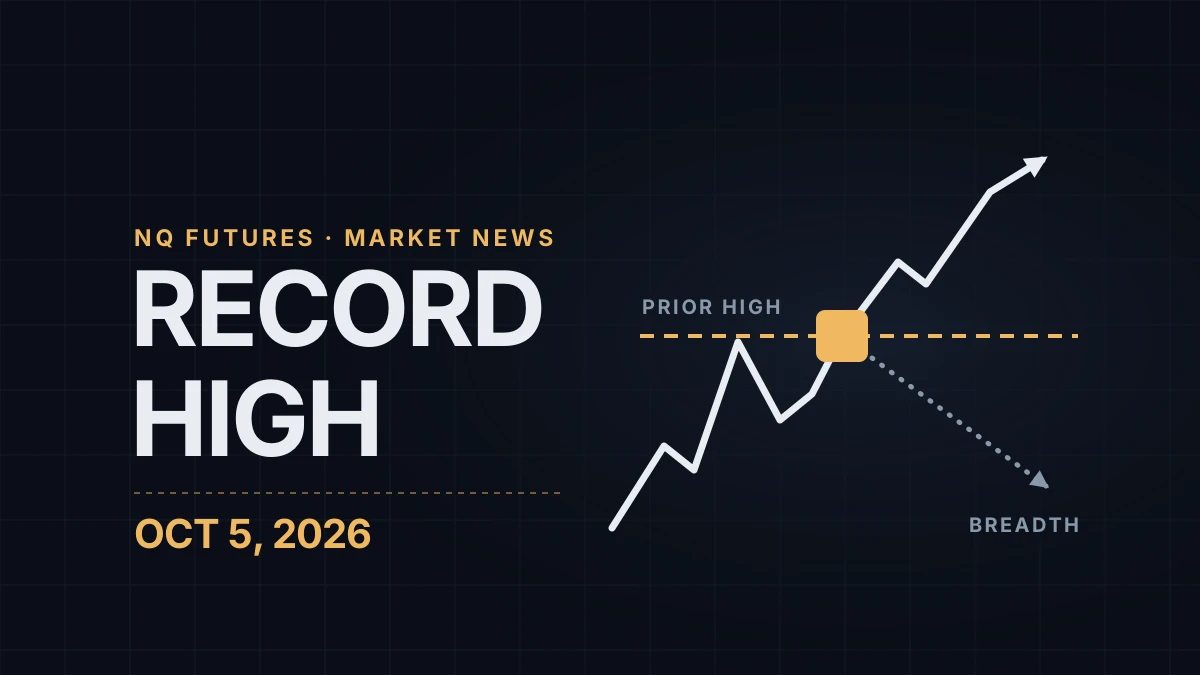
The Nasdaq-100, the index behind NQ futures, closed at a record high of 31,076 on Monday, October 5, 2026, up 0.9% on the day. E-mini Nasdaq-100 futures (NQ) kept climbing on Tuesday: the December contract (NQ 12-26) traded as high as 31,616.50 at 11:15 AM ET / 17:15 CEST, about 300 points above Monday's settlement (the exchange's official daily closing price). The run started before Monday, with Friday's jobs report, and Nvidia carried it from there.
| When | What | Number |
|---|---|---|
| Fri, October 2, 8:30 AM ET / 14:30 CEST | September nonfarm payrolls | +29,000 jobs vs 84,000 expected; unemployment 4.2% vs 4.1% expected |
| Fri, October 2 | Odds of an October hike (CME FedWatch) | about 22% at the close; hold about 78% |
| Fri, October 2, close | Nasdaq Composite | +1.19% to 27,190.86 |
| Mon, October 5, close | Nasdaq Composite | +1.05% to 27,477.31, record |
| Mon, October 5, close | Nasdaq-100 | +0.9% to 31,076, record |
| Tue, October 6, 11:15 AM ET / 17:15 CEST | NQ 12-26 | 31,616.50 at the day's high, about +300 points |
Sources: BLS employment report via TheStreet; CME FedWatch at Friday's close; index closes via TheStreet and Trading Economics; NQ quote via Yahoo Finance at the time of writing.
Payrolls kept the October hike off the table, mostly
Nonfarm payrolls (NFP), the monthly count of US jobs added outside agriculture, came in at 29,000 for September against a consensus of 84,000, and unemployment rose to 4.2%. With the Fed's target range at 3.75% to 4%, the market had been weighing another hike at the October 27-28 meeting of the Federal Open Market Committee (FOMC). CME FedWatch, which converts the prices of fed funds futures (contracts on the Fed's policy rate) into meeting probabilities, had those odds near 71% a week earlier and about 25% the night before the report; by Friday's close they were about 22%. Treasury yields dropped right after the release, though the 10-year ended the day higher, and the broader Nasdaq Composite closed up 1.19%. Tech reacts to that kind of repricing more than most sectors, because so much of its value sits in earnings several years out.
October is still not settled for everyone. Bill Adams, chief US economist at Fifth Third Commercial Bank, said the jobs report wasn't weak enough to pull the Fed's focus away from inflation, and that the September consumer and producer price reports (CPI and PPI), geopolitics and fuel prices have more power to sway the decision.
Nvidia did the heavy lifting
Nvidia (NVDA) traded as high as $240.10 on Monday, an intraday value of about $5.79 trillion, and ended the day at $238.90, its first record close since May. The fundamentals have been in place since the August earnings report. The latest push came from a $150 billion increase to the buyback authorization (the largest such increase in history, by Nvidia's account, leaving $235 billion authorized), a top-pick call from Morgan Stanley, and a forward price-to-earnings ratio (P/E on the next twelve months of expected earnings) below 30, the lowest in close to a decade. The stock is also catching up: it is up about 28% this year against roughly 96% for a widely tracked semiconductor exchange-traded fund.
For NQ, what counts is the weight. Nvidia is 8.43% of the Nasdaq-100 (as of October 2, from the Nasdaq-100 weights breakdown), so a 2% move in the stock is worth about 0.17% of the index. At current levels that is roughly 50 NQ points, or $1,000 on one NQ contract and $100 on one MNQ (Micro E-mini Nasdaq-100). Options prices imply roughly even odds of a $6 trillion valuation by the end of October; since $240.10 equals about $5.79 trillion, that line sits near $249 a share.
The rest of the AI chain
TSMC's US shares (TSM) closed at a record $485.80, up about 2.8%, after Elon Musk confirmed early talks about TSMC working with Terafab, his planned Texas chip plant for Tesla, SpaceX and xAI. TSM trades on the NYSE and is not in the Nasdaq-100, so it reaches NQ through sentiment and through the chip names that are. Foxconn's third-quarter revenue beat pointed the same way, toward strong global demand for AI infrastructure.
SpaceX (SPCX) gained 7.6% and led the Nasdaq's advance. It entered the Nasdaq-100 on July 7 at about 1.3% of the index and has been about 2.8% since the September rebalance, so Monday's move was worth roughly 0.2 percentage points of the index's 0.9% gain. Software got its own catalyst when Schneider Electric agreed to buy PTC for $22.6 billion in cash, and the S&P 500 software and services group was up 1.4% by mid-morning.
Oil stopped making it worse
Jamie Cox of Harris Financial Group made the point on Friday that outside energy, inflation pressure is lower. Energy is where the problem has been: US diesel hit a record $6.53 a gallon on September 22, according to AAA. The G7 then agreed to release 100 million barrels of crude and fuel from emergency reserves over four months, front-loading diesel in the first 20 days, and shipping data showed Middle East crude exports above pre-war levels on four days in the last week of September. By Tuesday morning West Texas Intermediate (WTI), the US crude benchmark, was down 1.86% at $87.77, and Brent, the international benchmark, was down 1.64% at $98.67.
Cheaper fuel weakens the case for a hike from the other side.
Record highs with 24-year-high yields
The bull case under the rally is earnings. Kyle Rodda of Capital.com points to FactSet data showing estimates for the coming reporting season revised up to nearly 30% growth, after about 50% in the second quarter, and Yardeni Research has the S&P 500's PEG ratio (P/E divided by expected earnings growth) at a 30-year low.
The bond market disagrees. On Monday the 10-year Treasury yield touched 5.35% and closed near 5.31%, its highest since 2002, and the 30-year traded above 5.7%. Under the index, the damage shows: 206 Nasdaq stocks hit new 52-week lows on Monday and only 46 hit new highs, on the day the Composite closed at a record. Companies with net cash and fast-growing earnings can absorb 5% yields; smaller ones that borrow at those rates feel every step higher. The same concentration is why the Nasdaq-100 outran the S&P 500 on Monday, 0.9% against 0.7%, and it is the core of the difference between NQ and ES.
Geopolitics has not gone away either. President Trump sent 9,000 US troops to the Middle East last week and has not ruled out new strikes on Iran, and Houthi attacks on Saudi targets keep Gulf supply risk alive.
What I'm watching
Two numbers carry most of the risk to this high. One is the 10-year yield against Monday's 5.35%: a break above it while Nvidia stalls is the combination I would expect to test the record. The other is Nvidia near $249, the $6 trillion line, because at 8.43% it is the largest single swing factor in NQ.
| Event | Date | Time |
|---|---|---|
| FOMC minutes (September meeting) | Wednesday, October 7 | 2:00 PM ET / 20:00 CEST |
| September CPI | Wednesday, October 14 | 8:30 AM ET / 14:30 CEST |
| September PPI | Thursday, October 15 | 8:30 AM ET / 14:30 CEST |
| FOMC rate decision | Wednesday, October 28 | 2:00 PM ET / 19:00 CET |
TSMC reports on October 15 and Tesla on October 21. Europe moves its clocks back on October 25, a week before the US, so the FOMC decision lands at 19:00 CET instead of the usual 20:00 (what the clock change does to NQ hours). CPI and PPI are the 8:30 AM ET kind of print covered in trading high-impact news on NQ, and every date above is on the economic calendar.
Educational content, not investment advice. Futures trading involves substantial risk of loss. Examples are for illustration only. Read the full Risk Disclosure.
Read next
NQ Week Ahead (Oct 5–9, 2026): A Record, a 5.3% 10-Year and Three Treasury Auctions
September payrolls came in at 29,000, October hike odds fell to about 22% and NQ set a record a day after the 10-year's highest close since 2002. With the big data already out, the rest of the week belongs to the bond market: three auctions, the Fed minutes and Friday's inflation expectations.
NQ Week Ahead (Sep 28–Oct 2, 2026): PCE, Micron, Payrolls and a Breakout Under Test
NQ broke out of a five-week range last week and settled Friday at 30,889, inside the value it built on the way up. Oil, core PCE, Micron and September payrolls now test the breakout, in that order.
NQ Week Ahead (Sep 21–25, 2026): Flash PMI, Costco, Xi in Washington and a 10-Year at 5%
The Fed hiked, NQ printed a lower low at 29,053 and closed the week back at the prior value area high. This week has no tier-1 release, so the 10-year yield, Wednesday's flash PMI and Thursday's Xi visit decide whether last week's failed breakdown gets resolved.