0DTE Options and Intraday NQ: What Changes When Most Option Trading Is Same-Day
Most S&P 500 index option volume is in contracts that expire the same day, and NDX, QQQ and NQ options expire every weekday. When each one settles, why same-day trading never shows up in a morning GEX chart, what research says about dealer hedging and volatility, and how NQ traders handle it.
In July 2026, 66.2% of SPX options volume was in contracts that expired the same day they traded, a record by Cboe's count. For 2025 as a whole the share was 59%, about 2.3 million contracts a day. These are 0DTE options, zero days to expiration, and their growth is why same-day option hedging gets blamed, and now and then credited, for intraday moves in index futures, NQ included.
If NQ itself is new, NQ vs MNQ tick and point value is the place to start. How dealer hedging turns option positions into futures orders is covered in gamma exposure on NQ. This post is about what changes when those options live for hours instead of weeks.
What expires every day
| Contract | Same-day expirations | Expiry and settlement | Central Europe |
|---|---|---|---|
| SPX weekly options (SPXW) | Every weekday since May 2022 | 4:00 PM ET, cash, on the closing value | 22:00 |
| Nasdaq-100 PM-settled index options (NDXP) | Every weekday | 4:00 PM ET, cash, on the closing value | 22:00 |
| QQQ options | Every weekday since November 2022 | At the close, settled in QQQ shares | 22:00 |
| CME options on E-mini Nasdaq-100 futures | Every weekday since October 2022 | 3:00 PM CT (4:00 PM ET), fixed on the average NQ price of the last 30 seconds; exercise into NQ futures | 22:00 |
On the third Friday of the month, the standard monthly SPX and NDX options settle on opening prices, and in March, June, September and December so do the quarterly NQ options, while the contracts in the table still expire that afternoon; monthly opex on NQ lays out that calendar. In the week of October 26, when Europe has changed its clocks and the US hasn't, the 4:00 PM ET expirations fall at 21:00 Central European time.
Cboe reports SPX same-day volume in its volume releases. It put July at 66.2%, and in the third quarter of 2026 same-day contracts averaged a record 3.2 million a day out of 4.9 million, about 65%. No exchange publishes a comparable share for the Nasdaq-100 products. The very high share sometimes quoted for NDX traces back to a social media post, not to Nasdaq or Cboe, so it's left out here. SPX options are hedged mainly in S&P 500 instruments rather than in NQ, which makes the SPX layer indirect for an NQ trader: it moves ES, and NQ usually moves with ES.
Why same-day gamma is hard to see
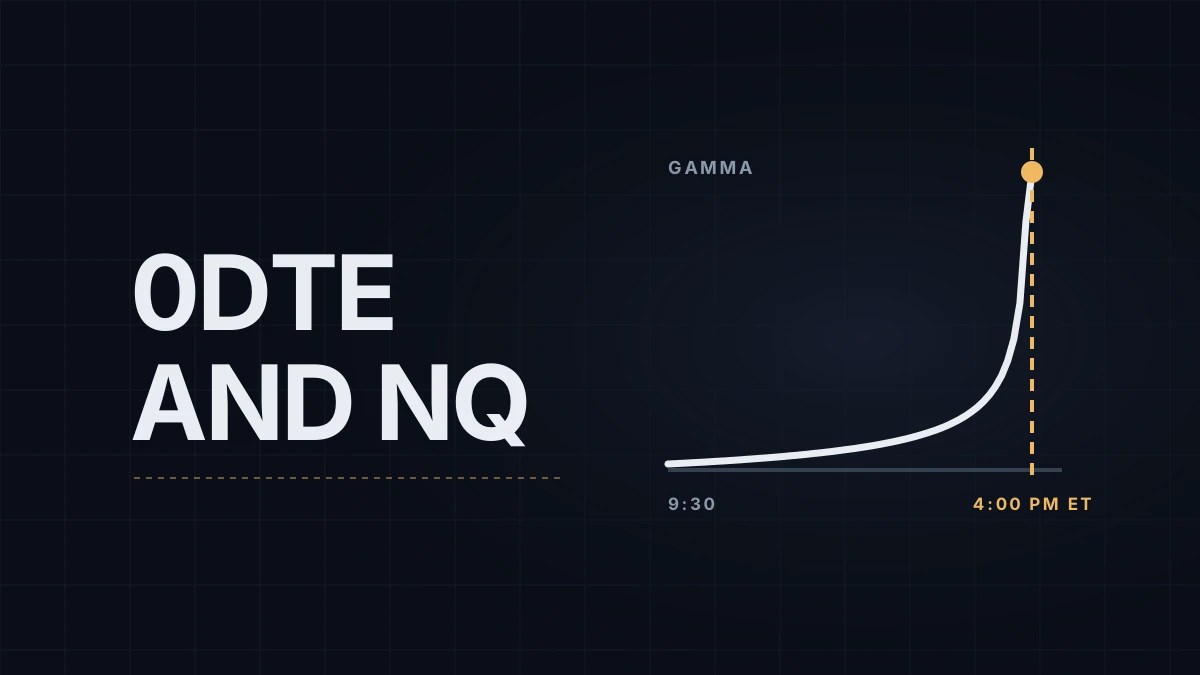
Gamma is how fast an option's delta changes as the index moves, and it peaks for options near the money and close to expiry. An at-the-money option in its last hours reacts to a move that would barely register on a monthly contract, so the dealer on the other side rebalances the hedge more often and in larger steps. Whether that rebalancing damps moves or chases them depends on whether dealers are net long or net short those options: the positive and negative gamma regimes a morning GEX chart tries to describe.
That chart has a blind spot. GEX models are built from open interest, which is published once a day as of the previous close. A 0DTE option bought after the open and sold before lunch, or held until it expires at 4:00 PM ET, never appears in any open interest file. The morning chart includes today's expiring contracts only as far as they were opened on earlier days. Anything opened today isn't in it, and same-day trading is now the largest part of SPX volume. Services that show intraday 0DTE positioning estimate it from the stream of option trades, with assumptions about who bought and who sold.
What the research found
When the S&P 500 dropped sharply in the last two hours of trading on December 20, 2023, JPMorgan's strategists pointed at 0DTE flows. Cboe answered that market makers had been mostly long gamma that day, which damps moves rather than driving them. That exchange sums up the debate, and the studies since then mostly support the damping view as far as dealers are concerned.
Dim, Eraker and Vilkov found that market makers' net gamma in SPX 0DTE options was positive on average, and that positive gamma came before lower intraday volatility and more reversals, while negative gamma came with momentum. A 2026 version of that work, merged with a study by Adams, Fontaine and Ornthanalai and run on data from 2018 to 2024, measured intraday volatility about 7% lower on expiration days in the years before every weekday had one, mostly because options opened on earlier days reached expiry rather than because of same-day trading. Cboe's own estimates put market makers' net 0DTE gamma at 0.04% to 0.17% of a day's S&P 500 futures liquidity in 2023, and at no more than 0.2% on two of the busiest futures days of April 2025. Amaya, Garcia-Ares, Pearson and Vasquez, working with Cboe data from 2020 to 2023, found that market-maker gamma adds at most 3.3 percentage points to annualized daily volatility.
The counterweight comes from the other side of the trade. Brogaard, Han and Won found that a one-standard-deviation rise in 0DTE trading went with volatility 9.1% above its average; the effect stayed positive after controlling for market-maker gamma, and they attributed it mainly to speculative retail traders. Retail traders are a large part of that flow: Cboe put their share of SPX 0DTE volume at about 53% in August 2025, and its chief executive cited 57% for June 2026.
The day most often blamed on same-day options, August 5, 2024, when the VIX spiked before the US open, has since been examined by the BIS, in an SEC working paper and by Cboe, and none of their explanations rests on same-day options. The BIS traced the VIX jump to wider quotes before the open, mostly on deep out-of-the-money puts. Separately, 0DTE's share of volume fell that day.
Taken together, dealer hedging of same-day options is small next to the futures market and, on average, damping. What the research leaves open is how much the speculative side of the flow adds on its own.
What it means for an NQ trader
Same-day gamma is largest in the last hours before 4:00 PM ET, 22:00 in Central Europe, when the remaining options sit close to the money with little time left. A trader active in the US afternoon is the one who meets it: price that keeps returning to a big strike when dealers are long gamma, faster runs when they're short. A trader in the European session sees 0DTE mostly as background, since most of the day's same-day volume trades after the US open.
Traders handle it three ways, and each has a cost. Some ignore it and read the day from structure and levels alone, which is free and misses context on afternoons when options flow dominates. Some use the morning gamma levels and regime as a filter, knowing the chart can't see positions opened today. Some pay for intraday options-flow services that estimate 0DTE positioning live, which adds a model with its own assumptions to every decision.
I trade the European session and I'm flat by the US open, so the late-day 0DTE effects fall outside my window. What I take from options is the gamma regime as a filter before the session, and nothing intraday.
Educational content, not investment advice. Futures trading involves substantial risk of loss. Examples are for illustration only. Read the full Risk Disclosure.