Trading Around News Events on NQ: Flat, Fade or Follow
A scheduled release changes the market for a few minutes: the book thins, the spread widens, the first move runs stops and the second move is the one that matters. Three ways to trade around that, what each one costs, and what the prop firm rulebooks say about news.
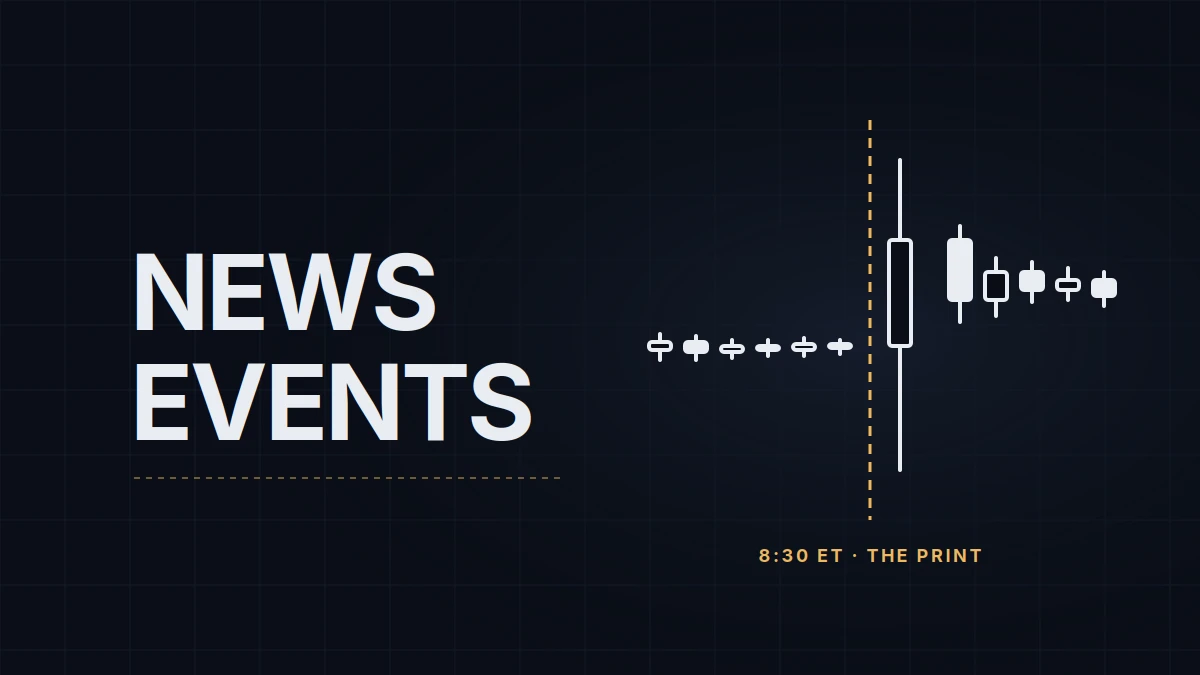
Ten seconds before a scheduled release, the NQ order book looks different from the way it looked a minute earlier. Resting orders near the market have been pulled, the spread that is normally a tick wide shows two or three, and the depth that would absorb a hundred contracts is gone. The number prints, and for a few seconds the market is trading on almost no liquidity. That is why a release moves the E-mini Nasdaq-100 50 points in the time it usually takes to move five, and why the question of what to do around it has three honest answers rather than one.
What a release does, minute by minute
The events are on the calendar weeks ahead, and they come in three shapes. Data releases at 8:30 AM ET (14:30 CEST): CPI, the jobs report, retail sales, the numbers that land in the European afternoon and inside the pre-market of the US session. Policy at 2:00 PM ET (20:00 CEST): the FOMC statement, with a press conference at 2:30; the next one, at the time of writing, is Wednesday, October 28, and the December 9 meeting after it comes with new projections. Earnings outside regular hours: a mega-cap report after the 4:00 PM close moves the Nasdaq more than most data releases, and a large retailer's pre-market print around 7:00 AM ET (13:00 CEST) can move it before Europe has finished lunch.
Whatever the shape, the minutes around it follow a pattern.
Before. Volume dries up from about ten minutes out. Liquidity providers withdraw resting orders because they do not want to be filled on the wrong side of a number they cannot predict. The market drifts, often toward a level, on almost no volume, and that drift means nothing.
The print. The first move is mechanical: algorithms parse the headline and trade it within milliseconds, into a book with nothing in it. Fifty to a hundred points in a few seconds is normal for a surprise on NQ. Market orders in this window fill at whatever is there, which can be a long way from the last price on the screen.
The first minute. The initial move triggers stops on one side and runs into the traders who fade any spike. Frequently it reverses most of the way, sometimes all of it, sometimes it reverses and then resumes. The first minute is the one with the widest bars of the day and the least information, because nobody who traded it read the number.
Minutes two to fifteen. Liquidity comes back, the book rebuilds, and the market picks a direction on the number's substance rather than its headline. The move that begins here is the one most traders mean when they say they "trade the news", and it is a normal move: it has pullbacks, it respects levels, and it can be traded with a normal stop.
Three ways to handle it, and what each costs
Flat. Close everything before the release, place no orders through it, wait for the first bars to finish. The cost is obvious: the move happens without you, and on the biggest days of the month the trader who is flat has no trade. The benefit is the mirror of the cost: no fill at a price you never saw, no stop triggered by a spike that reversed, no drawdown spent on a coin flip. For most intraday methods, and for every method that relies on stops placed close to the market, flat is the default, and the number of traders who say so is smaller than the number who do it.
Fade. Sell the spike, buy the drop, on the argument that the first move overshoots. The argument is often right, and the trade is one of the hardest to execute: the entry is a limit order into a thin book that may fill only when the spike keeps going, the stop must sit beyond a move that just did something the market rarely does, and when the fade is wrong it is wrong by a hundred points in ten seconds. Fading a release is a trade for people who size it as a lottery ticket and are fine losing the ticket.
Follow. Wait for the first minute to finish, then trade the direction the market chooses once liquidity returns, with a normal entry at a normal pullback and a stop sized to the range of the day it just became. This is the version that most resembles ordinary trading, and its cost is patience: the follow trade often enters 40 points from the print, after the easy part, and on the days when the first move was the whole move there is nothing to follow.
The three are not a ranking. They are answers to different questions: flat asks "is my method built for this", fade asks "do I want a small bet on mean reversion", follow asks "can I wait until the market is normal again". A method that answers the first question truthfully usually finds that the second and third are for other people.
What the rulebooks say
News trading is allowed at Lucid, Apex and Topstep at the time of writing, with clauses that matter more than the headline permission. Lucid lists no restriction on releases. Apex allows trading through news and prohibits placing entry orders on both sides of the market ahead of a release to catch the move either way, which its rules treat as a non-directional strategy. Topstep allows it, states that trades affected by releases are not eligible for exceptions or reset credits, and has one hard mechanism: around CPI releases, new opening trades on the equity index minis are blocked in its simulated accounts for the five minutes before and five minutes after the print, micros are capped at a size that depends on the account, and pending orders do not fill inside the window. A trader who planned to buy the dip on the CPI number with a resting limit on a Topstep account has a plan that the platform will not execute.
The rulebooks and the order book agree on the same thing from opposite directions. The exchange side removes liquidity because the outcome is unknowable; the firm side removes size because the fill is uncontrollable. The trader who is flat through the print and trades the market afterward is doing, by choice, what both of them do by design.
I flatten before the 8:30 releases that fall inside my window and treat the first quarter hour after them as something to read rather than trade.
Educational content, not investment advice. Futures trading involves substantial risk of loss. Examples are for illustration only. Read the full Risk Disclosure.