NQ Volatility: ATR, Average Daily Range and Why a Fixed Stop Can't Work
The same 30-point stop is a tenth of a calm day's range and a twentieth of a wild one's. What ATR and average daily range measure on NQ, a formula that turns the VXN into an expected range, where the range happens inside the session, and three ways traders size stops to it.
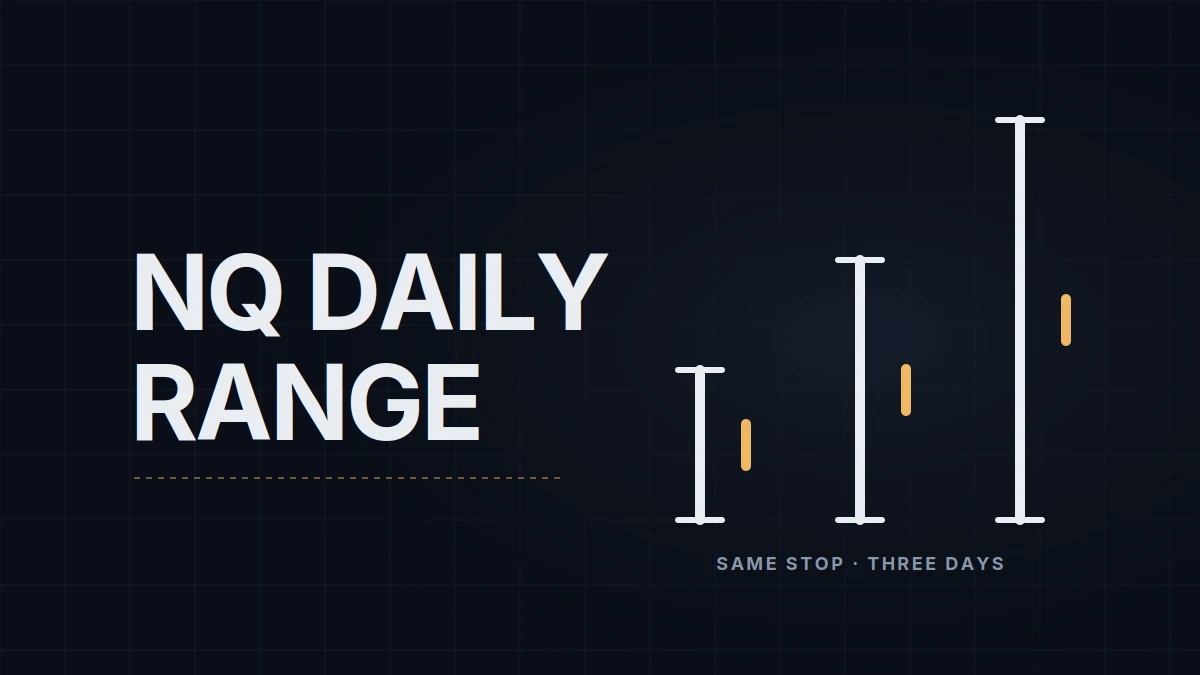
A 30-point stop on a day when NQ travels 280 points from high to low is about 11% of the day's range. The same stop on a 750-point day is 4% of it, roughly the width of one noisy five-minute bar at the open. Nothing about the stop changed; the market it was placed in did. This is the whole argument against fixed stop distances, and the numbers that make it concrete are the ones this post is about: the daily range, the true range, the ATR, and how they move on the E-mini Nasdaq-100 from one regime to the next.
Four numbers and what each one leaves out
The daily range is the day's high minus its low. Simple, and it hides one decision: which "day". A daily bar built on the full Globex session (6:00 PM to 5:00 PM ET, 00:00 to 23:00 CEST) contains the overnight move; a bar built on regular hours only (9:30 AM to 4:00 PM ET, 15:30 to 22:00 CEST) does not, and it is routinely a third smaller. Any range figure without its session template attached is not comparable with any other.
The true range adds the gap. It is the largest of: today's high minus low, today's high minus yesterday's close, yesterday's close minus today's low. On a contract that trades 23 hours a day the gap is usually small on weekdays and real on Monday morning and after the daily maintenance break, so true range and plain range differ mostly around weekends and holidays.
ATR, average true range, is the average of the true range over N bars, 14 by default. It is a smoothed number, which is its virtue and its flaw: it is stable enough to plan around and slow enough to be wrong for a week after the regime changes. When volatility doubles in two sessions, a 14-day ATR has moved perhaps a fifth of the way there.
Average daily range (ADR) is the plain range averaged over N days, and it is the number most traders mean when they say "NQ moves about X points a day". The useful form is ADR as a percentage of the index level, because the point figure ages with the price: a 1% day was 150 points when NQ traded at 15,000 and is roughly 295 points with NQ near 29,500, where it traded at the time of writing.
What NQ moves
The cleanest way to get an expected range that stays correct as the index moves is to derive it from the VXN, the Cboe's implied-volatility index for the Nasdaq-100, which usually sits a few points above the VIX. The one-day expected move is the annualized volatility divided by the square root of the number of trading days in a year:
| VXN | One-day move, % of index | Points with NQ near 29,500 | Per MNQ ($2/pt) | Per NQ ($20/pt) |
|---|---|---|---|---|
| 15 | 0.95% | ~280 | ~$560 | ~$5,600 |
| 20 | 1.26% | ~370 | ~$740 | ~$7,400 |
| 25 | 1.57% | ~465 | ~$930 | ~$9,300 |
| 30 | 1.89% | ~560 | ~$1,120 | ~$11,200 |
| 40 | 2.52% | ~745 | ~$1,490 | ~$14,900 |
That is a one-standard-deviation, close-to-close figure, so about two days in three land inside it and the third one doesn't. The realized high-to-low range is usually wider, because the range measures the extremes of the day and the formula measures where it closed. Read the table as the floor of what to expect, then check it against the daily ATR(14) on your own chart, which measures what the market has done rather than what options imply; when the two disagree, the market is moving from one regime to another and the wider number is the one to plan with.
For a 25K evaluation with a $1,000 loss limit, one MNQ contract's share of a normal day's range is between half and all of the drawdown. That single comparison explains most of the sizing conversation on prop accounts.
Where the range happens
The daily figure is spread very unevenly across the 23 hours, and the session structure decides how. The overnight Globex session usually builds a range of a fraction of the day's total and does it slowly. The European open at 3:00 AM ET (09:00 CEST) adds a leg. The 8:30 AM ET (14:30 CEST) data window can print a large part of the day's range in minutes on a release day. The first hour of regular trading, 9:30 to 10:30 AM ET (15:30 to 16:30 CEST), is where a large share of the day's high-to-low travel is made on an ordinary day. Midday shrinks, the last half hour expands again.
The practical consequence is that a stop sized to the daily ATR is the wrong unit for an intraday trade. The unit that matters is the ATR of the timeframe you enter on, at the hour you enter. A 5-minute ATR(14) read in the first half hour of regular trading is often several times the value the same indicator shows at 1:00 PM ET (19:00 CEST). A 30-point stop that is one and a half bars of noise at lunch is half a bar of noise at the open, and gets hit by nothing more than the market breathing.
Why a fixed stop can't work, and what traders do instead
A stop has one job: to sit where the trade is wrong and nowhere closer. "Wrong" is a place on the chart, beyond the level or the swing that justified the entry, and the distance from the entry to that place is set by the market's current noise, not by a number chosen last month. A fixed 30 points is inside the noise on a VXN-30 day and needlessly far on a VXN-15 day. It is a different stop every day wearing the same label. Stop placement on NQ compares the level, ATR, structure and time stops on a single trade.
Three ways traders make the stop track volatility, each with a cost.
An ATR multiple. Stop = 1.5× to 2× the ATR(14) of the entry timeframe. It scales automatically, and the cost is twofold: the size has to change with it, otherwise a wider stop is simply more risk, and the ATR lags, so the multiple is too small for the first few sessions of a new regime.
A structure stop with an ATR check. The stop goes past the level or the swing; then the distance is compared with the current ATR. A stop well under one ATR of the entry timeframe is probably inside the market's ordinary noise, and one that takes several ATRs needs a target at least as far away for the trade to pay. Where those lines sit depends on the trader and the method: a wide stop doesn't by itself mean the entry is too far from the level. The thresholds are set in advance, so the check gives its answer before the order goes in. The cost is that some entries fail the check and are skipped.
Fixed dollars, variable size. Risk per trade is a dollar amount; the stop is placed on structure; the contract count is what gives. On a day when the structural stop is 60 points instead of 30, the size halves. The cost is that on the widest days the size rounds down to zero, which on an evaluation is usually the right answer.
The three are not exclusive. Most traders who last on NQ run the second and the third together: structure decides where, ATR decides whether the where is tradeable today, dollars decide how many. That is also where I stand: the stop belongs to the setup and never to a number, and the ATR's job is to tell me on which days the setup is too small for the market it is in. Most days I read it by eye from the bars, and NinjaTrader's ATR indicator settles it when the eye isn't sure.
Educational content, not investment advice. Futures trading involves substantial risk of loss. Examples are for illustration only. Read the full Risk Disclosure.