"Is this prop firm legit?" is the question behind most review searches, and a star rating answers a narrower one. At a firm that invites customers to review it, a 4.7 from 20,000 reviews mostly measures how many satisfied customers it asked to write something, and when it asked them. The useful information sits in smaller places: the labels on each review, the dates, the complaints that cite a rule, and how the firm replies. Reviews are one input next to the rulebook itself, the parts of which the prop firm evaluation guide walks through, and next to the warning signs collected in the prop firm red flags post.
Here is what to read, in roughly this order.
- The notice above the stars. Trustpilot can place a consumer warning on a profile or withdraw its rating when a business breaches the platform's guidelines, for example by soliciting or buying reviews in ways the rules don't allow. Between August 22 and 25, 2026, a prop firm comparison site re-checked 145 prop firm profiles and found a guidelines-breach notice on 39 of them. A notice tells you something about how reviews were collected. It doesn't by itself tell you whether the firm pays, and some firms have disputed theirs publicly.
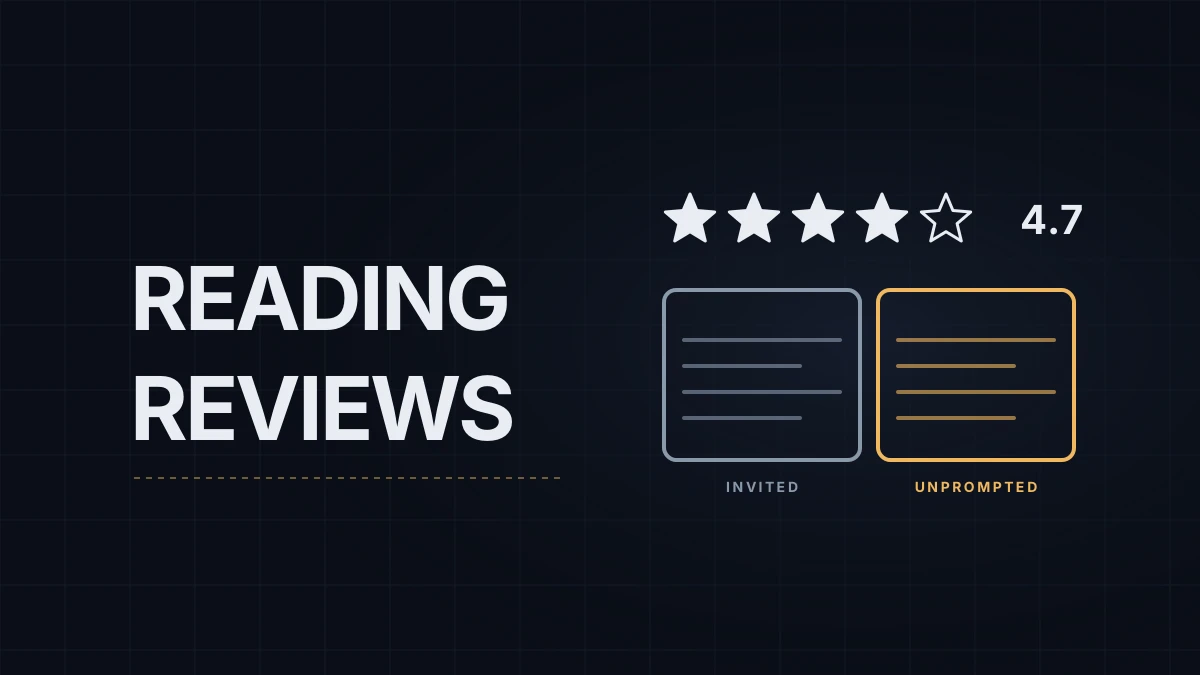
- Invited or unprompted. Each review on Trustpilot carries a label. Reviews the platform calls Verified come from a business interaction it could confirm, and at firms that invite customers through Trustpilot's tools they make up most of the page. Trustpilot requires firms to invite everyone at the same point in the customer journey, whatever their experience; a firm that invites only after payouts is breaking that rule, and that pattern is one reason notices appear. Unprompted reviews come from people who went looking for the page on their own, happy or not. Read a sample of each and compare what they talk about.
- Dates and bursts. Sort by most recent. Dozens of five-star reviews inside a few days, often around a promotion, say more about a campaign than about service. A burst of one-star reviews after a rule change says the change hit existing customers, which is worth knowing whatever you think of the rule; the rule changes post covers how firms handle existing accounts.
- The rule each complaint cites. Many of the most detailed one-star reviews of futures prop firms are about a payout that was denied or reduced. Open the help center and find the rule the reviewer names: consistency, a prohibited practice, KYC documents. Complaints fall into two groups. In the first, the trader broke a written rule he hadn't read. In the second, the firm applied a rule that isn't written down, or changed one and applied it backward. The first group is a lesson; the second is the red flag. The denied payouts post lists what risk desks usually check.
- How the firm replies. A reply that quotes the specific rule and the trade that broke it is a firm that documents its decisions. A pasted paragraph about "our team is reviewing" on every complaint is a firm that doesn't want the discussion public. Silence on the most serious complaints is an answer too.
- Payout proof, and what it proves. Payout certificates and dashboard screenshots are marketing. A certificate shows a number the firm itself issued, and a screenshot can be edited in a minute. Lifetime payout totals on a firm's homepage are its own unaudited claim. More useful: how long payouts take from request to money according to independent posts, and whether complaints about delays come in waves. A wave of delay complaints deserves more attention than any rating, and the post on what happens when a prop firm shuts down covers how to limit what you have at stake with one firm.
What the rules on fake reviews cover
Since October 21, 2024, the US Federal Trade Commission's rule on consumer reviews bans fake reviews (including AI-generated ones), reviews bought on the condition that they say something positive or negative, insider reviews that don't disclose the connection, and threats used to get negative reviews removed. When it was adopted, the civil penalty was up to $51,744 per violation. The rule gives enforcement teeth. It doesn't verify a single review, and it doesn't reach firms based outside the US the same way.
Who is writing the "best prop firm" list
Review sites and YouTube channels mostly earn money from affiliate links, so a ranking of "best prop firms" is often also a list of affiliate deals. That doesn't make it wrong. It means the ranking should show its criteria and the rules behind them, so you can check the work. On this site, the Lucid links in prop trading posts are marked as affiliate links, and the comparisons here, like Lucid vs Topstep vs Apex, put the rules side by side instead of ranking.
Regulation is the last piece. Most futures prop firms run evaluations on simulated accounts without registering with the CFTC or the NFA, as the post on whether prop firms are regulated explains, so a review page is one of the few public records of how a firm treats its customers. Read it for patterns, and read the rulebook for the rules.
Educational content, not investment advice. Futures trading involves substantial risk of loss. Examples are for illustration only. Read the full Risk Disclosure.