Lucid vs Topstep vs Apex: The Same 50K Account Under Three Rulebooks
LucidFlex, the Topstep Trading Combine and an Apex 4.0 EOD evaluation all ask for $3,000 on a 50K with a $2,000 drawdown. Run the same hypothetical weeks through all three and the differences show up: consistency, the daily loss limit, payout timing, and the cushion left after the first payout.
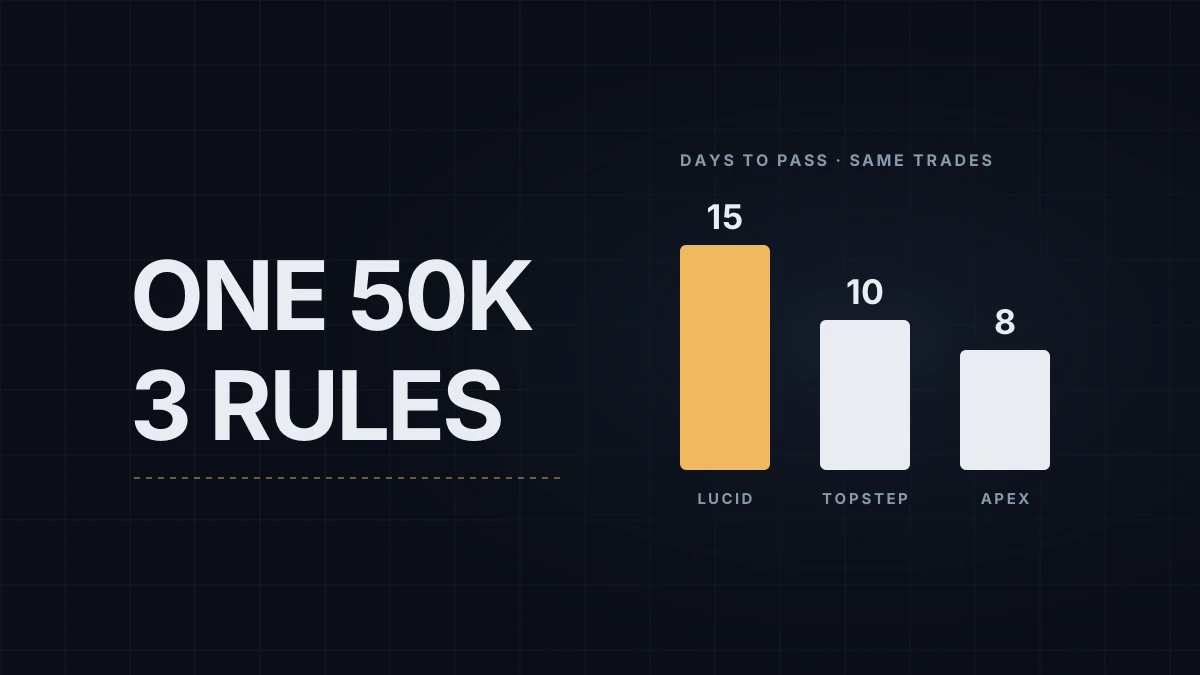
On a 50K account, LucidFlex, the Topstep Trading Combine and an Apex 4.0 end-of-day evaluation all ask for the same thing: $3,000 of profit without letting the balance fall $2,000 below its highest close. The headline numbers match, so the comparison has to happen one level down, in the rules about big days, bad days and the first payout. This post takes three stretches of hypothetical trading and runs each one through all three rulebooks, using the rules as the firms' help centers describe them on October 30, 2026. It isn't a ranking, and no rulebook comes out ahead in all three. If evaluations are new to you, start with prop firm evaluations explained.
The rules side by side
| 50K, at the time of writing | LucidFlex | Topstep Trading Combine | Apex 4.0 EOD |
|---|---|---|---|
| Pricing | One-time fee, no activation fee | $49 a month plus $149 at activation, or $95 a month with none | One-time fee for 30 days of access, plus activation or a No Activation Fee version |
| Profit target | $3,000 | $3,000 | $3,000 |
| Drawdown | $2,000, end-of-day trailing | $2,000, end-of-day trailing | $2,000, end-of-day trailing |
| Daily loss limit | Optional at purchase | Optional at purchase, $1,000 | $1,000, always on |
| Evaluation consistency | Best day at most 40% of profit (50% as a paid add-on) | Best day at most 55% of profit | None |
| Evaluation size | 4 minis / 40 micros | 5 minis / 50 micros | 6 contracts |
| Funded size at the start | 2 minis, 3 from $1,000 of profit, 4 from $2,000 | Lower than the Combine, scaling with the balance | 2 contracts, 3 from $1,500 of profit, 4 from $3,000 |
| First payout needs | 5 days of $150+ | 5 winning days of $150+ (Standard path) | 5 days of $250+, best day under 50%, balance of $52,600 |
| First payout limit | Half the profit, up to $2,000 | Half the balance, up to $2,000 ($4,000 on Combines bought with the daily loss limit, a current promotion) | $1,500 |
| Split | 90/10 | 90/10 | 100% |
| After the payouts | Live review after the 5th, at Lucid's discretion | Live only by Topstep's invitation | Account closes after the 6th |
| NinjaTrader 8 | Yes | No, TopstepX only | Yes |
All three trail the drawdown on closing balances but enforce it in real time: the floor is fixed for the day, and touching it at any moment ends the account. On the funded side, each stops trailing near the starting balance: $50,100 at Lucid and Apex, the starting balance itself on Topstep's Express Funded Account. Topstep also offers a Consistency path for the funded account (3 trading days, best day at most 40%, $3,000 cap), and Apex sells an intraday-trailing version of each evaluation; the scenarios below use the Standard path and the end-of-day evaluation. Each firm has its own detailed page here: Lucid's four account types, Topstep in 2026 and Apex 4.0.
Scenario 1: one big day
A trader makes steady $300 to $500 days, plus one $1,800 day early in week one. No day comes near the floor.
| Mon | Tue | Wed | Thu | Fri | |
|---|---|---|---|---|---|
| Week 1 | +350 | −200 | +1,800 | +300 | −250 |
| Week 2 | +450 | +400 | +350 | −300 | +500 |
| Week 3 | +400 | −200 | +450 | +300 | +350 |
| Passes on | Profit at pass | Why | |
|---|---|---|---|
| Apex | Day 8 | $3,200 | No consistency rule; the target is the target |
| Topstep | Day 10 | $3,400 | On day 8 the $1,800 day is 56% of profit, so the target rises to $1,800 ÷ 0.55 = $3,273 |
| LucidFlex | Day 15 | $4,700 | At 40%, the $1,800 day pushes the target to $1,800 ÷ 0.40 = $4,500 |
With Lucid's 50% add-on the target would be about $3,600 (Lucid builds in a small cushion), reached on day 11. None of the three fails the account over the big day; where a consistency rule exists, it costs time, not the account. Time still has a price: seven extra trading days are seven more days in which a bad session can reach the floor. The consistency rule shows how the percentage moves as profit builds.
Scenario 2: a bad morning
Same kind of trader, different first week. On day 3 a position goes $1,150 against them before recovering to close the day at −$300.
| Mon | Tue | Wed | Thu | Fri | |
|---|---|---|---|---|---|
| Week 1 | −450 | +300 | −300 (low −1,150) | +600 | +500 |
| Week 2 | +450 | −200 | +550 | +400 | +500 |
| Week 3 | +350 | +450 | +300 | −150 | +500 |
At Lucid and Topstep, bought without the optional daily limit, day 3 is a $300 loss and both accounts pass on day 12 with $3,150. At Apex the built-in $1,000 daily loss limit counts open losses, so the position is flattened at −$1,000 and the day closes there. The account survives, but it's $700 further back, and it passes on day 15 with $3,100.
The same rule works in the trader's favor on a day when price keeps going: the limit is what stops a −$1,150 morning from becoming a −$1,900 one. And it isn't unique to Apex. Buy Topstep's optional $1,000 limit and day 3 plays out exactly the same way there.
Scenario 3: the first payout
Now the trader is funded at all three firms and trades the same two weeks.
| Mon | Tue | Wed | Thu | Fri | |
|---|---|---|---|---|---|
| Week 1 | +350 | +200 | −300 | +500 | +180 |
| Week 2 | +260 | −150 | +900 | +300 | +240 |
| First payout | Trader receives | Room to the floor afterwards | |
|---|---|---|---|
| LucidFlex | Day 6: half of $1,190 = $595 | $535.50 | $495 |
| Topstep XFA (Standard) | Day 6: half of $1,190 = $595 | $535.50 | $595 |
| Apex EOD PA | Not yet after day 10 | None | $2,380 |
Lucid and Topstep both count five days of $150 or more by day 6 and pay half of what's there. The difference is what happens to the floor. At Lucid a payout request moves the floor straight to $50,100, so the account at $50,595 has $495 of room; at Topstep the floor goes to $0 on the XFA's scale after the first payout, which leaves the $595 that stayed in. Apex counts days of $250 or more and has its fifth on day 9, and the best day ($900) is 36% of the profit, under the 50% line. But the balance must reach $52,600 before any request, and after day 10 it's $52,480. The trader is $120 away from a first request, and at $52,600 only $500 sits above Apex's $52,100 safety net; the full $1,500 needs a balance of $53,600. Meanwhile the floor is locked at $50,100, with $2,380 of room.
So the earliest payout and the largest cushion come from different rulebooks. A trader who wants money out in the second week fits the first two; a trader who'd rather keep $2,000 between the balance and the floor until the account has real profit fits the third. Payout caps covers what each structure is worth over the life of an account. Accounts bought with Lucid's daily loss limit on can also request a payout during the session, from that session's profit, after which trading pauses until the end of the trading day; the scenario assumes the limit is off.
What changes the answer
Three things in a trader's own record decide which of these rulebooks costs less. How uneven the winning days are decides how much a consistency rule delays things: a trader whose best day is often half the week's profit loses the most time at Lucid's 40% and none at Apex. How often a losing trade goes deep before recovering decides whether a hard daily limit helps or hurts. And how soon money needs to come out decides between an early payout and a larger cushion.
Platform is the fourth filter, and for some readers the first: new Topstep accounts trade only on TopstepX, so a NinjaTrader 8 workflow, ATM strategies included, rules it out from the start. Which firms still connect to NT8 is in prop firms that support NinjaTrader 8.
I trade LucidFlex, so weigh this comparison with that in mind. My exits start from a target of at least 35 points, and when a move has momentum the trailing stop takes over before it, so my winning days vary a lot in size, and the funded account having no consistency rule matters more to me than the evaluation's 40%.
Educational content, not investment advice. Futures trading involves substantial risk of loss. Examples are for illustration only. Read the full Risk Disclosure.