Know Your Customer (KYC) checks confirm that you are who you say you are and live where you say you live. Futures prop firms run them because they pay real money out of simulated accounts, because each firm caps how many accounts one person may hold, and because their payment providers require it. Most traders meet the check at the worst possible moment, with a first payout request pending. Like the rest of the process described in the prop firm evaluation guide, it goes faster when you know the rules in advance.
When it happens
Firms pick different moments, at the time of writing:
| Moment | Example | What it means for you |
|---|---|---|
| At registration, before buying | Some firms ask new traders flagged by their fraud checks to verify before purchase | You find out on day one |
| Before a second purchase | Topstep requires its identity verification (IDV) after the first purchase and before the second | Done early, out of the way |
| Before the first payout | The common default; Lucid and Apex verify at this stage for most traders | The check runs while you wait for money |
| Before a live account | Firms moving traders to real capital verify again or more deeply | Expect paperwork with the promotion |
Topstep runs its check through a third-party verification partner and notes that it may ask for re-verification if an earlier submission needs clarification.
What it asks for
The usual set:
- A government photo ID. Passport, national ID card or driver's license, valid, all four corners visible, no glare.
- Proof of address. A utility bill, bank statement or government letter with your name and address, usually issued in the last three months (MyFundedFutures, for example, takes nothing older). Photos of the paper document are expected, not screenshots.
- A selfie or live check. A short video or photo matched against the ID.
- For a business. If you want payouts to a company, expect incorporation documents and a separate business verification; Tradeify, for example, asks for KYB (Know Your Business) verification when a business requests payouts.
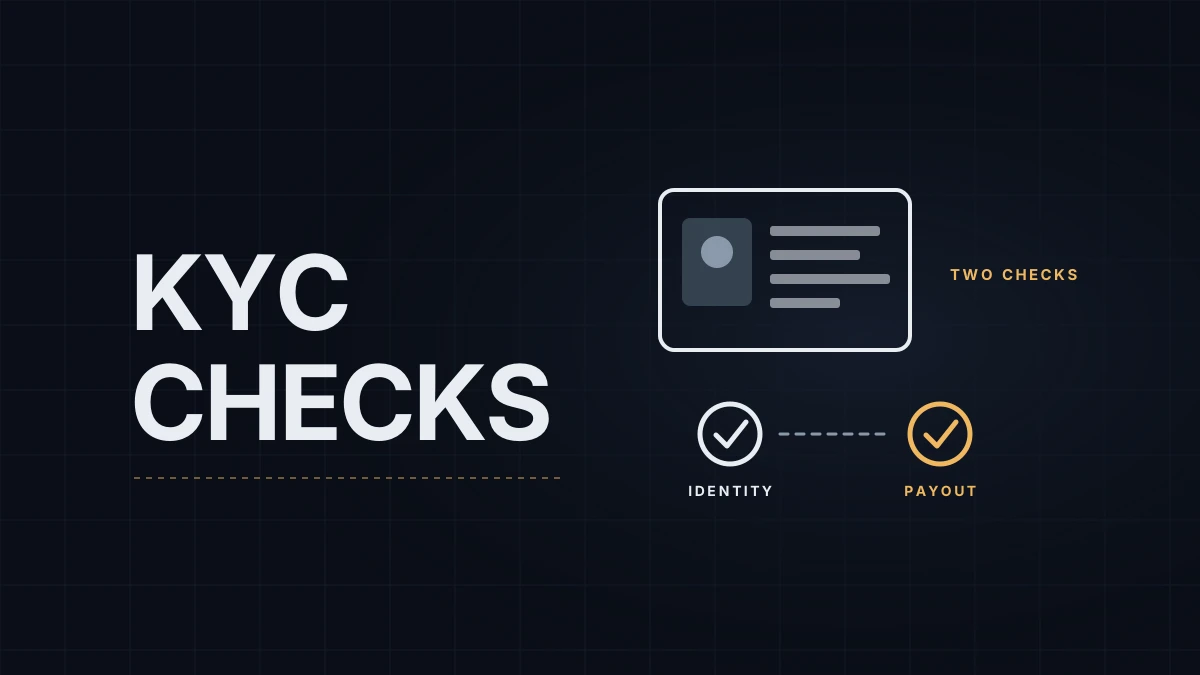
Two checks, not one
The firm's verification lets the firm pay you. The money then often moves through a payment provider, which runs its own identity check under its own rules. Firms using such providers say so in their help centers, and traders who discover it on payout day lose a few more business days. Where the firm allows it, open and verify the provider account as soon as you pass; at some firms the provider's invitation arrives only after your KYC or first payout is approved, so have the documents ready before then. The international payouts post covers the providers and transfer methods.
Five reasons it stalls
- A name that doesn't match. The name on the firm account, the ID, the address document and the bank or payout account must agree. A missing middle name or a married name on one of them is enough for a manual review.
- An old or unofficial address document. Older than the firm's window, a screenshot, or an address that differs from the one on the account.
- A country mismatch. Registering from one country and verifying from another, or living in a country on the firm's restricted list. Firms check location data during verification, and a VPN that hides it counts against you; the VPN and VPS rules post lists what each firm says.
- Accounts that look related. Identity is how firms enforce their account caps. Two people verifying from the same address or device can trigger a review; the multiple accounts post covers the household caps behind it.
- Leaving it until payout day. Verification that takes two days is fine in week one of a funded account and expensive when a payout is already approved and waiting.
None of this is unusual or a sign of a bad firm, as long as the firm states it up front. A firm that pays without checking anyone has a harder time staying open, and a payout that is held for KYC is a different thing from one that is denied over a trading rule, which the denied payouts post deals with.
Educational content, not investment advice. Futures trading involves substantial risk of loss. Examples are for illustration only. Read the full Risk Disclosure.