Trading Multiple Evaluations at Once: Diversification or Correlated Risk? The Math
Five copies of the same trade are one bet with five tickets, not five bets. What running several evaluations at once changes and what it doesn't: pass probability, drawdown per contract, the payout cap, the fee bill, and the one version of "multiple accounts" that diversifies anything.
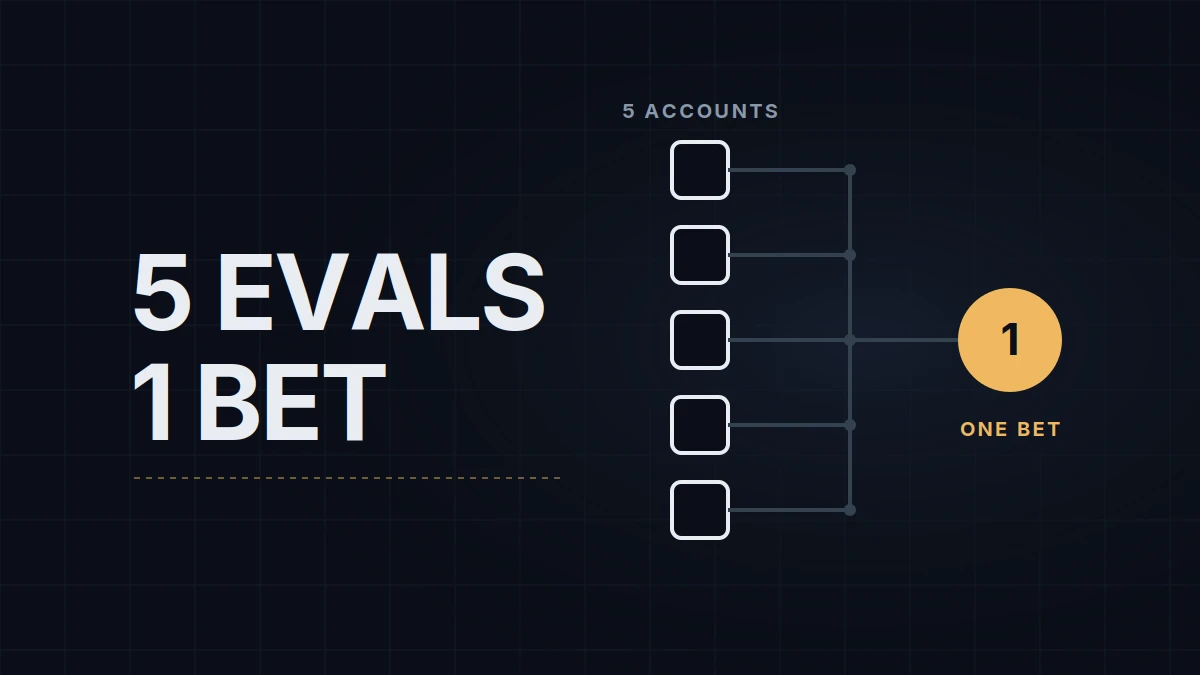
"If I run five evaluations and each has a 30% chance of passing, one of them should pass." That is the sentence behind most multiple prop firm accounts, and the arithmetic in it is right for lottery tickets and wrong for trading accounts. Five independent draws at 30% give an 83% chance that at least one wins (1 minus 0.7 to the fifth power). Five accounts taking the same trades from the same chart at the same second are one draw with five tickets, and the chance that at least one passes is 30%. Everything that follows is about which of the two situations you are in, because the fee bill is five times larger in both. If evaluations are new to you, the pillar post explains the model this post builds on.
Three ways to hold several accounts
Copied. One master account, N followers, a trade copier between them. Every account has the same entries, the same stops, the same day. The pass probability of the set equals the pass probability of one account, the consistency rule trips on all of them together, and a bad day is N bad days. What N buys is size: the same trade, N times over, on N separate max loss limits. This is the common version, and it is a sizing decision wearing a diversification costume.
Staggered. Trade one evaluation until it passes, then start the next while trading the funded one, and so on. The accounts still take the same trades once two are open, so nothing is diversified, but the risk is spread across time instead of stacked in one week: a losing streak in month one costs one fee, not five. The price is speed. Building five funded accounts this way takes five passes in sequence, and each later one is exposed to the streak that the copier version would have survived or not survived all at once.
Different. Different strategy, instrument or session on each account, which is the only version where the accounts can win and lose independently. It is rare in practice because a discretionary trader has one method, and the partial versions don't deliver: the same setup traded on ES in one account and NQ in another moves together most of the time, as the NQ vs ES post shows, and a morning-only account next to an afternoon-only account is two half-days of the same trader. Real independence costs N times the screen time and N methods worth trusting.
The rest of this post is about the first version, because it is the one people mean.
What N changes and what it doesn't
Take a public example: a 25K evaluation with a $1,000 max loss limit (MLL, the balance the account is closed at) for about $100 at list price at the time of writing, traded with one Micro E-mini Nasdaq-100 (MNQ) contract, which moves $2 per index point.
| 1 account, 1 MNQ | 5 accounts, 1 MNQ each | 1 account, 5 MNQ | |
|---|---|---|---|
| Fee to start | $100 | $500 | $100 |
| Loss on a 50-point stop-out | $100 | $500 total, $100 per account | $500 |
| Stop-outs to failure | 10 | 10 (all five fail on the same day) | 2 |
| Pass probability of the set | p | p | p, lower in practice: two stop-outs is a normal Tuesday |
| Payout requests when funded | 1 cap per cycle | 5 caps per cycle | 1 cap per cycle |
Two rows carry the argument. The five-account column has the same drawdown per contract as the single-contract column, ten stop-outs, because each contract sits on its own $1,000 line, while five contracts on one 25K get two. A firm sells drawdown by the account, so the copier is a way to buy $5,000 of room for $500 and trade five contracts on it, where one account of the same size would give two contracts that room. That is the honest reason to run copies, and it has nothing to do with probability. The scaling post covers the contract caps that decide where it stops.
The other row is the payout. Every funded account has its own payout rules: a cap per request, a minimum number of profitable days, a cycle. Five accounts mean five caps, and for a trader whose profit outruns a single cap, that is the second honest reason. Neither reason survives if the trades are not already profitable on one account. Multiplying a negative expectancy by five produces a larger negative number and a five times larger fee bill on the way there.
What N doesn't change is the only risk that matters. A day that costs you 3% of one account costs 3% of every account. A rule you trip, you trip everywhere; a consistency rule (a cap on how much of the profit may come from one day) that blocks one payout blocks all five. The firms know this, which is why they cap the funded stage rather than the evaluation stage: at the time of writing Apex allows unlimited evaluations but 20 funded accounts per household, Topstep sells unlimited Combines but allows five Express Funded accounts and one Live account, and Lucid (affiliate link) caps a household at ten evaluations and five funded accounts. Copying between your own accounts is permitted at all three, in the same direction, and the copier rules post has the wording.
Sizing N
Because N is size, the way to choose it is the way to choose contracts: from the drawdown and the stop, not from the pass rate. If a trader's method needs about ten stop-outs of room to survive an ordinary losing streak, and the stop-out on their setup costs $100 per contract, then one contract per $1,000 of MLL is the ceiling, and N is however many $1,000 lines they can afford to lose in fees during the months it takes to find out whether the method works. Buying more accounts to raise the chance of a pass does nothing to the chance and everything to the bill.
I run followers of the same size as the master and treat the count as a contract count, changed for the same reasons and at the same pace as contracts would be on one account. The copier that does it is free and lives in NinjaTrader; the setup is a post of its own in the Tools topic.
Educational content, not investment advice. Futures trading involves substantial risk of loss. Examples are for illustration only. Read the full Risk Disclosure.