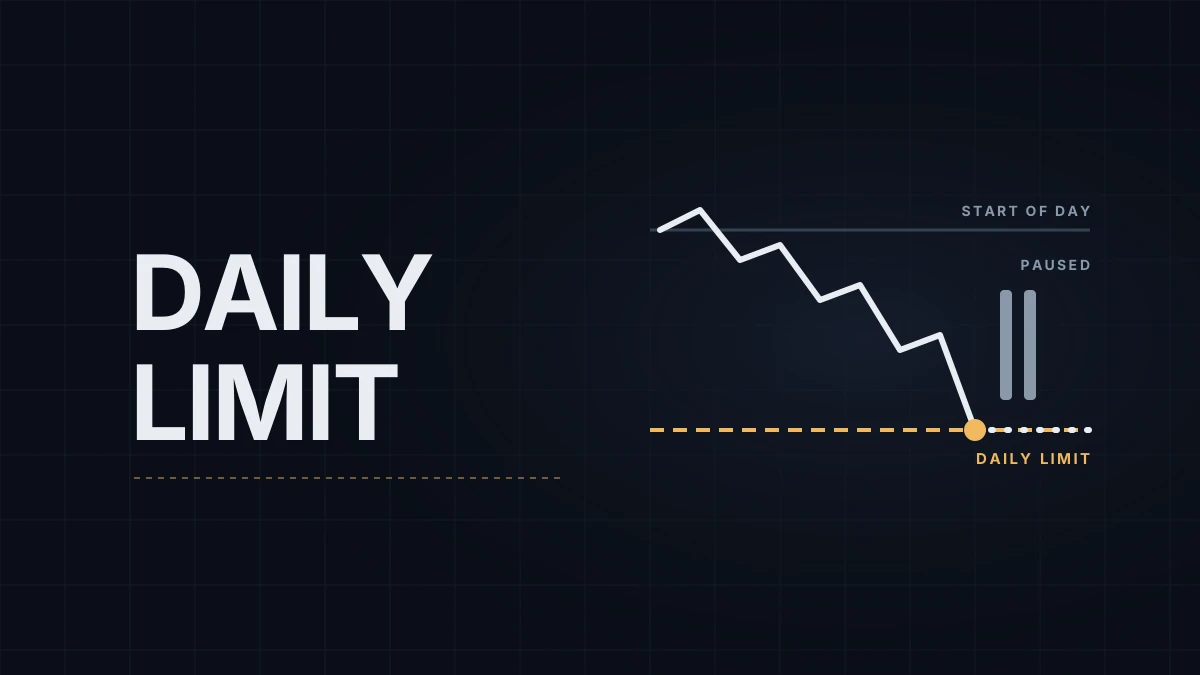
A daily loss limit (DLL) caps how much an account can lose in one trading day. A max loss limit (MLL), the trailing or static drawdown covered in the trailing drawdown guide, caps how much it can lose in total. The difference in consequence is the whole point: at most futures prop firms today, hitting the DLL ends your day, while hitting the MLL ends the account. Both sit in the rulebook described in the prop firm evaluation guide, and traders mix them up more often than any other pair of rules.
Three ways firms use a daily limit
A soft pause. When net P&L for the day reaches the limit, the platform flattens your positions, cancels working orders and blocks new ones until the next session. The account survives. This is the common model among US futures firms at the time of writing.
A hard breach. The account fails the moment the daily loss is exceeded, the same as hitting the max loss. Futures firms have mostly moved away from this, but it remains standard in many forex and CFD challenges, and older or smaller futures firms still use it. If a rulebook says "violation" or "breach" next to the daily limit, read it as this kind.
No daily limit at all. The max loss is the only floor. More freedom on a bad day, and nothing stops a bad day from becoming the last one.
The rule at three firms, at the time of writing
| Firm and account (50K) | Daily loss limit | Max loss | When the DLL is hit |
|---|---|---|---|
| Topstep Trading Combine and Express Funded | Optional, $1,000 | $2,000 | Positions flattened, orders cancelled, trading stops until the next session; not a rule violation |
| Topstep Live Funded | Automatic, $2,000 | Balance-based | Same pause |
| Apex Trader Funding, EOD accounts | $1,000; fixed in the evaluation, rising with the scaling levels in the funded account | $2,000 | Account stays active; resets at 6:00 PM ET |
| Lucid Trading, LucidPro | Optional, $1,200 (funded: 60% of the best end-of-day profit once the balance closes above $52,100) | $2,000 | Trading locked until the next session |
| Lucid Trading, LucidFlex | Optional, chosen at purchase | $2,000 | If switched on, trading locked until the next session |
Topstep sells the optional DLL with a small discount on its no-activation-fee Combines ($10 off the 50K), calling it a Responsible Trading Discount. Apex keeps the evaluation limit fixed, raises it in the funded account as the account moves up its scaling levels, and never drops it below the first-level amount. Lucid lets you switch its limit on or off when you buy a LucidFlex or LucidPro account; with it on, the evaluation costs less and the funded account gets on-demand payouts.
The arithmetic that matters
On a 50K account with a $2,000 max loss and a $1,000 DLL, two maximum-loss days in a row end the account, even though neither day broke a daily rule. With a $1,200 DLL, the second bad day ends it partway through, after $800. The DLL protects you from one catastrophic session; it doesn't protect you from two ordinary bad ones. A trader who sizes so that a typical losing day costs $300 has six or seven bad days of room; one who regularly runs into the DLL has two.
Three details change how the limit behaves in practice:
- Open positions count. Topstep measures the DLL against net P&L for the day, and the pause flattens open positions when it triggers. A trade that is down past the limit stops your day before you've decided to close it.
- The day doesn't always reset when you expect. Apex counts most holiday and half-day sessions together with the next full trading day, and the DLL doesn't reset in between. Thanksgiving week and Christmas Eve are the usual cases.
- The limit is per account. With five accounts on a copier, each hits its own DLL. A copier that keeps sending orders to a paused account produces rejections, not trades, and the accounts drift out of sync; the copier rules post covers what firms allow there.
Should you choose one when it's optional?
Arguments for: it stops the revenge-trading spiral at a fixed number instead of at the max loss, and it costs nothing extra: Topstep takes a few dollars a month off its No Activation Fee Combines, and Lucid prices its evaluations lower with the limit on. Arguments against: it can end a day you'd have recovered, and a firm-set limit isn't tuned to your strategy. Many traders get the protection without the trade-off by setting their own, tighter limit in the platform, below the firm's number; the NinjaTrader daily loss limit guide shows how. A personal limit at 40% of the max loss gives you two and a half bad days of room instead of two, and you choose where it sits.
Educational content, not investment advice. Futures trading involves substantial risk of loss. Examples are for illustration only. Read the full Risk Disclosure.