When to Stop Trading an Evaluation: Drawdown Left, Days Left and the Math of Walking Away
A damaged evaluation measured in days instead of dollars: losing days left, winning days needed, trading days on the clock. Simulated odds for a fresh and a damaged account, the fee arithmetic of walking away, and the firm rules (clocks, rebills, inactivity) that change the answer.
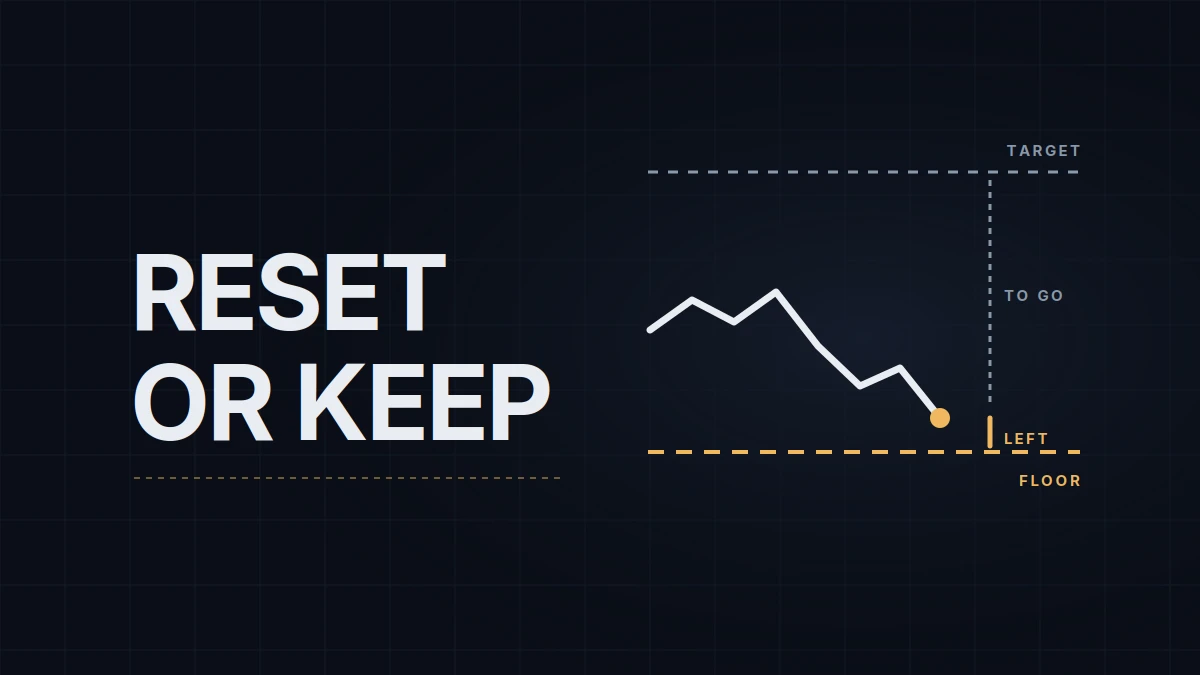
Take an evaluation that has gone wrong without ending: a 50K account with a $3,000 profit target and a $2,000 end-of-day trailing drawdown, down $1,300 after a bad week. That leaves $700 of drawdown and $4,300 to the target. Should you reset your evaluation, stop trading it, or keep going? Three numbers and one fact about the firm decide it, and the fee arithmetic points the opposite way from most traders' instinct.
The account and its rules are hypothetical. The drawdown trails the highest end-of-day balance and stops trailing once it reaches the starting balance, so this account's floor still sits at $48,000. How trailing drawdowns work in general is in trailing drawdown explained, and the evaluation itself in the pillar.
Three numbers, counted in days
Dollars hide the problem; days show it. Divide the drawdown left by a typical losing day, divide the distance to the target by a typical winning day, and count the trading days left on the clock, if the evaluation has one. Take a hypothetical trader whose days are winners of $450 or losers of $300 in equal proportion, with one day in ten flat, which works out to $67.50 on an average day:
| Fresh account | This account | |
|---|---|---|
| Drawdown left | $2,000 | $700 |
| Losing days it can absorb | 6.7 | 2.3 |
| Distance to target | $3,000 | $4,300 |
| Winning days needed, net | 6.7 | 9.6 |
Both accounts span the same $5,000 from floor to target. The damaged one starts much closer to the floor, and for any fair bet that position is the whole story: with no edge and a floor that stays put, the chance of reaching the target before the floor is close to the cushion divided by the full span. That's 2,000 ÷ 5,000 = 40% for the fresh account and 700 ÷ 5,000 = 14% for this one. For a trader with an edge the formula is the pessimistic case; for one whose costs outweigh the edge, it's the optimistic case. A trailing floor lowers all of these odds, because it follows every new high.
What 40,000 simulated paths say
Each cell below is 40,000 simulated evaluations with the same hypothetical trader and rules; without an edge their winning days shrink to $300, and half size halves every day's result. A pass means reaching the target before the floor; paths that run out of days count as neither.
| Account | No edge, no clock | Edge, no clock | Edge, 21 trading days left | Edge, 11 trading days left |
|---|---|---|---|---|
| Fresh | 28% | 77%, median 29 days | 23% | 5% |
| This account, full size | 11% | 51%, median 39 days | 5% | under 1% |
| This account, half size | 10% | 79%, median 108 days | 0% | 0% |
Without a clock, a damaged account traded by someone with an edge still passes about half the time. At half size, with the stop where the setup puts it and half the contracts, it passes as often as a fresh account, only far more slowly. Without an edge, halving the size changes almost nothing (11% against 10%), as the fair-bet rule predicts: size changes how long the walk takes, not where it tends to end.
A clock changes everything. Twenty-one trading days take this account from 51% to 5%, and eleven take it under 1%. Even the fresh account ends on the clock in 68% of the 21-day paths, which says as much about the fit between a trader making $67.50 a day and a 30-day evaluation as about any single account.
The fee arithmetic
An account that hasn't breached costs nothing extra to keep trading, which makes it a free second chance. Say a reset costs $100 and, for this trader, a fresh account passes 77% of the time. Restarting now, the expected fees until a pass are $100 ÷ 0.77, about $130. Trading the damaged account first and restarting only if it breaches cuts that to (1 − 0.51) × $130, about $64. As long as continuing costs nothing, walking away from an account that's still alive is never the cheaper choice.
Four situations change that arithmetic:
- A clock. At Apex, at the time of writing, an evaluation is a one-time fee for 30 consecutive calendar days, weekends included, with no resets; when the days run out the account expires and can't be extended. The remaining days cost nothing, but the table shows what they're worth toward a pass once most of the cushion is gone. What they're still worth is practice under real rules, traded exactly as a fresh account would be.
- A rebill. At the time of writing, Topstep rebills its evaluation, the Trading Combine, every 30 days, lets you reset an active account at any time rather than only after a breach, and moves the rebill date to 30 days after the reset; each rebill also banks a reset credit. That makes the rebill date the natural moment to compare the damaged account with a fresh one.
- Inactivity. At Lucid a LucidFlex evaluation has no clock at the time of writing, but the inactivity policy deletes any account that hasn't been traded to at least $1 of profit or loss within 30 calendar days.
- The trader. The odds above belong to someone who trades the damaged account exactly like a fresh one. Pressing size to get it back, or taking marginal trades to hurry, makes a different trader with worse odds; the reset post lists the signs.
The rule, written down
- Can the account take one normal loss? If the drawdown left is smaller than a full stop at your normal size, the next ordinary trade can end it. Size down to what the cushion covers and leave the stop where the setup puts it. On the E-mini Nasdaq-100 (NQ) a 40-point stop costs $800 a contract, more than the whole $700; on the Micro E-mini Nasdaq-100 (MNQ) the same stop costs $80. Position sizing has the method.
- Does the clock leave enough days? Divide the distance to the target by your average day. If the answer is larger than the trading days left, the clock is the likelier end, and the account has become practice rather than a pass attempt.
- Is a rebill or an inactivity deadline coming? That date is when to decide, not the evening after a loss.
- Can you trade it like a fresh account? If not, stop for the day and decide tomorrow.
I trade LucidFlex evaluations on Lucid (affiliate link), which have no clock, so the calendar never decides for me. I keep each one at a single MNQ, which leaves no size to cut when the cushion shrinks. The stop stays where the setup puts it, because a stop moved to fit the account is a different strategy from the one that built the account.
Educational content, not investment advice. Futures trading involves substantial risk of loss. Examples are for illustration only. Read the full Risk Disclosure.