Stop Belongs to the Setup, Size Belongs to Capital
The most common sizing question bundles two decisions that have nothing to do with each other. Where the stop goes is a fact about the trade; how many contracts is a fact about the account. One division connects them — and running it backwards is how evaluations end.
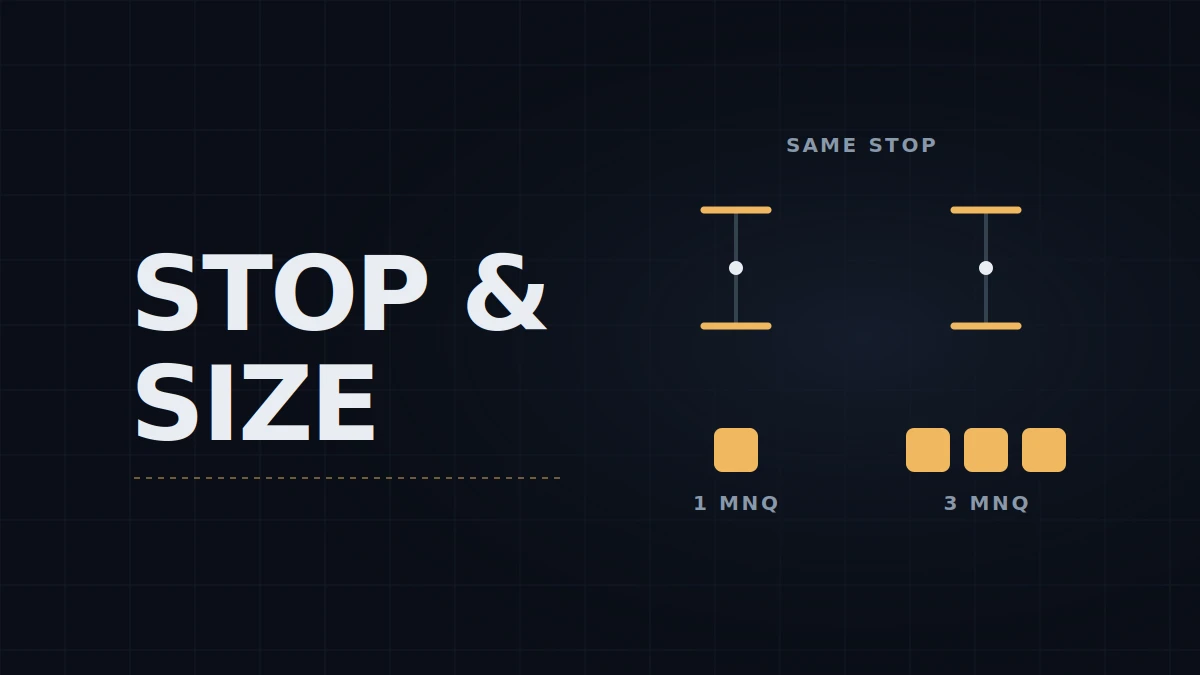
"How many contracts should I trade?" is the most common position sizing question in futures, and it can't be answered the way it's asked, because it bundles two decisions that have nothing to do with each other. Where your stop goes is a fact about the chart in front of you. How many contracts you carry is a fact about your account. Sizing gets simple, almost mechanical, the moment you stop letting one decision contaminate the other.
Start with the stop, because the market sets it, not you. A stop is the price at which the trade idea is wrong: past the level that made you enter, beyond the distance that counts as ordinary noise around it. If price trades there, the reason you got in no longer exists, and the position is just exposure with a story attached. That distance comes from structure — where the level sits, how wide the current rotations are — and it changes with conditions. My own stops are situational for exactly this reason: the same setup needs more room on a fast day than on a quiet one, and pretending otherwise doesn't make the noise any smaller.
Notice what's absent from that paragraph: your account balance. The chart has no idea how much money you have.
Size is the opposite. It's pure arithmetic on the account: decide what one trade is allowed to cost in dollars, price the stop per contract, divide.
Worked through on a common evaluation structure — a 25K account with a $1,000 max loss limit, the trailing drawdown that ends the account if you touch it: giving one trade a tenth of that room means a budget around $100. Say the setup needs 40 points. On the E-mini Nasdaq-100 (NQ) a point is worth $20, so the stop costs $800 per contract. It doesn't fit, and no amount of wanting it to fit changes the division. On the micro (MNQ) a point is $2, the same stop costs $80, and the arithmetic returns one contract. The instrument and the size fell out of the account; the stop never moved. If the dollar cost of a point is new to you, NQ vs MNQ: what a 20-point move actually costs covers it.
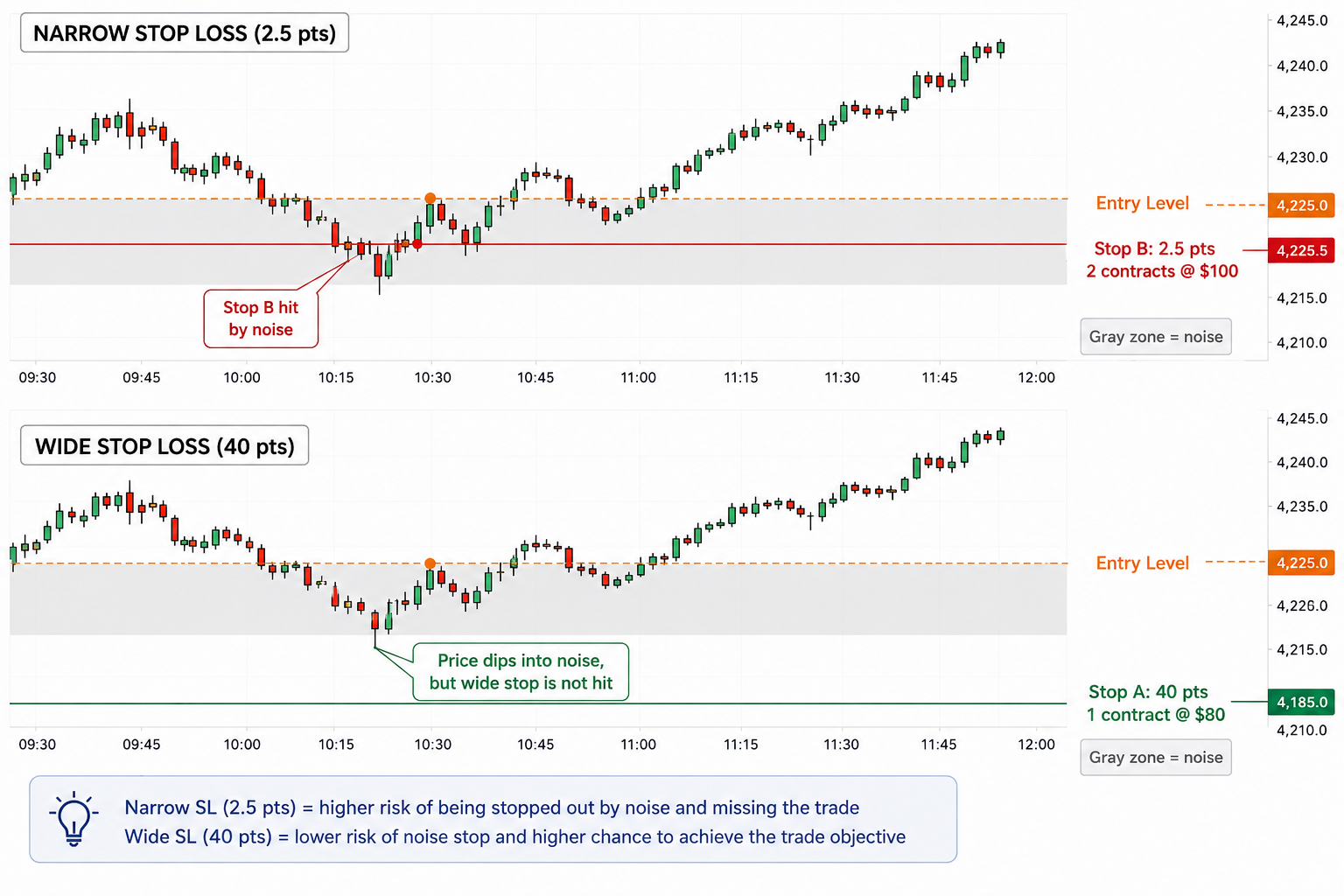
Run the same process backwards and you get the version that ends evaluations. Pick the size first, because two contracts feel like progress. Now a $100 budget spread across 2 NQ contracts allows 2.5 points of stop — ten ticks, on an index that rotates ten ticks while you blink. The stop sits inside ordinary noise, so it gets hit by movement that means nothing, over and over, on trade ideas that were never given the chance to be right or wrong. The chart below is the same entry twice: once with the stop the structure asked for, once with the stop the size allowed.
Sometimes the honest division returns zero. The proper stop on the smallest contract costs more than the budget: a wide, fast day, a level with a lot of air under it. That isn't a sizing problem to engineer around; it's the account telling you this trade isn't for you today. Skipping it costs nothing. Taking it anyway costs the difference between your budget and reality, billed on every attempt.
The setup tells you where you're wrong. The account tells you how much wrong you can afford. Keep the two answers in that order and sizing stops being a feeling.
Educational content, not investment advice. Futures trading involves substantial risk of loss. Examples are for illustration only. Read the full Risk Disclosure.