Nasdaq-100 Weights: Top Holdings, the December Reconstitution and Why Seven Stocks Move NQ
Ten securities are 47% of the Nasdaq-100. The top ten with their weights at the time of writing, the float and concentration rules behind them, the December 2026 reconstitution dates, and the weight-times-move arithmetic that lets one earnings report move NQ overnight.
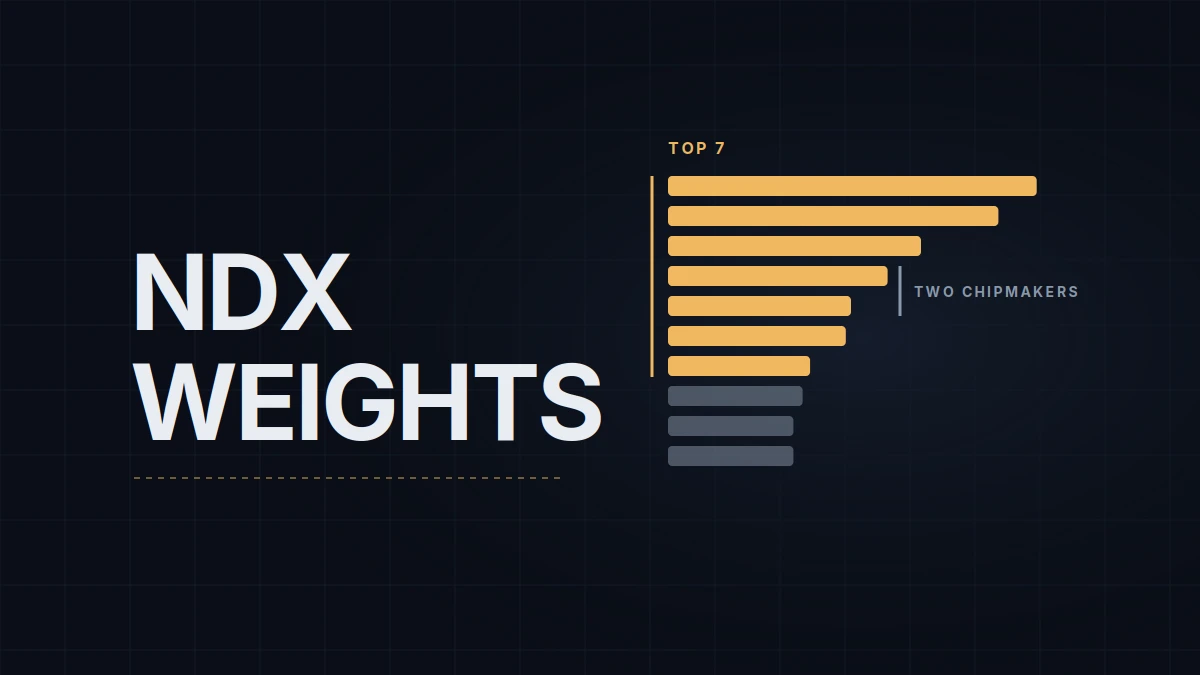
Ten securities made up 46.77% of the Nasdaq-100 at the start of October 2026, measured by the holdings of QQQ, the exchange-traded fund that tracks the index. Everything else in it shared the remaining 53%. Those Nasdaq 100 weights are why one earnings report can move NQ, the E-mini Nasdaq-100 future, further than most economic releases do, and why the index has rules for trimming its largest members. NQ tracks the index point for point; what a point is worth on NQ and on the micro, MNQ, is in the NQ vs MNQ pillar.
The top ten at the time of writing
The table is QQQ's holdings on October 2, 2026. The fund holds the index's stocks at almost exactly the index's weights, and both drift every trading day as prices move.
| Rank | Company | Ticker | Weight |
|---|---|---|---|
| 1 | NVIDIA | NVDA | 8.43% |
| 2 | Apple | AAPL | 7.28% |
| 3 | Microsoft | MSFT | 5.75% |
| 4 | Micron Technology | MU | 5.01% |
| 5 | Advanced Micro Devices | AMD | 4.27% |
| 6 | Amazon | AMZN | 4.06% |
| 7 | Meta Platforms | META | 3.24% |
| 8 | Alphabet, class A | GOOGL | 3.01% |
| 9 | Tesla | TSLA | 2.91% |
| 10 | SpaceX | SPCX | 2.81% |
Alphabet's class C shares sit just below the table, in eleventh place at 2.81%. The two share classes add up to 5.82%, which makes Alphabet the third-largest company even though neither class makes the top five on its own. Counted by company, the seven largest are NVIDIA, Apple, Alphabet, Microsoft, Micron, AMD and Amazon, and together they weigh 40.62%. Two of them are chipmakers that were never part of the "Magnificent Seven" label from 2023; Meta and Tesla, which were, now rank below them. Add Intel (2.59%) and Broadcom (2.53%) and five semiconductor companies account for 22.83% of the index.
How a weight is set
The Nasdaq-100 holds 100 of the largest non-financial companies whose primary listing is on a US Nasdaq exchange. Banks, insurers and anything else classified in the financial industry are excluded by rule, which is one reason the index looks so different from the S&P 500.
A company's weight starts from its market value, price times shares, with one adjustment: the share count used is the lower of the shares outstanding and three times the free float, the shares that change hands. SpaceX shows what that does. It went public in June 2026 and entered the index on July 7 under the Fast Entry rule, which lets a company whose market value would rank inside the index's current top 40 join early; a new listing typically goes in after 15 trading days. Its market value would put it between Amazon and Meta in the table above, yet it is tenth, at 2.81%, because only a small part of its shares trade.
Then come the caps. In March, June and September, Nasdaq checks two limits: no company above 24%, and the companies weighing more than 4.5% no more than 48% together. If either is broken, weights are cut back, a single company to 20% and the heavy group to 40%. The same limits can force a special rebalance between scheduled dates, as on July 24, 2023, when the largest members had grown too heavy. In December the reconstitution resets the weights instead, with extra limits on single securities: one above 15% is cut to 14%, and if the five largest reach 40% together they are brought down to 38.5%, with every other security capped at 4.4%. At the time of writing the weights sit well inside those limits, with the five companies above 4.5% at 32.3%, largely because the caps have already trimmed the largest companies. On market value alone NVIDIA would be 13% to 14% of the index, not 8.43%, and a December reset run on today's prices would cut the biggest names back again.
When the list changes
The main scheduled change to membership comes once a year, in December. Companies are ranked on their market value on the last trading day of November, which in 2026 is Monday, November 30. Nasdaq announces the result after the close on the sixth trading day before it takes effect, and it takes effect at the open on the first trading day after the third Friday of December. For 2026 that points to an announcement after the close on Friday, December 11, and changes effective Monday, December 21. In 2025 the announcement came on December 12, and six companies went in while six came out.
Between Decembers the quarterly rebalances change weights and remove any member that has dropped out of the top 125 by market value, Fast Entry adds the occasional giant new listing, and a company that is acquired or delisted gets replaced. Index funds trade December's changes at the close on Friday, December 18, the same day the December NQ contract settles.
Why seven stocks move NQ
The arithmetic is weight times move. NVIDIA at 8.43% rising 5% after earnings adds about 0.42% to the index. With NQ near 31,400 at the time of writing, that is roughly 130 points from one stock: $2,600 on an NQ contract, $260 on an MNQ. If the seven largest companies rise 2% together, the index gains about 0.81%, some 250 NQ points, and the rest of the index would have to fall about 1.4% on average to cancel it.
The big names also tend to move together, which is why their moves add up instead of canceling. Five of the thirteen largest holdings sell chips into the same data-center spending, and a report from one of them moves the others the same evening.
Earnings are where the weight shows. Most large members report after the 4:00 PM ET close (22:00 CEST). The cash index stops calculating at the close, but NQ keeps trading on CME Globex until 5:00 PM ET and again from 6:00 PM ET, so the main market pricing an after-hours report for the whole index is the future; the index catches up at 9:30 AM ET the next day. Micron, the fourth-largest weight, reported its fiscal fourth quarter after the close on September 30, 2026. On the usual calendar most of the rest of the top ten report between late October and early November, and NVIDIA has scheduled its report for November 17. The economic releases post puts these reports next to CPI and payrolls as NQ's own tier-1 events, and what a night like that leaves on the chart is in the overnight session post.
I trade the European morning, so an after-hours report is about eleven hours old when my session opens and already in the price. What it leaves me is the high and low the night has made by then, which go on the chart with the other levels.
Educational content, not investment advice. Futures trading involves substantial risk of loss. Examples are for illustration only. Read the full Risk Disclosure.