US and EU Clocks Change on Different Dates: NQ Session Times from October 25 to November 1 (and Every Spring and Fall)
CME never changes its clock, so US traders see nothing move. Everyone else does, twice a year, and for one week each fall and two or three each spring the US and European clocks are out of step. The NQ session table for that week, the spring version, and what to check in NinjaTrader.
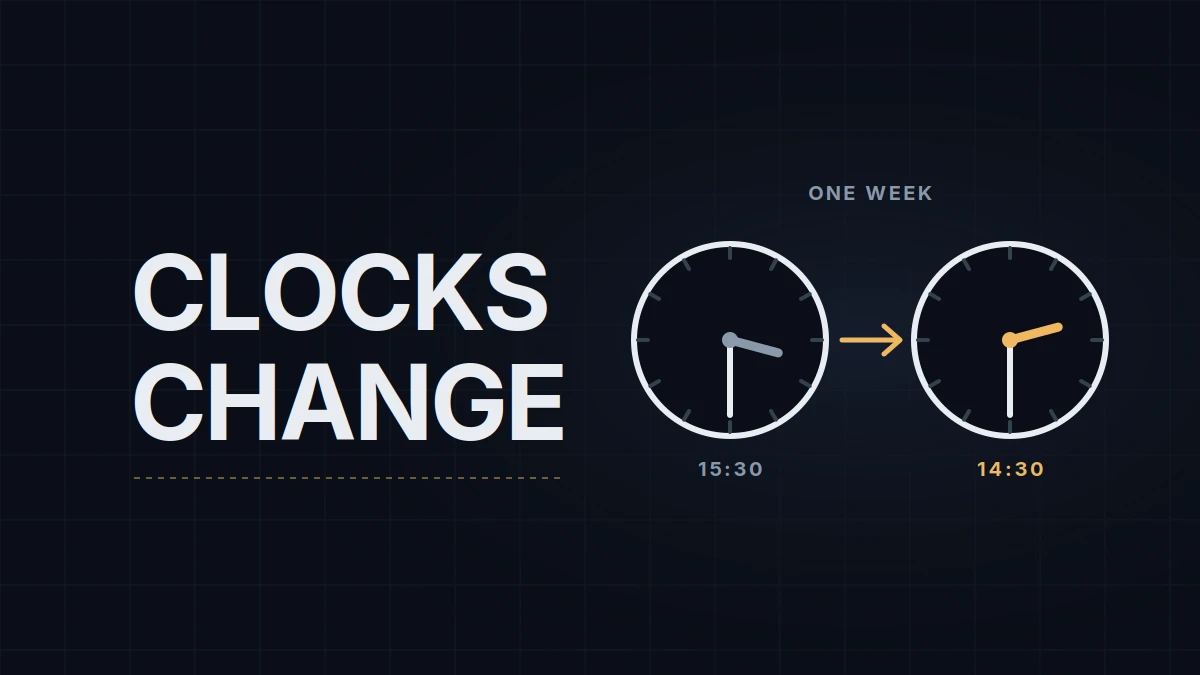
Europe sets its clocks back on Sunday, October 25, 2026. The United States does the same on Sunday, November 1. For the five trading days in between, the usual six-hour gap between New York and Central Europe is five hours, and every session time a European trader knows by heart moves one hour earlier: the E-mini Nasdaq-100 (NQ) regular-hours open lands at 14:30 CET instead of 15:30, and the 8:30 AM ET data releases print at 13:30. The normal NQ trading hours are in the sessions post; this one covers the weeks when they don't apply, and the reason behind them, which is the same every year.
The week of October 26 to 30, 2026
CME defines the Globex session in Chicago time: NQ trades from 5:00 PM to 4:00 PM Central the next day, with a maintenance halt from 4:00 to 5:00 PM, Sunday evening through Friday afternoon. Those hours don't move. What moves is how they translate into a clock that changed on a different date.
| Event | ET (unchanged) | Normal CEST/CET | October 26 to 30 |
|---|---|---|---|
| Globex reopen (Sunday to Thursday evening) | 6:00 PM | 00:00 | 23:00 CET |
| Tokyo cash open | 8:00 PM | 02:00 CEST until October 24, then 01:00 CET | 01:00 CET |
| European cash open (Frankfurt, Paris) | 3:00 AM | 09:00 | 09:00 CET (4:00 AM ET for US readers) |
| London cash open | 3:00 AM | 09:00 | 09:00 CET (4:00 AM ET for US readers) |
| US data at 8:30 AM ET (CPI, NFP, GDP) | 8:30 AM | 14:30 | 13:30 CET |
| RTH open (US cash open) | 9:30 AM | 15:30 | 14:30 CET |
| 10:00 AM ET data (ISM, consumer sentiment) | 10:00 AM | 16:00 | 15:00 CET |
| FOMC statement | 2:00 PM | 20:00 | 19:00 CET |
| US cash close | 4:00 PM | 22:00 | 21:00 CET |
| Globex daily halt | 5:00 PM | 23:00 | 22:00 CET |
Read the ET column as fixed. The US clock hasn't changed yet, so a trader in Chicago or New York sees the same 9:30 AM open they always see. The only thing that moves for them that week is Europe: the Frankfurt and London opens arrive at 4:00 AM ET instead of 3:00, and on Sunday, November 1 the Tokyo open, which has no daylight saving at all, moves from 8:00 PM to 7:00 PM ET and stays there until March.
The first affected session is Sunday, October 25, when Globex reopens at 23:00 CET rather than midnight. The last is Friday, October 30. From Monday, November 2 the six-hour gap is back and the winter table applies: RTH opens at 15:30 CET, data at 14:30, Globex reopens at midnight.
Why it happens, and the spring version
The two regions use different rules. The European Union and the United Kingdom switch on the last Sunday of March and the last Sunday of October. The United States switches on the second Sunday of March and the first Sunday of November. In the fall Europe moves first, so the mismatch lasts one week. In the spring the US moves first, and the mismatch lasts two or three weeks, during which the RTH open is again at 14:30 CET.
| Spring mismatch (RTH at 14:30 CET) | Fall mismatch (RTH at 14:30 CET) | |
|---|---|---|
| 2026 | March 8 to March 28 (three weeks) | October 25 to October 31 (one week) |
| 2027 | March 14 to March 27 (two weeks) | October 31 to November 6 (one week) |
Japan, China and India don't observe daylight saving, so the Asian block of the Globex session moves for everyone else twice a year and never for them. Australia switches in the opposite direction (its clocks go forward in October), which is why the Sydney open drifts around the ET table by two hours across the year.
What to check on your side
NinjaTrader 8 handles the exchange side by itself. The built-in trading-hours templates (CME US Index Futures ETH and RTH) are defined in the exchange's time zone, and the platform converts them to the display zone set under Tools › Settings › General (Options in older builds), so session boundaries, daily bars and the RTH shading on a chart stay right through both mismatch weeks. What breaks is anything you defined in your own local time: a custom trading-hours template with a 15:30 session start, an alert set to fire at 14:25 before the 8:30 print, or a habit. The economic calendar lists release times in ET with an ET / Local switch that converts them to your zone, which is the one check that catches all three.
For a European trader who works the morning and goes flat before the US releases, the week shortens the window by an hour and moves the flat-before-data cutoff to 13:25 CET. I mark both changes on the calendar the Friday before, because the first session of the mismatch is the one where the 8:30 print arrives while the chart still looks like 13:30.
Educational content, not investment advice. Futures trading involves substantial risk of loss. Examples are for illustration only. Read the full Risk Disclosure.