NQ Week Ahead (Aug 31–Sep 4, 2026): Payrolls, Broadcom and a Fed That Isn't Finished
Last week's post carried two roadmaps and the market traded both: the downside path early, the upside path late, ending with a rejection at 29,800. Now NQ sits inside balance with a Fed that sounds unfinished, payrolls on Friday and Broadcom midweek. Levels, scenarios and calendar inside.
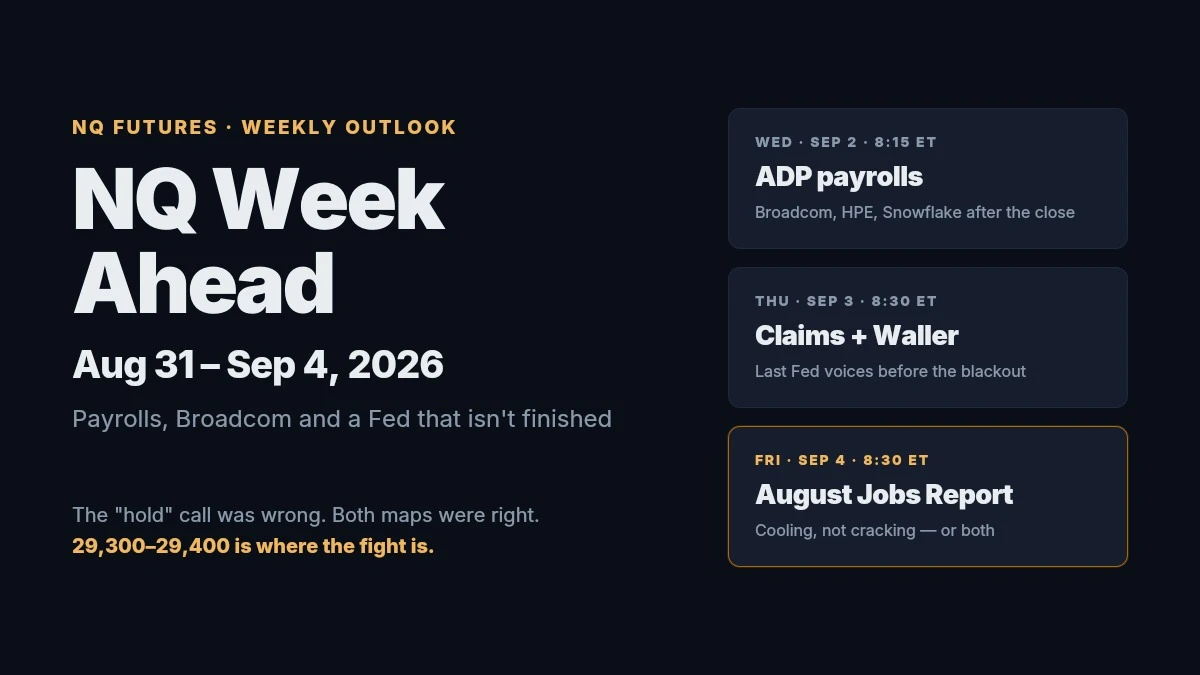
Week three of the series. Same format as always: where the market stands, what's on the calendar, and the levels I'm working with going into the week.
Last week's post carried two roadmaps. The market traded both of them.
The early sessions belonged to the downside path from that post: 29,280, then a loss of 29,200, then expansion toward 29,050. The line I said bulls had to hold — 29,300 — did not hold. From midweek on, the other roadmap took over: 29,400 reclaimed, a rotation back through the 2026 point of control, 29,680, and finally 29,800, which Friday tagged early and then spent the rest of the session giving back.
So the honest score is this: the "hold" call was wrong, and both maps were right. What I got wrong was the sequence. What the map got right was the locations. For a reversal trader that's the only split that matters — the locations are the trade, the sequence just decides which way you're facing when you get there.
What Actually Happened
The week had three distinct phases, and each one had a different driver.
Phase one: sellers. Soft housing and consumer prints early in the week — July new-home sales dropped hard, consumer confidence weakened — were the first real evidence that borrowing costs are biting somewhere. That took some pressure off yields, and the Treasury's expanded buyback plan for the long end helped too, but NQ still couldn't hold 29,300. Support failed, the gap below opened, and the downside roadmap traded through 29,200 toward 29,050.
Phase two: the offset. Midweek brought the inflation print the Fed cares about most. Headline PCE came in at 3.7% year-over-year against 3.6% expected; core stayed at 3.3%. That's not progress toward 2%, it's a plateau above 3%, and rate markets responded by pricing more September hike risk. And yet the index rallied — because Nvidia reported the same night. Another beat, guidance for roughly 70% revenue growth next fiscal year, the stock up close to 9%, and the Nasdaq up 1.6% on Thursday. One earnings report absorbed a hot inflation number. That's the regime in a single day.
Phase three: the Fed. Jackson Hole turned hawkish before the Chair even spoke. Schmid questioned whether policy is restrictive at all; Hammack repeated that she's ready to raise. Then Warsh on Friday: the 2% target is not moving, progress so far is modest, financial conditions show little sign of restraint, and if confidence in disinflation doesn't build, the Fed has more to do. September hike odds went from roughly 40% before the speech to about 55% after it, the 2-year pushed toward 4.31%, the dollar strengthened. NQ printed 29,800 and rejected back into the range.
The Macro Backdrop in Two Minutes
The cleanest way to describe last week: the inflation side won the argument, and the growth side kept the tape from breaking.
Pushing on NQ:
- Sticky inflation with no urgency to ease. PCE at 3.7% headline and 3.3% core, while Q2 GDP held at 1.5%, consumer spending was revised up to 3.4% and weekly claims fell to 203K. A Fed facing sticky prices, solid consumption and no layoffs has no reason to be gentle — and it said so.
- A market now pricing a September hike as a coin flip, with the front end repricing to match.
- Trade friction back on the board: 50% tariffs on Canadian vehicles and parts from January 1 after talks collapsed, Canadian retaliation starting in September. That's a goods-price problem for Q4.
Holding NQ up:
- AI capex, again. Nvidia's beat and guide kept the semiconductor complex bid through a week where rates alone would have argued for lower.
- Oil, in the right direction for once. Despite expanded Iran sanctions, secondary-sanction threats and Iranian rhetoric about Hormuz, tanker traffic improved and Iran–Oman progress on managing Strait transit eased the immediate supply fear. Brent and WTI headed for weekly losses of more than 5%, which takes a little heat out of the inflation narrative.
- The first genuine cracks in rate-sensitive data — housing and confidence — which the bond market has started to notice.
Net: the Fed is closer to a hike than a cut and the market knows it; what keeps NQ from breaking down is earnings and cheaper oil. That's a standoff, and standoffs produce ranges.
Where the Market Stands Now
NQ closed the week back inside the balance that has defined the past two weeks. Thursday and Friday were spent almost entirely inside the 2026 high-volume node, around the year's point of control — the same area buyers failed at two weeks ago and reclaimed last week. It is the fulcrum of the year, and it's where price is sitting right now.
The compression around it is unusually tight:
- The 5-day, 20-day and 50-day SMAs are all clustered near the node.
- Several anchored VWAPs — from the all-time high, the summer low and the April pivot — converge in the same area.
- Implied volatility is suppressed; the VIX hasn't expanded on any of this.
- QQQ still carries open gaps both above and below — unfinished business in both directions.
When that many references overlap in one zone, the market is telling you it hasn't decided. And the calendar says the decision is coming: new month today, the September contract roll in about two weeks, the end of Q3 four weeks out. Historically this is where volume and range start expanding — but start is the operative word. The first days of September rarely resolve the summer range; they set up the fight.
For how I trade, this is the regime Key Level Reversal is built for. Compression around a confluence zone means failed moves, reclaims and short bursts from the wrong-footed side — exactly what a level-based reversal setup feeds on. It's the breakout trader who has to wait.
The Level Map
The central reference this week is the prior-week high at 29,800 and the value structure below it. Reading from the top down:
Above the prior-week high
- 30,050 → 30,115 → 30,255 — the band of overhead inventory. Only a target after acceptance above 30,000.
- 30,000 — the round number and the gate to that band.
- 29,870 → 29,920 — first objectives if 29,800 is taken and held. 29,870 is the level the Aug 17 map keyed off; it hasn't stopped mattering.
- 29,800 — prior-week high, Friday's rejection. The most important line above.
Inside the balance
- 29,700 — the sellers' line after Friday. While price trades below it, downside rotations stay live.
- 29,550–29,700 — the 2026 HVN / year POC zone (≈29,575 on my profile). The densest two-way trade of the past fortnight. First visits get responsive selling; sustained trade above 29,700 changes the map.
- 29,300–29,400 — the gap area plus the 5-day SMA. Also last week's "hold" line that broke and got reclaimed. This is where I expect the fight.
- 29,225 — prior-week POC. Lose it and the map flips.
Below the balance
- 29,000 / 28,946 — prior-week value area low and the lower daily Bollinger Band. The first place I'd look for responsive buyers.
- 28,815 → 28,700 — expansion targets only after acceptance below prior-week value. The 28,850–28,700 zone is the Aug 3 breakout origin that has been on this map for three weeks.
Upside path: 29,300–29,400 holds → 29,550–29,700 reclaimed with acceptance, not a wick → 29,800 taken → 29,870 / 29,920 → 30,000. I don't buy 29,800 breaking. I buy a failed breakdown at 29,300–29,400 that reclaims — that's the setup, and it's what produced the second half of last week.
Downside path: rejection under 29,700 → 29,550 → 29,400 → 29,300, where I expect two-way trade rather than a clean break → a loss of 29,300 with failed reclaims → 29,225 → 29,000 / 28,946. Acceptance below prior-week value is what turns a rotation into expansion toward 28,815 and 28,700. Without it, every downside move remains a candidate for the same violent reclaim that squeezed shorts last Wednesday and Thursday.
The Calendar (All Times ET)
The full week, with every release, is on the calendar page. The parts that move NQ:
- Monday: month-end, nothing tier-one in the US. The UK bank holiday thins the European morning — expect a quieter tape with sharper wicks.
- Tuesday: ISM Manufacturing and JOLTS job openings, both at 10:00 AM. Fed's Barr speaks. Dell and Palo Alto report after the close.
- Wednesday: ADP private payrolls at 8:15 AM, factory orders at 10:00 AM, the Fed Beige Book at 2:00 PM. Bank of Canada and RBNZ decisions the same day. Broadcom, HPE and Snowflake after the close.
- Thursday: Challenger layoffs at 7:30 AM, jobless claims and the trade balance at 8:30 AM, ISM Services at 10:00 AM. Fed's Waller speaks at 8:30 AM — one of the last Fed voices before the blackout ahead of the September 16 meeting.
- Friday: the August Jobs Report at 8:30 AM — payrolls, unemployment rate, average hourly earnings, and revisions to June and July. Then a three-day weekend: US markets are closed Monday, September 7, for Labor Day.
The sequencing matters. ISM, JOLTS, ADP, Challenger and claims all print before payrolls, so by Friday morning the market will already have a view. That tends to make the jobs number a confirmation-or-correction event rather than a surprise from a standing start — which is exactly when positioning gets caught.
Cooling, Not Cracking
Everything on this calendar runs through one question: is the labor market cooling gently, or cracking? The market wants the first and fears both extremes.
What helps NQ: payroll growth that's moderate, an unemployment rate that holds, and wage growth that slows — the combination that argues against a hike without arguing for a recession. ISM headline activity staying above 50 while the prices and employment components soften. Broadcom confirming that orders for custom accelerators, networking and data-center gear are still accelerating, with guidance to match. A Beige Book that describes easing prices without collapsing demand. Oil continuing lower on Hormuz de-escalation.
What hurts NQ: hot wages or a strong payroll print that pushes hike odds through 55% and the 2-year through 4.31%. Or the opposite failure — weak payrolls with a rising unemployment rate, which trades as a growth scare rather than relief. ISM showing activity falling while prices rise, the stagflation combination. Broadcom guiding cautiously and taking the whole semiconductor complex — and Thursday's Nvidia gain — down with it. Any renewed disruption in the Strait that puts crude back into the inflation story.
Last week showed the offset can work: a hot PCE and a hawkish Fed still produced a tag of 29,800 because Nvidia landed in between. This week has the same shape — Broadcom on Wednesday night, payrolls on Friday morning. Whether AI can absorb the Fed twice in a row is the question the range will answer.
How I'm Trading It
My window is the European session, 09:00–15:30 CEST — 3:00 to 9:30 AM ET. That determines which of these events I'm actually exposed to.
Monday is thin and it's month-end. Slow rotations, sharper wicks, no data. Sizing comes off the cushion as always, but I'll be quicker to pass on a level that reacts sloppily.
Tuesday's ISM and JOLTS land at 16:00 CEST, after my session. My hours are the run-up. Dell after the close means a mild gap into Wednesday.
Wednesday is the day I care about. ADP prints at 14:15 CEST, inside the window — I'm flat into it and the first rotation after it is for watching. The Beige Book and the Broadcom report both come after I'm done, which makes Thursday a gap day for me: by the time I sit down the overnight has repriced the whole semiconductor complex, and the levels that survive the Globex reaction are the ones I trust for the session.
Thursday's claims land at 14:30 CEST, inside the window — and Waller speaks at the same minute, so that's one flat-into moment, not two. ISM Services at 16:00 is after it.
Friday has payrolls at 14:30 CEST — inside the window, on the last session before a US long weekend. I'm flat into 8:30 AM ET by rule. Whether I trade afterward depends entirely on whether price arrives at a mapped level with a clean reaction inside the last hour. Realistically, Friday is a high-probability no-trade day for me, and if it is, I'll log it as one. Filtering is a result, not a miss.
The level I care about most is 29,300–29,400. It's where the gap is, where the 5-day SMA is, where last week's hold line broke and was reclaimed, and the most likely place a Broadcom- or payrolls-driven move meets responsive buyers — or doesn't. Above it, the tell is 29,800: I want to see whether a second visit gets the same rejection as Friday, or whether the market has finished with it.
Journal tags for the week: the gamma regime each morning — compression around confluence usually means positive gamma, which is the regime reversals work in, and a flip to negative after payrolls is my signal to stand down; the no-trade days; and the September roll, which means I start watching December contract volume from next week.
Nothing here is financial advice. This is my own weekly preparation, published as-is — levels are references, not signals.
Educational content, not investment advice. Futures trading involves substantial risk of loss. Examples are for illustration only. Read the full Risk Disclosure.
Read next
NQ Week Ahead (Oct 12–16, 2026): September CPI, Chip Earnings and the Range Under the Record
Two days after Tuesday's record at 31,616.50, a report on OpenAI's revenue took 450 points off NQ in 45 minutes. Now comes the only CPI report between the Fed's September hike and its October decision, with TSMC, ASML and the first big banks of earnings season around it.
Nasdaq Record High: Payrolls, Nvidia and the Narrow Rally Behind NQ's New High
The Nasdaq-100 set a record close of 31,076 on October 5, 2026, after weak payrolls cut the odds of an October Fed hike and Nvidia pushed toward a $6 trillion value. Under the surface, new 52-week lows outnumbered new highs and the 10-year yield sat at its highest since 2002.
NQ Week Ahead (Oct 5–9, 2026): A Record, a 5.3% 10-Year and Three Treasury Auctions
September payrolls came in at 29,000, October hike odds fell to about 22% and NQ set a record a day after the 10-year's highest close since 2002. With the big data already out, the rest of the week belongs to the bond market: three auctions, the Fed minutes and Friday's inflation expectations.