US Elections and Index Futures: Election Night on Globex, Limit Moves and What Past Cycles Showed
Election results arrive after the US stock market closes, while NQ trades on Globex. The 2026 midterm timeline in ET and CET, what index futures did overnight in 2016, 2018, 2020, 2022 and 2024, why the overnight limit matters, and the ways traders handle the night.
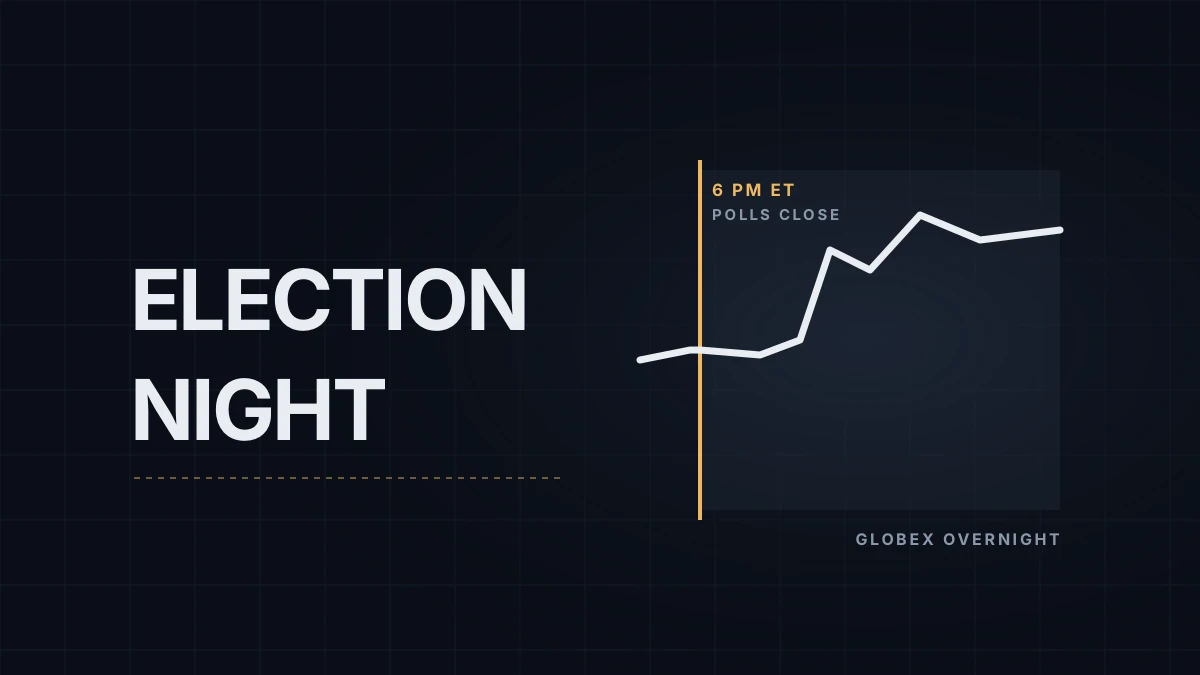
The first polls in the US midterm elections close at 6:00 PM ET on Tuesday, November 3, 2026, the same minute CME Globex reopens after its daily maintenance break. Everything markets react to that night happens in the overnight session of NQ, the E-mini Nasdaq-100 future: results arrive state by state for hours after the stock market's regular session has closed, and from 8:00 PM ET even the exchanges' after-hours sessions are shut, so index futures are where the reaction shows first. Control of the House and the Senate is on the ballot.
For traders in Europe the calendar adds a wrinkle. The US returns to standard time on Sunday, November 1, so in election week New York is six hours behind Central European Time: polls start closing at midnight CET, and most of the picture forms while Europe sleeps. The contract itself is covered in NQ vs MNQ tick value and point value, and the overnight session in general in the NQ overnight session.
The night, hour by hour
| ET | CET | What happens |
|---|---|---|
| Tue 10:00 AM | 16:00 | JOLTS job openings report |
| Tue 4:00 PM | 22:00 | US cash close; NQ keeps trading |
| Tue 5:00–6:00 PM | 23:00–00:00 | Globex daily maintenance break |
| Tue 6:00 PM | Wed 00:00 | Globex reopens for the November 4 trade date; first polls close |
| 7:00–8:00 PM | 01:00–02:00 | Polls close in a large group of states, including Georgia, Virginia, North Carolina, Ohio, Pennsylvania, Florida and most of Michigan and Texas |
| 9:00–11:00 PM | 03:00–05:00 | Arizona, Wisconsin and New York, then the West Coast |
| Wed 3:00 AM | 09:00 | European cash markets open with the overnight move in the price |
| Wed 9:30 AM | 15:30 | US cash open |
The closing times follow the usual state schedule; individual states set them. November 3 isn't a CME holiday, so the session runs on the normal hours. The rest of the week is busy too: ISM services on Wednesday at 10:00 AM ET, the Treasury's quarterly refunding announcement the same day, and the October jobs report on Friday, November 6, at 8:30 AM ET (14:30 CET).
What past election nights did
| Election | Overnight in index futures | Next US cash session |
|---|---|---|
| 2016, presidential | S&P 500 futures fell about 5% to the overnight limit around midnight ET, and Nasdaq-100 futures were locked limit down too; by 6:41 AM ET Nasdaq-100 futures were down 2.7% | Nasdaq Composite +1.1%, S&P 500 +1.1% |
| 2018, midterm | S&P 500 futures −0.4% early in the evening, then positive after the House was projected for the Democrats | Nasdaq Composite +2.6%, S&P 500 +2.1% |
| 2020, presidential | Nasdaq-100 futures rose as much as 4% and hit the 3.5% dynamic circuit breaker, a two-minute pause | Nasdaq Composite +3.9%, S&P 500 +2.2% |
| 2022, midterm | Very little reaction overnight; the expected wave of Republican gains didn't arrive | Nasdaq Composite −2.5%, S&P 500 −2.1%, with the FTX collapse and next-day CPI in the mix |
| 2024, presidential | Nasdaq-100 futures +1.3% late in the evening ET, still up about 1.5% before the cash open | Nasdaq Composite +3.0%, S&P 500 +2.5% |
Three things stand out in five nights. The two midterms moved less overnight than the three presidential elections. The overnight direction can reverse completely by the next close: 2016 went from limit down to a higher close. And the decisive call can come days later, as it did for the House in 2022, called on November 16, and for the presidency in 2020, called on November 7. A night without an answer leaves the market trading probabilities instead of a result.
Five nights is a tiny sample, and each had its own backdrop, so none of this is a forecast for 2026.
The limits are wider than in 2016
In 2016 the overnight price limit on CME equity index futures was 5%, which is why futures sat at the limit and stops below it couldn't fill. Since October 2020 the limit has been 7% either side of the previous day's reference price, plus a dynamic circuit breaker that pauses trading for two minutes when price moves 3.5% within an hour; that's the pause NQ hit in 2020. How the bands are set and what happens at the edge is covered in NQ price limits and circuit breakers.
Ways traders handle the night
Flat before the break. Closing everything before 5:00 PM ET removes the overnight risk and the overnight opportunity together. Many prop accounts require it anyway, since their trading day ends before the maintenance break.
Trade the overnight session. Liquidity is thinner than in regular hours and moves can come in jumps when a large state is called. In 2024 at least one futures broker raised margins on US equity index futures for election night, so a retail account can find its usual size unavailable. Check the broker's or the firm's notices on Tuesday.
Wait for the morning. By the European open the overnight move is in the price and the first reactions have had hours to settle. The cost is that the easy part of the move, if there was one, is gone, and a late call can still move the market during the day.
Skip Wednesday. If the result isn't known by morning, some traders sit the day out rather than trade a market waiting for a headline. It's the same call traders make on high-impact news days, with one difference: a scheduled release has a known time, and an uncalled race doesn't.
My trading day starts in the European morning, so by the time I could touch NQ on Wednesday the night is already on the chart. On Tuesday I'm flat at the end of my session as on any other day.
Educational content, not investment advice. Futures trading involves substantial risk of loss. Examples are for illustration only. Read the full Risk Disclosure.