NQ Price Limits and Circuit Breakers: The Overnight Band, Cash-Session Halts and What Happens at the Limit
Overnight, NQ can't trade outside a band set every afternoon by CME. The overnight ±7% limit, the 3.5% dynamic circuit breaker, the downside-only 7%, 13% and 20% levels during US hours, how they tie into NYSE trading halts, and what March 2020 showed about being on the wrong side of a limit.
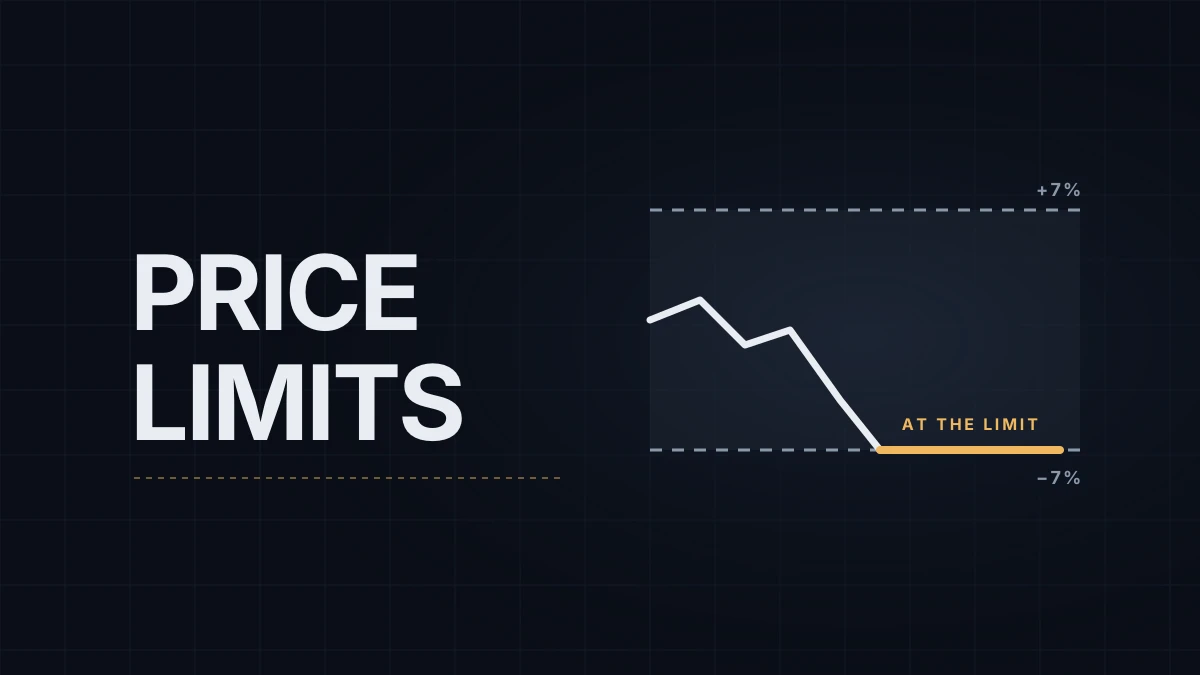
For the trading session of Monday, October 26, 2026, CME's price limit guide put the December NQ contract's overnight band at 27,090.50 to 31,144.50, about 7% either side of a reference price of 29,117.50. NQ, the E-mini Nasdaq-100 future, can trade anywhere inside that band during the overnight hours and nowhere outside it. During US hours the upside opens up and the downside gets three steps instead.
The contract itself is covered in NQ vs MNQ tick value and point value, and the session schedule in NQ trading hours. MNQ has the same limits and follows NQ's halts.
Where the band comes from
The reference price is the volume-weighted average price of that contract month's trades in the 30 seconds before 3:00 PM Central time (4:00 PM ET) on the previous business day. The band's width isn't a percentage of that futures price but of the Nasdaq-100 index's close on the previous business day, so 7% of an index close near 28,958 gives the 2,027 points either side in the example above. CME republishes the levels for every trade date.
The limits through the day
| Window | ET | Central Europe, normal week | Limit | At the limit |
|---|---|---|---|---|
| Overnight | 6:00 PM to 9:30 AM | 00:00 to 15:30 | ±7% hard limit, plus a 3.5% dynamic circuit breaker | Trading continues at or inside the band; nothing trades beyond it |
| US session | 9:30 AM to 3:25 PM | 15:30 to 21:25 | Downside only: 7%, then 13%, then 20% | Short observation period or halt, then the next level |
| Late US session | 3:25 to 4:00 PM | 21:25 to 22:00 | Downside 20% only | No trading below it |
| After the cash close | 4:00 to 5:00 PM | 22:00 to 23:00 | ±7%, downside never past 20%, plus the 3.5% breaker | As overnight |
In the weeks when Europe and the US change clocks on different dates, October 26 to 30, 2026 and March 15 to 26, 2027, the European times are an hour earlier.
Overnight. The ±7% limit is hard: the market can sit at the edge of the band and trade there, but no trade prints beyond it, and there's no halt or widening until the session changes. Inside the band a second mechanism runs, the dynamic circuit breaker. If price moves more than 3.5% within a rolling 60-minute window, trading pauses for two minutes and reopens with the window reset.
US hours. There's no upside limit during the cash session. On the downside NQ follows its own three-step process. If the lead month is limit offered at −7%, a two-minute observation period starts; if it's still at the limit when that ends, trading halts for two minutes and resumes with the 13% limit, and the same happens from 13% to 20%. Below 20% nothing trades for the rest of the session.
When stocks halt. The steps tie into the market-wide circuit breakers of the stock exchanges, which halt all US stocks for 15 minutes if the S&P 500 falls 7% (Level 1) or 13% (Level 2) from the previous close, between 9:30 AM and 3:25 PM ET, each at most once a day. A 20% fall (Level 3) closes the stock market for the day at any time. When stocks halt at Level 1 or 2, NQ halts too and resumes 10 minutes after the halt began, about five minutes before stocks are due to reopen, with the next limit in force. After a Level 3 halt, NQ stays halted for the rest of the session.
Velocity logic: the short pauses
Separate from the limits, CME's matching engine pauses a market for a few seconds when price moves a set number of ticks in a very short time. During the pause orders can be entered, changed or canceled but nothing matches, and then the market reopens with an auction. On NQ these pauses can happen around big data releases; several were reported across equity index futures on April 9, 2025, the day of the tariff pause announcement. Nothing trades during a pause, so a stop can only trigger on the first trades after the reopening, which can be well away from its price.
What March 2020 showed
The current numbers date from October 2020. Before that the overnight limit was ±5% and there was no dynamic breaker, and in March 2020 equity index futures hit the lower limit in several overnight sessions, including the night of March 8 to 9 and the night of March 15 to 16, after the Fed's Sunday rate cut. Stocks hit Level 1 halts on March 9, 12, 16 and 18, 2020, the only four times the current market-wide rules have triggered. A trader long into those nights could sell only at the limit or higher, and only if a buyer was there, and a stop below the limit couldn't trigger until the session changed.
That's the practical meaning of a limit: it's a floor under trading, not under losses. A stop beyond the band doesn't fill when the band is hit; it fills when price trades there, which can be at the next session's open. Prop firm rules that require positions to be flat by the end of each day keep traders out of the gap between sessions, but anyone trading during the overnight hours can still be caught on the wrong side of a limit; the NQ overnight session covers what trades in those hours.
Most of the hours I trade fall before the US cash open, inside the overnight band, so the ±7% limit and the 3.5% breaker are the rules that apply to most of my session.
Educational content, not investment advice. Futures trading involves substantial risk of loss. Examples are for illustration only. Read the full Risk Disclosure.