Futures Commissions and Fees Explained: Exchange, Clearing, Platform, Data and the Real Cost per Round Turn
Twenty MNQ round turns a day is $760 a month at a retail broker and $400 to $490 on an evaluation, and both come out of the same drawdown. Where each cent goes, why NQ is cheaper per point than MNQ, what a lifetime plan has to save to pay for itself, and what data costs.
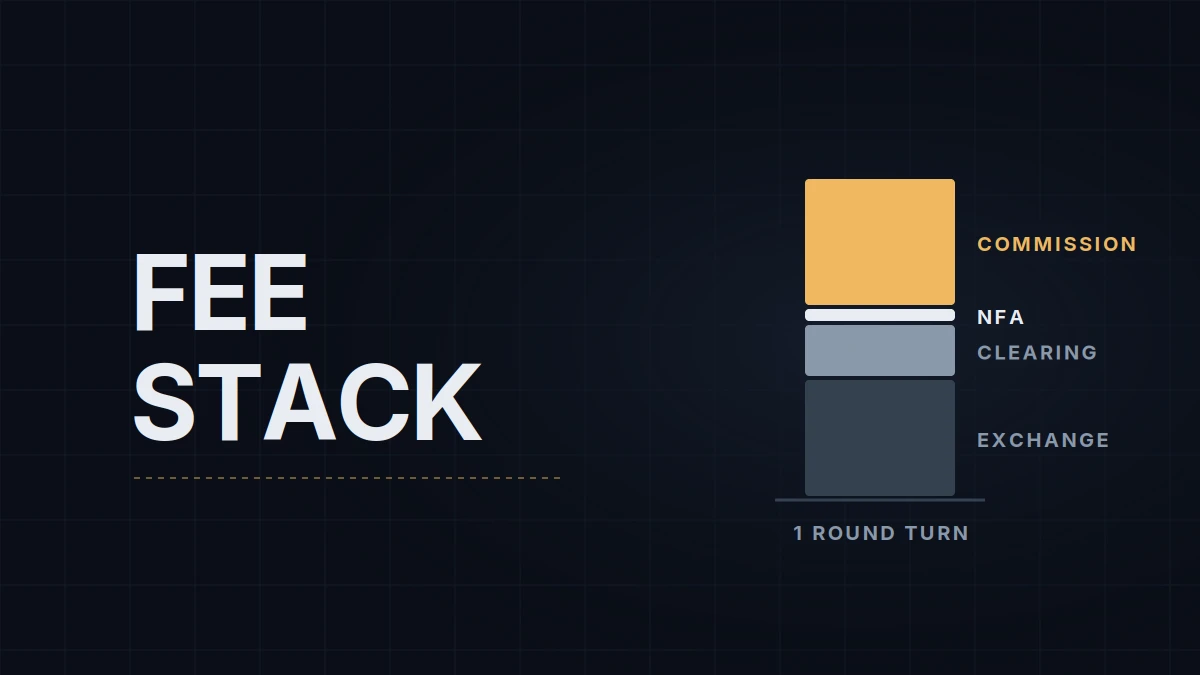
Twenty round turns a day on the Micro E-mini Nasdaq-100 (MNQ) at $1.90 each is $38, and over 20 trading days it is $760. On a 25K evaluation with a $1,000 max loss limit, that is three-quarters of the room, spent before a single trade goes wrong, because commissions are subtracted from the same balance the loss limit watches. The MNQ commission a broker advertises is the smallest line in that $1.90; the rest is a stack of fees that every futures trader pays and few can itemize. This post itemizes it, for MNQ and for the full-size E-mini Nasdaq-100 (NQ), whose tick and point values are the reason the two contracts don't cost the same per point.
The stack, per side
Futures fees are charged per side: once to open, once to close, so a round turn is two of everything below. The figures are for a retail account at one of the two brokers most NinjaTrader users connect through, on the plan with no monthly fee, at the time of writing.
| Line | Who sets it | MNQ | NQ |
|---|---|---|---|
| Exchange and clearing fee | CME Group, passed through unchanged | $0.35 | $1.38 |
| NFA regulatory fee | National Futures Association | $0.01 | $0.01 |
| Broker commission | The broker, by plan | $0.39 | $1.29 |
| Broker clearing or routing fee | The broker; some fold it into the exchange line | $0.15 to $0.20 | $0.15 to $0.20 |
| Per side | about $0.90 to $0.95 | about $2.83 to $2.88 | |
| Per round turn | about $1.80 to $1.90 | about $5.65 to $5.75 |
The exchange line is the one the broker can't do anything about. CME charges it to the clearing firm, the clearing firm charges the broker, and the broker charges you, and every broker's table shows the same $0.35 and $1.38 because they are the same fee. CME revises its schedule roughly once a year; the next version is dated October 1, 2026 and subject to regulatory review, so the pass-through line will move by a few cents around that date and broker tables update a few days later. The NFA fee is a cent per side now and becomes two cents on July 1, 2027.
The commission is where brokers compete, and the competition has a shape: pay nothing monthly and $0.39 per micro side, pay $99 a month and $0.29, or pay $1,499 once and $0.09, with E-minis at $1.29, $0.99 and $0.59 on the same three plans. The arithmetic of the choice is a round-turn count. The lifetime plan saves $0.60 per micro round turn against the free one, so it repays its $1,499 after about 2,500 round turns; at 20 a day that is 125 trading days, half a year. On E-minis it saves $1.40 a round turn and repays itself after about 1,070, or 54 trading days. The monthly plan needs about 25 micro round turns a day just to cover the $99. For a trader doing three trades a day the free plan is the cheapest by a wide margin, and the lifetime plan is a bet that the trade count stays high for years.
Why NQ is cheaper than MNQ per point
An NQ round turn costs three times an MNQ round turn and carries ten times the size. In ticks, which is the unit that matters for a stop, the difference is larger: an MNQ tick is $0.50, so $1.90 is 3.8 ticks, almost a full point, paid on every trade before it starts. An NQ tick is $5.00, so $5.70 is 1.1 ticks. Ten micros, the size of one mini, cost $19 a round turn against $5.70, so a trader who has reached ten contracts and stays in micros pays about three times more for the same exposure.
The premium buys granularity. Ten micros can be scaled out three at a time, sized to a $1,000 loss limit, or run at four contracts on a day that calls for four, and none of that exists at one NQ. That is the real trade, and the NQ vs MNQ post makes it in detail. The fee difference is the price of the granularity, and it deserves a monthly figure: ten micros instead of one mini is $13.30 more per round turn, which at 20 round turns a day comes to about $5,300 over 20 trading days.
Prop accounts charge less, and why
Evaluations and most funded accounts are simulated. No order reaches the exchange, so there is no exchange fee to pass through, and the "commission" on the statement is a number the firm chose, usually to resemble a live cost so that the sim P&L is realistic. At the time of writing a Micro E-mini Nasdaq round turn costs $1.00 at Lucid, $1.04 at Apex on Tradovate and $1.22 at Topstep on TopstepX; NQ costs $3.50, $3.10 and $3.78 at the same three, and each firm bundles the fee lines rather than itemizing them. The same 400 round turns that cost $760 at a retail broker cost $400 to $490 on an evaluation.
Lower is not free. The fee is still taken from the balance the max loss limit watches, which is why the opening arithmetic matters more on a prop account than anywhere else: the $1,000 of room on a 25K is $1,000 of losses plus fees, and at 20 round turns a day the fees alone use 40% of it in a month. The margin post has the other cost that prop accounts hide, which is that nothing on them is a real fill.
Data and platform
Market data is a separate bill, and it has two parts. CME licenses real-time data to non-professional subscribers at list prices of $1.55 a month per exchange for top of book (the best bid and offer, which is enough for a chart) and $12.10 for depth of book (the ladder a DOM or a heatmap needs), or $4.65 and $36.50 a month for the bundle of all four CME Group exchanges, at the time of writing. Brokers add an administration charge on top, so the same bundles reach a retail trader at roughly $12 and $41 a month; some brokers waive the top-of-book fee once the account is funded. Evaluations usually include top of book in the fee and charge for depth separately, and the firm's help center is the place to check, because it changes by data vendor.
The platform is the line that is most often zero. NinjaTrader's charting and order entry cost nothing when the account is with its brokerage or with Tradovate, and the paid license is the same $99 a month or $1,499 lifetime as the commission plans above, because they are the same thing: the license is what lowers the commission. Bookmap, TradingView and other tools are their own subscriptions, and the TradingView vs NinjaTrader post prices those.
One setting makes all of this visible: NinjaTrader shows P&L before commissions unless you tell it otherwise. Under Tools › Commissions, a template with the all-in cost per contract per side (NinjaTrader applies the per-unit commission on every fill, so entering the round-turn figure would count it twice) makes every figure in Trade Performance and on the chart net of fees, which is the number the journal should hold. On a prop account the firm's dashboard already shows the net figure, and the gap between the two is the fee bill, visible for the first time.
I trade micros, so the round-turn cost in ticks is a number I know the way I know the tick value, and the NinjaTrader template has held the all-in figure since the first week. Whether the granularity is worth its price is a question I ask again every time the contract count changes.
Educational content, not investment advice. Futures trading involves substantial risk of loss. Examples are for illustration only. Read the full Risk Disclosure.