Margin and Leverage on MNQ: Day-Trade Margin, Maintenance Margin and What Actually Blows Accounts
Three different numbers get called "margin" on a futures account, and only one of them is a rule you can break. Exchange initial and maintenance margin, broker day-trade margin, and the contract caps prop firms use instead, with the leverage math on MNQ and the failure that actually happens.
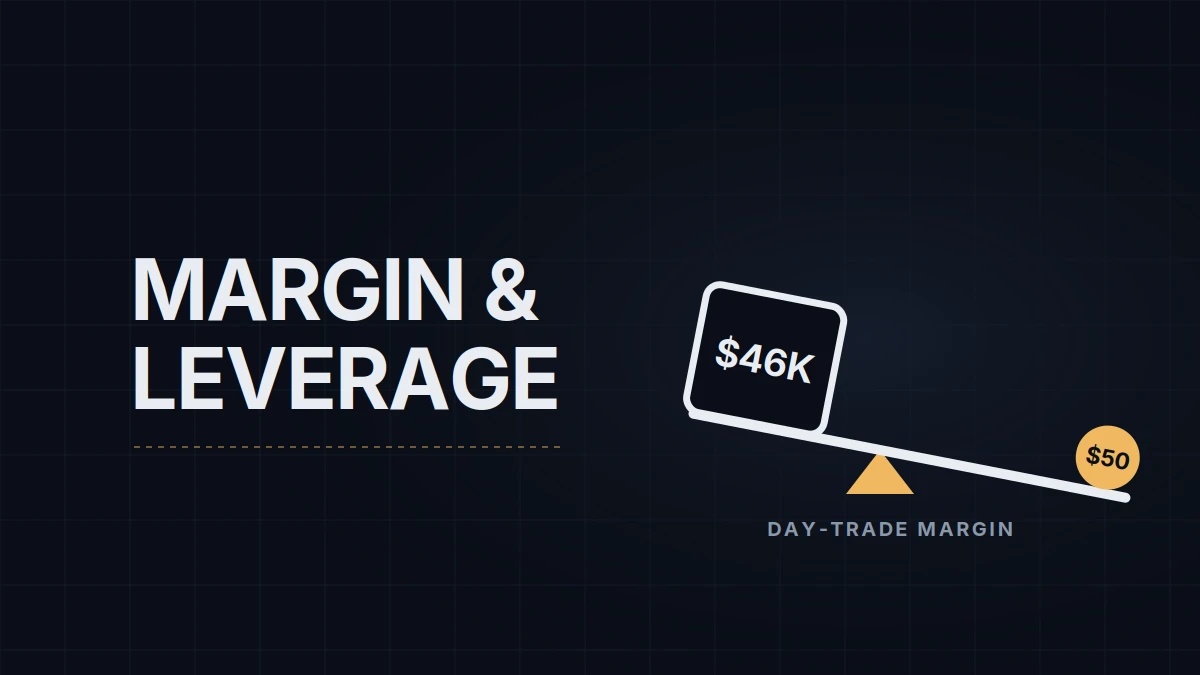
Fifty dollars. That is what a NinjaTrader brokerage account has to hold, at the time of writing, to carry one MNQ contract during the day, and one MNQ contract moves $2 for every Nasdaq-100 point on an index near 29,500, which makes it roughly $59,000 of exposure. The ratio is the number people quote when they talk about futures leverage, and it is almost never the number that ends an account. Margin is a deposit; it isn't your risk, and the two get confused in a way that costs money.
Three numbers, all called margin
Exchange margin is set by CME through its risk model and applies to every position held through the daily close. There are two figures: initial margin, the deposit required to open a position you intend to hold overnight, and maintenance margin, the level your account must stay above afterward. At the time of writing, NQ carries roughly $46,500 initial and $42,300 maintenance per contract; MNQ, one tenth the size, about $4,650 and $4,230. CME raises both when volatility rises and lowers them when it settles, so the numbers in a year-old article are wrong by definition.
Day-trade margin is the broker's number, and it can be a small fraction of the exchange's, because the broker is exposed only during liquid hours and only until it forces you flat. NinjaTrader's brokerage quotes $50 per micro and $500 per E-mini index contract intraday, at the time of writing; other futures brokers sit between roughly $40 and a few hundred per micro. Two conditions come with it. The discount applies only inside a window that ends before the session close, typically 15 minutes before, 3:45 PM CT / 22:45 CEST for CME index futures. And the broker's automated risk engine, not a phone call, enforces it: when the account can't cover the margin on open positions, they're liquidated.
The prop firm's version isn't margin at all. On an evaluation or funded account you don't post a deposit against each contract; the firm limits you with a contract cap (a maximum number of minis or micros per account size) and with the drawdown. The cap is the closest thing to a margin rule, and it is a hard rejection, not a liquidation: an order beyond it doesn't fill.
| Number | Who sets it | When it applies | What happens if you breach it |
|---|---|---|---|
| Initial / maintenance margin (NQ ≈ $46,500 / $42,300; MNQ ≈ $4,650 / $4,230) | CME | positions held through the daily close | broker liquidates or demands funds |
| Day-trade margin (MNQ $50, NQ $500 at NinjaTrader) | the broker | intraday, until ~15 min before close | auto-liquidation, sometimes at the worst price of the day |
| Contract cap (e.g. a fixed number of minis or micros per account size) | the prop firm | always | order rejected |
Figures at the time of writing; every one of them changes without notice.
The leverage math, and why it misleads
Leverage is exposure divided by capital. One MNQ at $59,000 of exposure on $4,230 of maintenance margin is about 14:1; on $50 of day-trade margin it is over 1,100:1. Those ratios are true and useless, because nobody loses margin. You lose points times dollars per point times contracts, and that number has nothing to do with the deposit.
Take a $2,000 brokerage account trading five MNQ on day-trade margin. Margin used: $250, an eighth of the account, which looks conservative. Now price moves 40 points against the position, a normal move on NQ inside an hour. Five contracts × $2 × 40 points = $400, a fifth of the account, on a single trade. The margin said 12.5%; the risk was 20%. Scale the same trade to twenty contracts and the margin is still only half the account while the 40-point move is the whole account. The contract post has the per-point and per-tick values; this is the arithmetic that sits on top of them.
The number that describes leverage as it is: dollars at risk at the stop divided by the account, and it only exists once the stop does. A position with a stop 20 points away on five MNQ risks $200, ten percent of a $2,000 account, regardless of the margin, and a position with no stop risks everything the market feels like taking. That is the whole argument of stop belongs to the setup, size belongs to capital: size comes from the stop and the account, and margin is a constraint you check afterward, not an input.
What actually blows accounts
Sizing by margin is the first failure. "I can afford forty micros" is a statement about deposits, and it gets read as permission. The correct sentence is "my stop on this setup is X points, so I can afford N contracts", and N is almost always a smaller number than the margin allows.
Holding past the intraday window is the second. At 3:45 PM CT the broker's margin reverts from $50 to the exchange's $4,230 per micro. An account holding ten MNQ on $500 of day-trade margin suddenly needs $42,300 it doesn't have, and the risk engine flattens it in the last minutes of the session, when spreads are widest. The same trap exists on the other side of the day for anyone trading the Globex open on a Sunday evening with a Friday position still open.
Overnight gap risk is the third, and the one margin was designed for. A position held through the close can reopen twenty or fifty points away after news, and the stop doesn't help because the market never traded at it. This is why exchange margin is a multiple of day-trade margin, and why most prop firms simply forbid holding through the close.
Liquidation itself is the fourth. Retail futures brokers don't issue margin calls the way the textbook describes; their software closes positions when the account no longer covers them, and it does so at market. Tradovate exposes the cushion as a column called "distance to auto-liquidation", and it is worth turning on in a self-funded account, because the number is smaller than most people think after a bad hour.
On a prop account, none of the four is usually the thing that ends it. The drawdown sits far closer than any margin figure, so it bites first; the contract cap prevents the forty-micro fantasy at the order stage; the close-of-day rule removes the overnight. Which is why traders who move from prop accounts to their own capital sometimes get hurt in the first month: the rails are gone and margin, which they never had to think about, is the only thing left.
Two ways to treat margin on your own account
Some traders take the broker's day-trade margin as given and size from the stop, using margin only as a ceiling they never approach. Others set their own margin rule, higher than the broker's, for instance never committing more than a quarter of the account as margin at any time, which caps size independently of the stop and survives the moment the stop is forgotten. The second rule adds nothing while the first is followed, and covers the day it isn't.
I trade prop accounts, where the contract cap and the drawdown do this job for me, and I size every trade from the stop and the account with margin nowhere in the calculation. The one margin number I do keep in mind is the cap, because an order that bounces off it at the wrong moment is its own kind of loss.
Educational content, not investment advice. Futures trading involves substantial risk of loss. Examples are for illustration only. Read the full Risk Disclosure.