Session Open Types on NQ: Open-Drive, Open-Test-Drive, Open-Rejection-Reverse and Open-Auction
The first half hour after the US open tells you how much conviction the market brought to the session. Dalton's four open types on NQ, each with an illustrative example, why location against the prior day is a separate read, and how to classify an open while it's still forming.
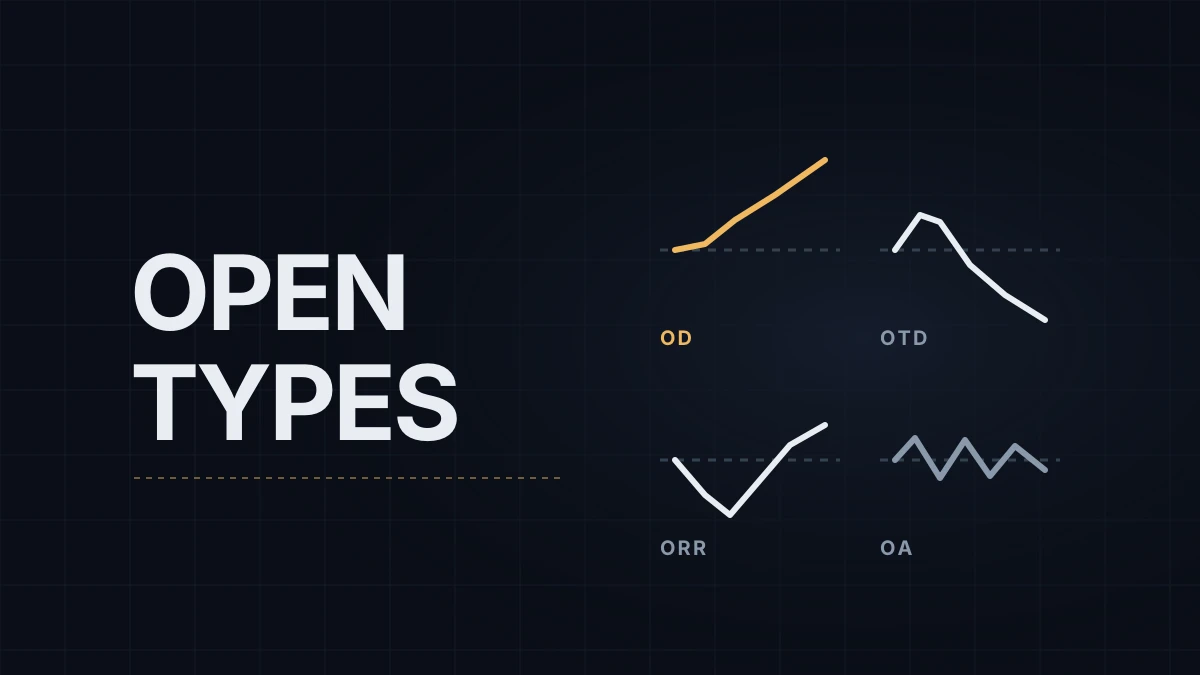
An open type is a label for how the market behaves after the US cash open: whether it leaves the opening price with conviction, tests something first, reverses, or rotates without direction. The four types come from James Dalton's Market Profile work, and on NQ, the E-mini Nasdaq-100 future, they're read from 9:30 AM ET, 15:30 in Central Europe in a normal week and 14:30 in the week of October 26 to 30, 2026. Dalton reads conviction from the first minutes of trade; by the usual convention, the label firms up by the end of the first 30-minute period and is confirmed or revised by the end of the first hour.
The open type is the first read of the session in Market Profile terms, which started with Market Profile (TPO) on NQ; tick and point value covers the contract.
| Open type | What price does after 9:30 | Usually read as | Ranked by conviction |
|---|---|---|---|
| Open-Drive | Moves away from the open in one direction and doesn't trade back through it | Longer-timeframe traders arrived with orders before the bell | 1, highest |
| Open-Test-Drive | Probes a known reference, finds little trade there, then drives the other way through the open | Conviction after a check | 2 |
| Open-Rejection-Reverse | Trades one way with real activity, meets enough opposite activity to turn, and comes back through the open | Two-sided trade, weaker conviction | 3 |
| Open-Auction | Rotates on both sides of the open with no drive | No early conviction | 4, lowest |
The examples below use round, illustrative NQ prices, with the open at 25,400.
Open-Drive
NQ opens at 25,400, dips only to 25,397 in the first minute and is 60 points higher by 9:50; once it lifts, price never trades back to the open. The reading is that traders with a longer horizon came in with orders already placed and took whatever was offered from the first minute. The early low near the open becomes the reference for the day, and of the four types this is the one most associated with trend-day behavior, covered in trend day vs range day on NQ.
Open-Test-Drive
The prior day's high is 25,430. NQ opens at 25,400, runs up to 25,432 by 9:40, prints a few trades above the old high and finds nobody willing to keep buying there. It turns and drives down through 25,400 to 25,350 by 10:00. The test and the drive go in opposite directions: the market checks a reference, the prior high or low, a value area edge or the overnight extreme, finds no business beyond it, and then commits the other way. The failed test becomes the reference extreme for the session; if price takes it out, the read was wrong.
Open-Rejection-Reverse
NQ opens at 25,400 and sells off with real volume to 25,360 by 9:45, and then the selling meets buying strong enough to turn it. By 10:00 price is back above 25,400. The difference from an open-test-drive is the first move: an open-test-drive probes a specific reference briefly and finds little trade, while an open-rejection-reverse is a genuine move that gets rejected. Both directions have shown up early, so the session tends toward two-sided trade, and the early extreme is a weaker reference than after a drive.
Open-Auction
NQ opens at 25,400 and trades between 25,385 and 25,415 for the first half hour, crossing the opening price again and again. Nobody arrived with an urgent order, and the early high and low say little about the rest of the day. Where the open-auction happens matters more than for the other types. Inside the prior day's range, it usually means balance and a slow session. Above or below the prior day's range, the market has opened at prices the previous session didn't trade and has to decide whether to accept them or return to old value. Dalton's own definition uses the prior day's range, its high and low; some later sources use the value area instead.
Location is a separate read
Dalton also classifies where the open happens: inside the prior day's value area, outside value but within the prior day's range, or outside the prior range. Location and type combine. An open-drive from inside value is a different session from an open-drive that starts above the prior day's high. An open outside value that trades back in is also the starting condition of the 80% rule. The first-hour box, the initial balance, is covered in opening range and initial balance on NQ.
Classifying it while it happens
By the usual convention, every type is provisional until the first 30-minute period ends at 10:00 AM ET, and the end of the initial balance at 10:30 AM ET confirms or overturns it. An open-drive that trades back through the open at 10:10 has stopped being an open-drive, and an open-auction that breaks out at 10:20 can turn into a trend day. The open here is the 9:30 AM ET cash open; NQ has been trading since 6:00 PM ET the evening before (Sunday evening for a Monday session), so the overnight high and low are among the references an open-test-drive can probe.
Percentages for how often each type leads to a trend day circulate online, but they rarely come with the sample, the market or the exact definition used, and the definitions differ from one source to the next. A personal record is more useful: log the open type of each session next to the day type it became, and after a few months the numbers belong to the market you trade, measured the way you classify it.
Educational content, not investment advice. Futures trading involves substantial risk of loss. Examples are for illustration only. Read the full Risk Disclosure.