Settlement Price on NQ: Why the Daily Settle Differs From the Last Trade and Where It Matters
NQ has two closing prices every day: the settlement CME sets from a 30-second window at 4:00 PM ET, and the last trade an hour later. How the settle is calculated, why the two can be 100 points apart on earnings nights, and where each shows up, from broker statements to prop accounts.
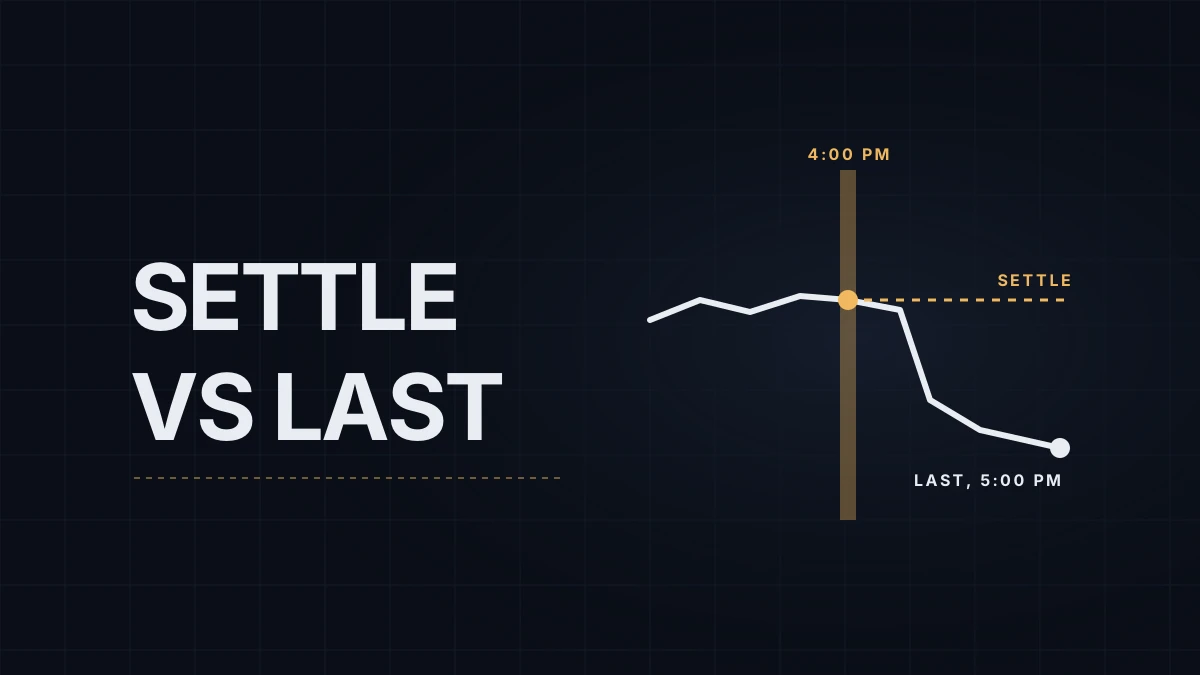
The NQ settlement price is set from 30 seconds of trading. CME takes the volume-weighted average price of all trades in the lead month between 2:59:30 and 3:00:00 PM Central time, which is 3:59:30 to 4:00:00 PM ET (21:59:30 to 22:00 CET). If the lead month doesn't trade in that window, the settle falls back to the bid and ask in that window, and failing a two-sided market, to a carry calculation from the cash index. The Micro contract, MNQ, settles to the same price as NQ. The futures pillar covers what a point on each is worth.
Two closes a day
The settlement window ends exactly when the stock market closes, but NQ keeps trading on CME Globex until 5:00 PM ET. That hour is when many large Nasdaq-100 companies publish earnings, so the last trade of the day can sit far from the settle. Take a hypothetical day: NQ settles at 28,011.75, a heavyweight reports at 4:05 PM ET, and the last trade at 5:00 PM is 27,890.00. Both are "the close" depending on who's asking, and they're 121.75 points apart, $2,435 on one NQ and $243.50 on one MNQ.
Where the settle shows up
Broker statements. Futures are marked to market every day, and the cash that moves in or out of a personal futures account is calculated from one settle to the next. A long NQ bought at 28,000.00 in the hypothetical above shows +$235 on that day's statement (11.75 points × $20) while the position is down $2,200 at 5:00 PM. The next day's statement catches up.
Daily charts and watchlists. TradingView draws daily bars for futures with "Use settlement as close on daily interval" switched on by default (the SET button at the bottom of the chart turns it off), and its watchlists and symbol pages always use the settlement. A "prior day close" taken from a daily bar is therefore the settle, while one taken from the last intraday bar is the 5:00 PM price. Either can work as a level; mixing them from day to day doesn't. More on choosing levels in key levels on NQ.
The basis. At the settle, the future and the cash index are measured at the same moment, which makes 4:00 PM the cleanest daily snapshot of NQ's premium over the index, explained in fair value and basis.
Expiration. The final settlement on the third Friday of March, June, September and December works differently: it's a special opening quotation of the index that morning, covered in cash settlement and expiration week.
Prop accounts
The end-of-day snapshots that prop firms use are clock times after the settlement window, and each firm requires positions to be closed by then: 4:10 PM ET at Topstep, 4:45 PM ET at Lucid and before 4:59 PM ET at Apex, at the time of writing (see the prop firm trading day). None of the three uses the settlement price for the end-of-day balance. The balance at the snapshot comes from your actual fills, so a trade held through a 4:05 PM earnings print counts at the price it was closed at, not at the 4:00 PM settle.
Educational content, not investment advice. Futures trading involves substantial risk of loss. Examples are for illustration only. Read the full Risk Disclosure.