Treasury Auctions and NQ: Why a 10-Year Auction at 1 PM ET Can Move Tech
Three Treasury auctions this week, each with results at 1:00 PM ET (19:00 CET). Most pass without a ripple; a weak one can push yields up within minutes, and NQ feels it more than most index futures. How the auction works, the four numbers in the result, and the ways intraday traders handle 1:00 PM.
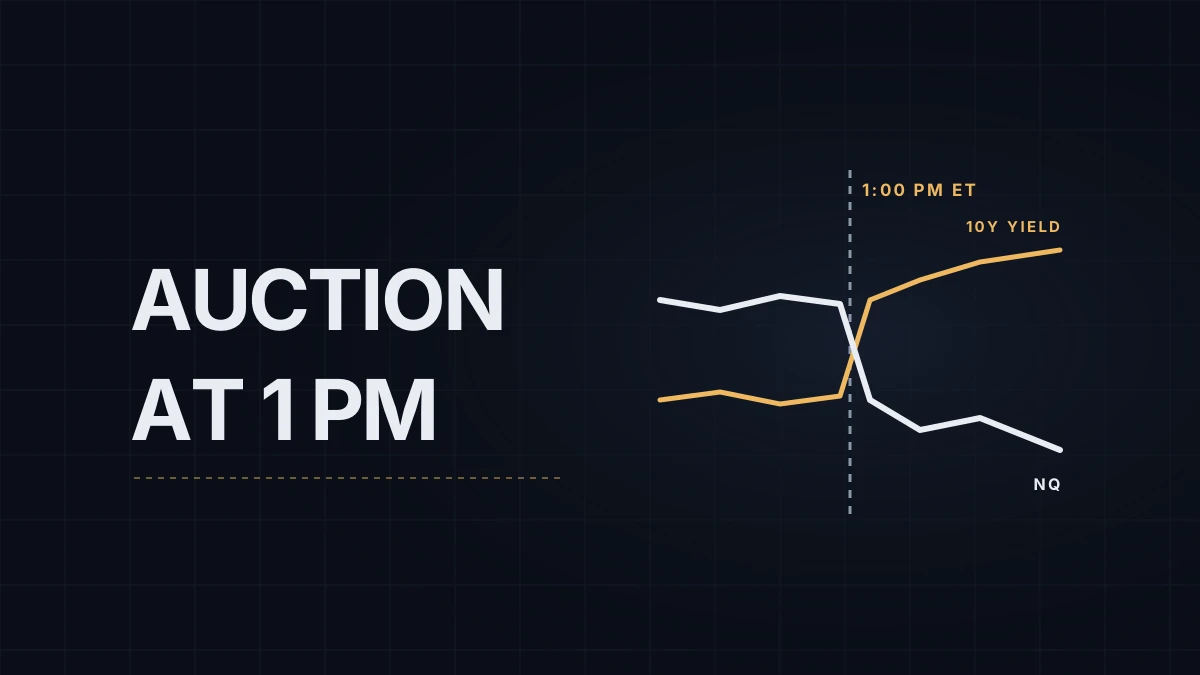
This week the US Treasury sells $125 billion of new notes and bonds in the November quarterly refunding. Each auction closes for bids at 1:00 PM ET, which is 19:00 CET, and the results are public within minutes.
| Day (2026) | Security | Size |
|---|---|---|
| Monday, November 9 | 3-year note | $58 billion |
| Tuesday, November 10 | 10-year note | $42 billion |
| Thursday, November 12 | 30-year bond | $25 billion |
Wednesday, November 11 is Veterans Day: SIFMA recommends a full close of the US bond market, while stock exchanges and CME equity index futures keep normal hours. Tuesday also has the October CPI report at 8:30 AM ET (14:30 CET), so the 10-year auction lands on a day when yields may already have moved once.
Most Treasury auctions pass without anyone outside the bond market noticing. A weak one can move yields within minutes of 1:00 PM, and the E-mini Nasdaq-100 (NQ) tends to react more than other index futures. If the contract itself is new to you, the futures pillar comes first.
How the auction works
Treasury sells each issue in a single-price auction. Bidders submit the yield they're willing to accept, Treasury fills the bids from the lowest yield upward until the full amount is sold, and every winning bidder gets the same yield: the highest one accepted, called the high yield or stop-out yield. Small non-competitive bids simply take that yield.
Three groups of bidders show up in the results. Primary dealers, the banks and securities dealers that trade directly with the New York Fed, are expected to bid in every auction and end up absorbing whatever others don't take. Direct bidders bid for their own account. Indirect bidders bid through an intermediary; foreign central banks are among them, and the group is usually read as end demand.
Four numbers in the result
Tail or stop-through. Before the auction the new note already trades on a when-issued basis, so there's a market yield at 1:00 PM. If the high yield comes in above it, the auction tailed: buyers needed a higher yield than the market expected, a sign of weak demand. Below it is a stop-through, a sign of strong demand. Both are measured in basis points (one basis point is 0.01%), and a tail of one or two basis points on a 10-year is already a talking point.
Bid-to-cover. Total bids divided by the amount sold. A 2.5 means $2.50 bid for every dollar of notes. It only means something next to recent auctions of the same maturity.
Indirect share. The percentage that went to indirect bidders. A drop compared with recent auctions is read as weaker end demand.
Dealer takedown. What the primary dealers had to keep. A high share means the auction relied on dealers because other buyers stayed away.
Why a bond auction moves tech
A weak auction means buyers wanted more yield to hold that debt, and the secondary market reprices to match within minutes. Higher long-term yields lower the present value of profits expected far in the future, and the Nasdaq-100 is weighted toward companies valued largely on exactly those future profits. So a jump in the 10-year yield tends to hit NQ harder than the E-mini S&P 500. The broader relationship, and the periods when it breaks, are in what moves Nasdaq futures.
The best-known example is February 25, 2021. Yields were already rising that week when a $62 billion 7-year note auction drew a bid-to-cover of 2.04, the lowest on record. Shortly after 1:00 PM the Treasury market went through what Federal Reserve staff later described as a flash event, and the 10-year yield touched about 1.61%, its highest in a year. The Nasdaq Composite closed down 3.5%, its worst day since the previous October. The auction didn't start that sell-off; it sped it up, which is the usual role an auction plays.
Handling 1:00 PM on auction days
The 10-year and 30-year auctions are the ones that tend to matter for index futures. Intraday traders usually pick one of three approaches:
- Flat into the result. No position at 1:00 PM on 10-year and 30-year days. The cost is missing whatever move follows, in either direction.
- No new entries around it. Open trades keep their stops, but nothing new from about 12:55 to 1:05 PM. The cost is a stop that can be hit by a spike that reverses minutes later.
- Treat it like a data release. Let the first five-minute bar after 1:00 PM form, then trade the range it sets. This is the same approach many traders use for high-impact news.
The 10-year yield or the 10-year note future (ZN) usually reacts first, so having one of them on screen gives a few seconds of warning. TreasuryDirect publishes the auction schedule and the results; the economic calendar has the data releases that often move yields earlier the same day.
For me 1:00 PM ET is 19:00 in Poland, after my afternoon block ends, so auctions matter mostly as the reason an afternoon that looked quiet can turn.
Educational content, not investment advice. Futures trading involves substantial risk of loss. Examples are for illustration only. Read the full Risk Disclosure.