Bid, Ask, Spread, Liquidity and Slippage: What Happens When You Hit the Button
Click buy at market and you are down one tick before anything happens. Not a loss on price, a payment for certainty. Where the bid and ask come from, what depth means, why a market order sometimes fills three ticks away, and the three ways traders handle the bill.
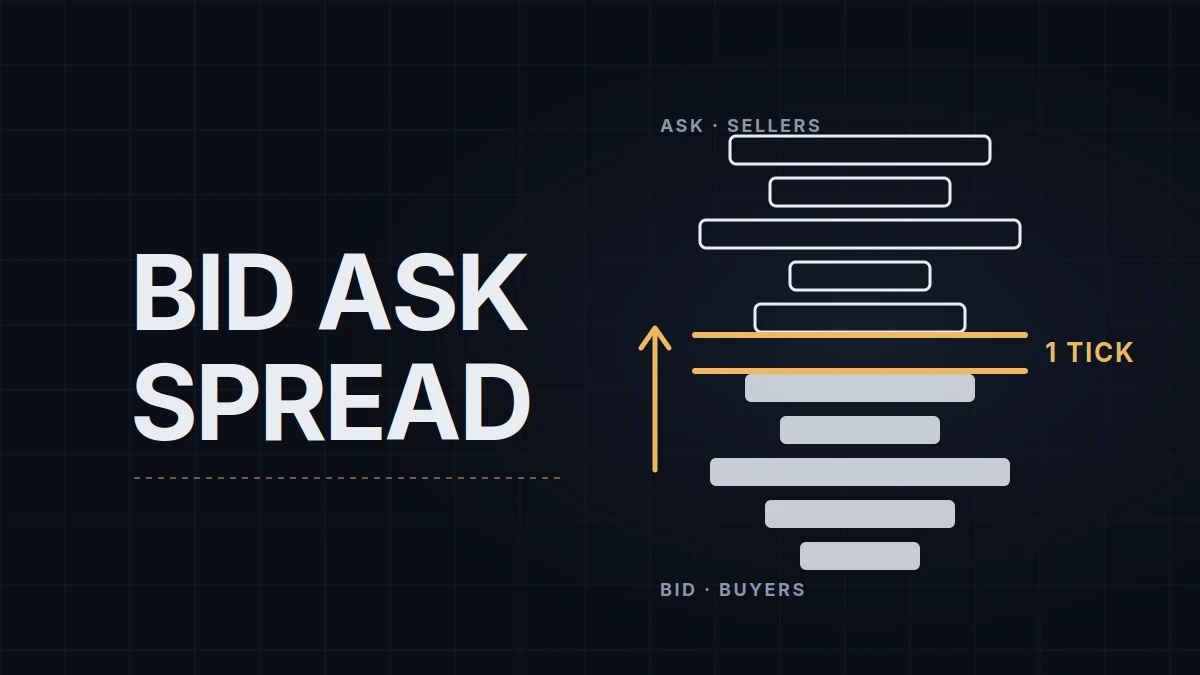
Click buy at market on the E-mini Nasdaq-100 and the position shows a $5 loss before price has moved at all. On the micro it shows $0.50. Nothing went wrong. You bought from the lowest seller in the book and the mark-to-market uses the highest buyer, and the two are one tick apart. That tick is the bid-ask spread, and a trader who never looks at it pays it hundreds of times a year without ever seeing the line item.
A price chart records trades. The bid and the ask are the prices that exist between trades, and understanding what happens in that gap explains most of the small, unexplained costs on a futures statement.
The book
Every futures contract has an order book at the exchange, a list of resting limit orders sorted by price. The bid is the highest price at which someone is currently willing to buy, with the number of contracts they want at that price next to it. The ask (or offer) is the lowest price at which someone is willing to sell. The spread is the difference between them. Below the best bid sit more bids at lower prices; above the best ask sit more asks at higher prices. That stack, price by price, is the depth, and the total number of contracts resting near the market is what traders mean by liquidity.
On NQ the minimum spread is one tick, 0.25 index points, which is $5 per contract. On MNQ the tick is the same 0.25 points and worth $0.50. During regular hours both books are usually one tick wide with real size on each side, tens to a few hundred contracts at the best price on NQ, and the two contracts have separate books that arbitrage keeps within a tick of each other. What you see on a depth ladder, or on a heatmap that keeps the history, is this list at one moment.
What the button does
A market order says: fill me now at whatever the book has. A market buy travels to the exchange's matching engine, is matched against the best ask, and fills at that price. NQ and MNQ match in price-time order, so the seller who has been resting at that price the longest is the one you trade with. If your order is smaller than the size at the ask, the whole thing fills at one price. If it is bigger, the remainder takes the next ask up, and the next, until it is done.
That last case is slippage: the difference between the price you expected and the price you got. It has two sources. One is your own size against the depth, which you control. The other is time: between your click and the engine, the book changed. On a quiet morning the two are the same price. In the seconds after a data release, a one-lot market order can fill four ticks from the last trade because the sellers who were there a moment ago pulled their orders. A stop order is the same story with a delay: it rests outside the book and becomes a market order when its price trades, which is exactly the moment the book on that side is thinnest. The order types post covers what each order does; this one is about what it costs.
The arithmetic for a one-contract trader is simple. Enter at market and pay one tick. Exit at market and pay another. That is $10 per round turn on NQ and $1 on MNQ, before commission, on every trade, whether it wins or loses. A trader taking ten trades a day on one NQ contract spends $100 a day crossing the spread. Against a 10-point target, two ticks is 5% of the target. Against a 4-point scalp it is 12.5%, and it is one reason scalping strategies that look fine on a chart come out flat on a statement.
When the spread stops being one tick
The one-tick spread with size behind it is a regular-hours condition, not a law. It widens when liquidity providers step back, and they step back at predictable times.
Scheduled releases are the clearest case: in the minute around an 8:30 AM ET (14:30 CEST) print the book thins, the spread shows two to four ticks and a stop can fill 5 to 10 points from where it was set, which is why trading around news events is its own topic and the release times are on the calendar. Overnight, especially in the Asian hours, the book is a fraction of its daytime depth. The last minutes before the daily maintenance break at 5:00 PM ET (23:00 CEST) thin out. In the week a contract rolls, volume splits between two expiration months and the older one gets thinner every day. And on any day, a fast move empties one side of the book for a few seconds, because resting orders are cancelled faster than new ones arrive.
The micro deserves a specific caution. Its tick is a tenth of the value, so the spread in dollars is a tenth, but its depth is its own. Twenty MNQ at market is not the same as two NQ; it walks the MNQ book, which in contract count is deeper than NQ's but in dollar terms is often thinner. A trader sizing up on the micro should read the depth on the contract being traded, not on the one drawn on the chart.
Paying it or not
A limit order sits in the book and waits. If price comes to it, you are the liquidity: you pay no spread, and someone else pays it to you. The cost is that price can touch your limit and turn without filling you, or never come at all. That is the trade-off, and traders resolve it in roughly three ways.
Some enter and exit only with limits. They pay nothing to cross, they miss the trades where price ran without pulling back to their order, and they accept that a limit exit can be skipped in a fast move. Others use market orders for everything. They get certainty of fill, and on one NQ contract they budget $10 a round turn for it. The common middle is a limit to enter, where waiting is cheap because a missed entry costs nothing, and a stop or market order to exit, where waiting can cost the whole account.
None of the three is the right one. The spread is the price of certainty, and the only mistake is paying it without knowing you did. My exits are stops, a trailing one and a hard one behind it, so every exit crosses the spread and some of them slip, by design. That cost lives in the setup's expected value, and the moment of the exit is a bad place to renegotiate it.
Educational content, not investment advice. Futures trading involves substantial risk of loss. Examples are for illustration only. Read the full Risk Disclosure.