Resulting: Judging a Trade by Its Process, Not Its Outcome
A rule-breaking trade that wins feels good; a by-the-book trade that loses feels like a mistake. Resulting, a poker term Annie Duke made popular, is judging decisions by their outcomes. What it costs, the four mixes of decision and outcome, and a journal routine that grades the decision first.
Two trades from the same Tuesday. The first follows the plan to the letter: a long at a level marked before the open, the stop under the level, size per the rules. It's stopped out for a full loss. The second is a short taken twenty minutes later on impulse, with no level behind it and twice the usual size, and it makes three times what the first one lost. By the evening, the second trade feels like the better decision.
Poker players have a name for that feeling. Resulting is judging the quality of a decision by the quality of its outcome, and Annie Duke, a former professional poker player, brought the word to a wider audience in Thinking in Bets (2018). A trade is a decision made on a price chart with what was known at that moment. Its result also contains everything that happened afterward, most of which nobody could have known.
Duke's first chapter opens with an example from football. In the February 2015 Super Bowl, with 26 seconds left and the ball on the opponents' one-yard line, Seattle's coach Pete Carroll called a pass instead of a run. It was intercepted, Seattle lost, and the call was widely labeled one of the worst in the game's history. Her argument is that the verdict came from the interception. A touchdown would have made the same call look clever, and an incomplete pass, which stops the clock, would have drawn little comment.
What one result can and can't tell you
A single trade mixes two things: the decision, and the spread of outcomes the market could have dealt that decision. On a setup that wins half the time, four or five losses in a row are a routine stretch, not a signal, and sample size shows how many trades it takes before results start to separate a real edge from noise. One outcome is a sample of one. Resulting treats it as a verdict.
The error runs in both directions, and the two directions cost different things.
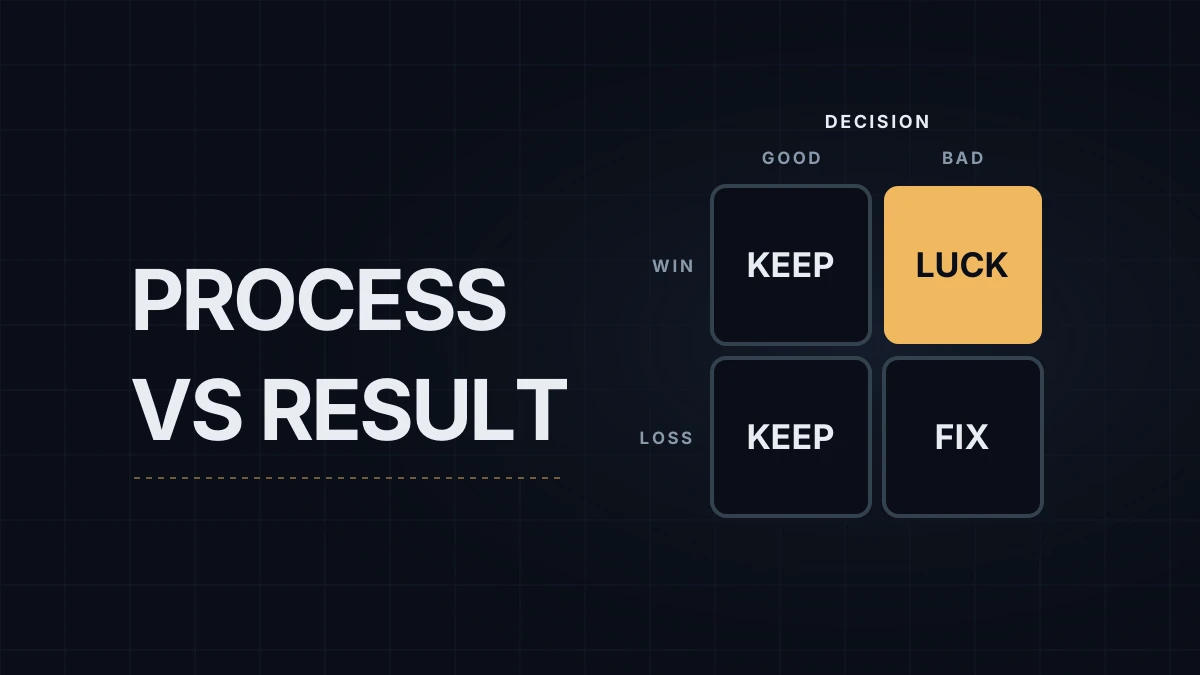
A good decision with a bad outcome invites you to fix something that isn't broken. Move the stop after a normal loss, skip the next instance of the setup, add a filter that would have avoided this one trade, and the system you're running is no longer the one that had the edge.
A bad decision with a good outcome is the expensive box, because it feels like skill. The impulse short in the opening example paid, and the payment taught that an impulse short can work at double size. That lesson gets repeated until the market charges for it, usually at the same double size.
The other two combinations are easier. A good decision that wins confirms nothing new, and a bad decision that loses teaches without argument.
None of this makes results irrelevant. Expectancy is measured in outcomes, over many trades. If decisions graded as good keep losing money across a hundred trades or more, the rules that defined "good" are the problem, and "the process was right" stops being a defense. Resulting overreads single outcomes. Its mirror image, refusing to read outcomes at all, protects a process that doesn't work.
Grading the decision before the result
The practical fix is timing: grade the decision before the outcome can lean on the grade.
At entry, or right after, record what the decision was based on. Did the setup match its written definition? Was the level marked before the session? Did the stop and the size follow the rules? Was a high-impact release due inside the trade's likely holding time? A setup grading scale like the one in trade setup grading makes that a single letter instead of a paragraph.
Grade the exit separately from the entry. An exit that followed its rule is a good exit even when price runs on afterward, and a stop moved by hand mid-trade is a bad decision even when the trade survives it. Keeping two grades stops a good entry from hiding a bad exit, and the reverse.
Then write the result next to the grades, and once a week count the four combinations. The number worth watching is the profit from trades graded as bad decisions. It shows up in the account like any other profit, but it was borrowed from luck, and a trading journal that separates it from the rest is the only place it becomes visible.
In my journal each position gets an entry grade and an exit grade, written before the P&L is in front of me.
Educational content, not investment advice. Futures trading involves substantial risk of loss. Examples are for illustration only. Read the full Risk Disclosure.