Prop Account Tracker: Five Numbers to Log Every Day, With a Template
A prop account can be one bad day from closing or one good day from a payout, and the dashboard rarely shows both at once. Five numbers to log after every session, a week of example rows, spreadsheet formulas you can copy, and how to track several accounts in one sheet.
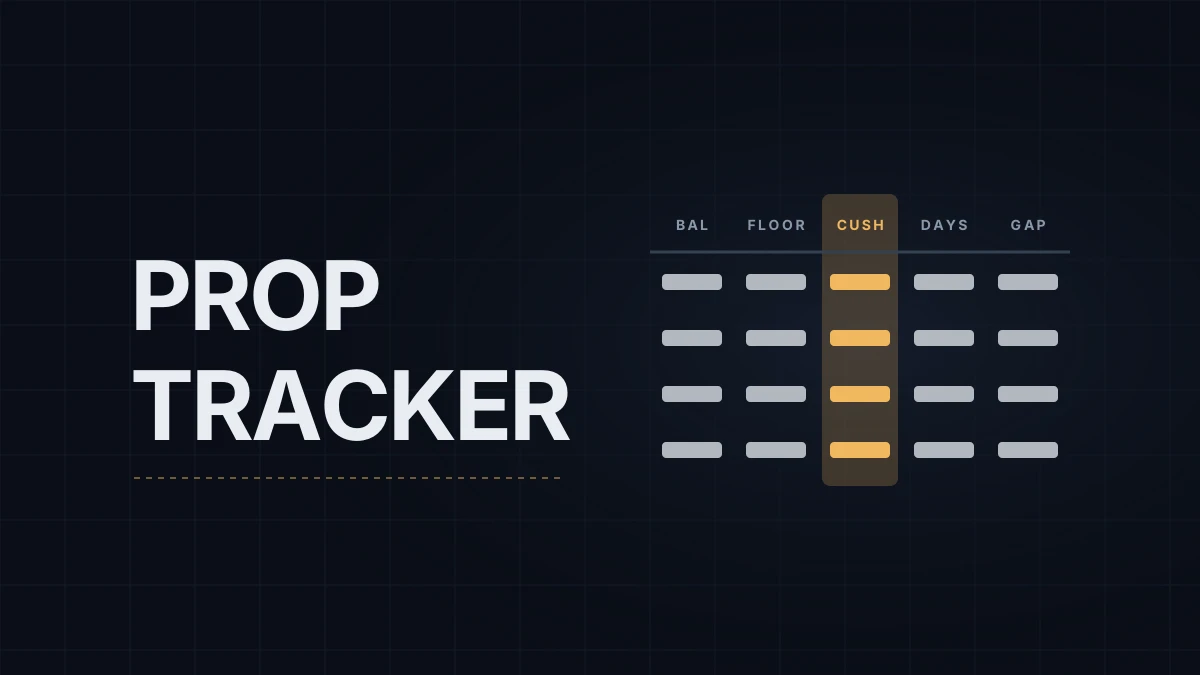
Log these five numbers for every prop account after every session, once the firm's end-of-day snapshot has been taken:
- Balance. The account balance at the snapshot.
- Floor. The balance at which the account fails, often called the max loss limit or drawdown threshold.
- Cushion. Balance minus floor: how much the account can lose before it ends.
- Qualifying days. How many days in the current payout cycle meet the firm's minimum, for example days of $150 or more.
- Consistency gap. How much more cycle profit the consistency rule needs before a payout, given the best day so far.
The firm's dashboard is the official record of the first three. A prop firm tracker spreadsheet adds the history, the payout side and all accounts in one place. The rules behind the numbers are covered in the evaluation pillar and trailing drawdown explained.
A week on one account
Example rules, close to common funded accounts at the time of writing but not any one firm's: a 50K account starting at $50,000, a $2,000 end-of-day (EOD) trailing drawdown that stops trailing once the floor reaches $50,100, payouts after five days of $150 or more, and a 40% consistency rule (the best day may be at most 40% of the cycle's profit).
| Day | Day P&L | Balance | Highest EOD | Floor | Cushion | Qualifying days | Cycle profit | Best day | Consistency gap |
|---|---|---|---|---|---|---|---|---|---|
| 1 | +$420 | $50,420 | $50,420 | $48,420 | $2,000 | 1 | $420 | $420 | $630 |
| 2 | −$180 | $50,240 | $50,420 | $48,420 | $1,820 | 1 | $240 | $420 | $810 |
| 3 | +$260 | $50,500 | $50,500 | $48,500 | $2,000 | 2 | $500 | $420 | $550 |
| 4 | +$310 | $50,810 | $50,810 | $48,810 | $2,000 | 3 | $810 | $420 | $240 |
| 5 | +$150 | $50,960 | $50,960 | $48,960 | $2,000 | 4 | $960 | $420 | $90 |
| 6 | +$200 | $51,160 | $51,160 | $49,160 | $2,000 | 5 | $1,160 | $420 | $0 |
Two things stand out once the rows are written down. The cushion never grows above $2,000 while the drawdown is still trailing; every new high drags the floor up with it, so the account is exactly as close to failing on day 6 as on day 1. The cushion only starts to grow after the highest EOD balance passes $52,100 and the floor stops at $50,100. And the $420 first day set the consistency target for the whole cycle: $420 ÷ 0.40 = $1,050, which wasn't reached until day 6. The consistency rule calculator shows the same arithmetic for other percentages.
The formulas
One row per day, with the first data row in row 2. Columns: A date, B account, C day P&L, D balance, E highest EOD balance, F floor, G cushion, H qualifying day (1 or 0), I qualifying days in the cycle, J cycle profit, K best day, L consistency gap. Row 2 starts the account (or a new cycle after a payout); every row below copies the row 3 formulas.
Row 2 (first day of the cycle)
D2  =50000+C2
E2  =MAX(50000,D2)
F2  =MIN(E2-2000,50100)
G2  =D2-F2
H2  =IF(C2>=150,1,0)
I2  =H2
J2  =D2-50000
K2  =MAX(0,C2)
L2  =MAX(0,K2/0.4-J2)

Row 3 and below
D3  =D2+C3
E3  =MAX(E2,D3)
F3  =MIN(E3-2000,50100)
G3  =D3-F3
H3  =IF(C3>=150,1,0)
I3  =I2+H3
J3  =D3-50000
K3  =MAX(K2,C3)
L3  =MAX(0,K3/0.4-J3)
Replace 50000 (starting balance), 2000 (drawdown), 50100 (where the floor stops), 150 (qualifying day) and 0.4 (consistency share) with your firm's numbers. After a payout, start a new cycle block with the new balance in place of 50000 in columns D and J. What happens to the floor after a payout varies by firm, so set F from the firm's rule at that point rather than from the formula.
Several accounts in one sheet
One tab per account keeps the formulas simple. A summary tab then pulls the latest row from each: account, balance, cushion, qualifying days, consistency gap. Sort it by cushion, smallest first. When several accounts are traded with a copier, the cushions drift apart because fills and payout timing differ, and the summary shows which account is closest to its floor before the session starts. More on running several accounts in multiple prop firm accounts.
Three adjustments for other rulebooks. With an intraday trailing drawdown the floor follows the highest balance during the session, including open profit, so log the floor the firm shows after the session instead of computing it from the EOD balance. Some firms count a qualifying day by net P&L after fees, so log P&L the way the firm does. And payout reviews also look at how the profit was made, which no spreadsheet captures; why payouts get denied lists what risk desks check. The tracker sits next to the trade-level trading journal, not in place of it.
Educational content, not investment advice. Futures trading involves substantial risk of loss. Examples are for illustration only. Read the full Risk Disclosure.