Consistency Math: Sizing a Payout Cycle So a Good Day Never Blocks the Payout
A consistency rule is two divisions and one uncomfortable fact: it depends on the shape of your days, not on your size. The largest day each cycle allows at 20%, 40% and 50%, how many sessions the same trader needs under each rule, and how Lucid and Apex apply it at the time of writing.
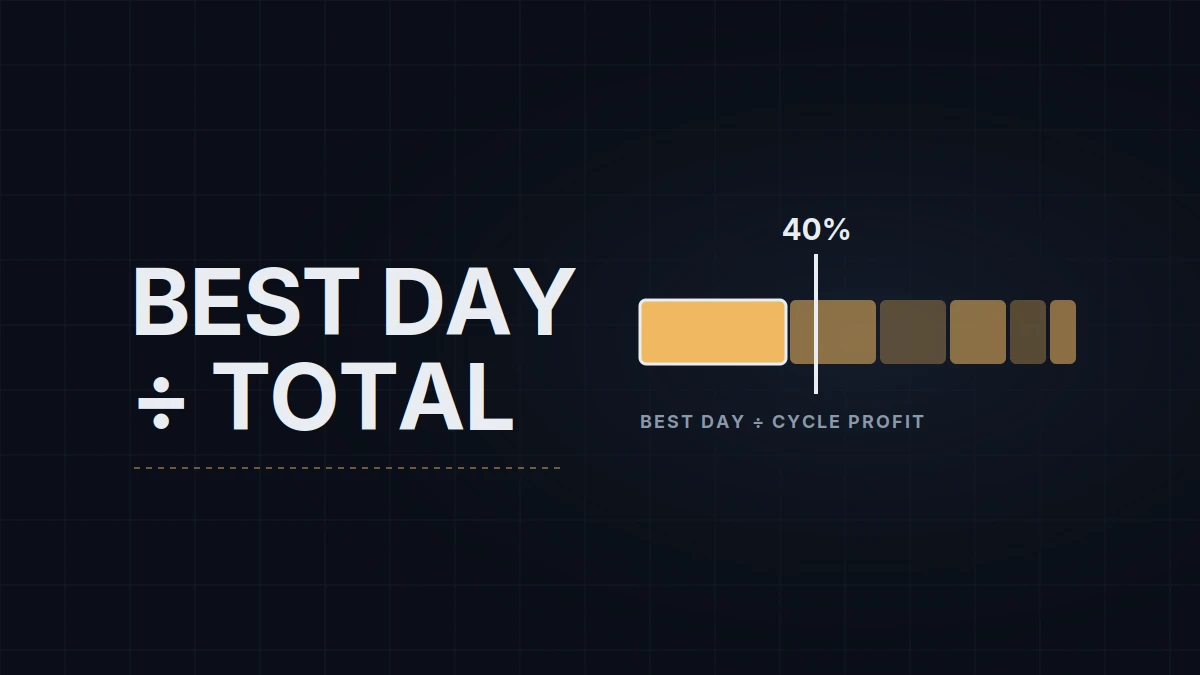
A consistency rule caps your best day as a share of the profit in the cycle, and planning around it takes two divisions. The largest day a cycle allows is the cap times the cycle's profit. The profit a cycle needs after a big day is that day divided by the cap. A $500 day under a 40% rule needs a $1,250 cycle; under a 20% rule, $2,500.
How the rule works, and which firms apply it at which stage, is in the consistency rule post; the rest of the payout rulebook, qualifying days, buffers and caps, is in payout rules. If evaluations and funded accounts are new, start with how a prop firm evaluation works. This post is the arithmetic of planning a payout cycle, the stretch between two payouts, around the rule.
The largest day a cycle allows
| Profit in the cycle | 20% rule | 40% rule | 50% rule |
|---|---|---|---|
| $500 | $100 | $200 | $250 |
| $1,000 | $200 | $400 | $500 |
| $2,000 | $400 | $800 | $1,000 |
| $3,600 | $720 | $1,440 | $1,800 |
Read across a row and you see how strict each rule is; read down a column and you see the only fix: a bigger day needs a bigger cycle. Check the wording at the edge. Some firms allow a day of exactly the cap ("no more than 40%"), others don't ("50% or more" fails the test), and on a cycle that ends near the line one dollar decides the request.
Two firms, at the time of writing. LucidPro applies 40% to the profit of each payout cycle and resets it after every payout (accounts bought or reset before 3:00 PM ET on November 28, 2025 keep 35%). On a 50K account every cycle needs at least $500 of profit. The first one also has to lift the balance over the $2,100 buffer, so a first request of $500 needs $2,600 of profit and allows a best day of up to $1,040. After that, a cycle that stops at the $500 minimum allows a best day of $200: 10 points on one E-mini Nasdaq-100 (NQ) contract, which an ordinary morning can exceed in a single trade, or 100 points on one Micro (MNQ). Apex applies 50% on its current Performance Accounts to the profit since the last approved payout (legacy accounts keep a 30% rule). On a 50K EOD account the first request of the full $1,500 needs $3,600 of profit, the $2,100 safety net plus the $1,500, so the best day has to stay under $1,800: 90 points on one NQ, 900 on one MNQ.
Size doesn't fix the ratio
Trade three contracts instead of one and every day triples: the best day, the total and the cap in dollars. The ratio between them doesn't move. A consistency rule is a statement about the shape of your days, how big the best one is next to all the others, and no position size changes that shape as long as it's the same every day.
What size does change is the other rule in the cycle, the qualifying-day minimum, which is written in fixed dollars. On a 50K Apex EOD account a day has to close at $250 or more to count at the time of writing, which is 125 points on one MNQ and 12.5 on one NQ. So the minimum puts a floor under size, while the consistency rule ignores size entirely and leaves two levers: a ceiling on the day, which clips the tail that causes the problem and some of the profit with it, or more days in the cycle.
How many sessions a cycle takes
The second lever is the one people underestimate, so it's worth putting numbers on it. Take a hypothetical trader: 60% of sessions green at $250 on average, 40% red at $150, which is $90 of net profit per session. A daily profit stop keeps the best day of a cycle near twice the average green day, $500.
| Rule | Cycle needed after a $500 best day | Sessions at $90 a session |
|---|---|---|
| 50% | $1,000 | about 11 |
| 40% | $1,250 | about 14 |
| 20% | $2,500 | about 28 |
With no consistency rule and five qualifying days to collect, the same trader finishes a cycle in roughly ten sessions if half of them clear the daily minimum. Under 50% the rule adds about one session, under 40% about four, close to a full trading week, and under 20% it nearly triples the cycle. Two things make the real number worse than the table. Averages hide streaks, and a red week in the middle of a cycle pushes the finish line out. And a longer cycle tends to produce a bigger best day, simply because it has more days to produce one, which raises the requirement again.
For your own numbers: with the best day at k times your average green day, and red days giving back a share r of what the green days make, a cycle needs at least k ÷ (cap × (1 − r)) green days. For the trader above, k = 2 and r = 0.4, that's about 7 green days at 50%, 8 at 40% and 17 at 20%. Both come from your trading journal once the trades are totaled by day instead of by trade: k is your largest green day divided by your average green day, and r is the red days' total divided by the green days' total.
A cycle plan in four lines
- Start from the request: the amount you want out, plus any buffer the account needs first, is the cycle's profit target.
- Multiply it by the cap and leave a margin: that's the ceiling for any single day in the cycle.
- Divide the ceiling by the point value times your contracts to get it in points. If ordinary good mornings in your journal reach that number, the rule will bind.
- Divide the cycle target by your average net profit per session. If the answer is longer than you can live with, the fix is a different account, not different trading.
LucidFlex, where my own accounts are, applies the rule only to the evaluation at the time of writing, 50% of the evaluation's profit, so my payout cycles have no cap to plan around, and in the evaluation the fixed daily target described in the consistency rule post keeps my best day under the cap by construction.
Educational content, not investment advice. Futures trading involves substantial risk of loss. Examples are for illustration only. Read the full Risk Disclosure.