Why Traders Pass Evaluations and Fail Funded Accounts
An evaluation has a finish line and a funded account doesn't, and that one difference explains most blown funded accounts. The arithmetic of passing by luck, what a payout does to the drawdown at Topstep and Lucid, the three ways funded accounts usually end, and how traders adjust.
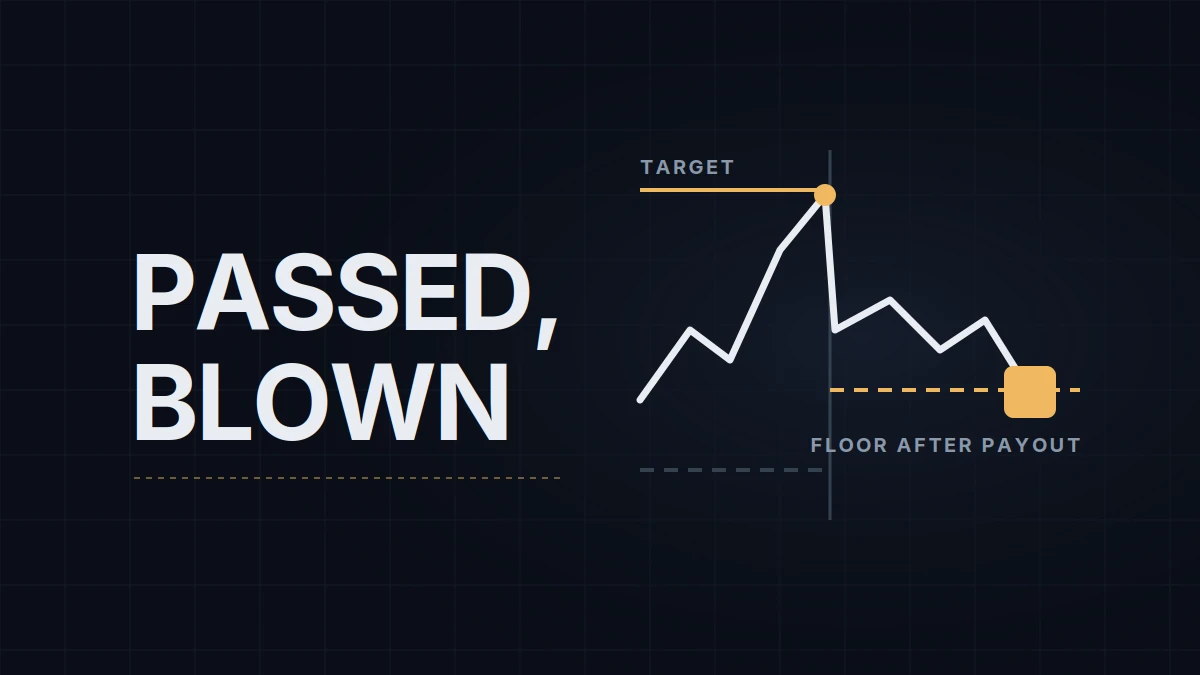
A trader with no edge at all, whose daily results are a coin flip, passes roughly three in ten 50K evaluations with a $3,000 profit target and a $2,000 end-of-day trailing drawdown. That number comes from simulating the rules, and it explains most of what people mean when they search "passed evaluation, failed funded". An evaluation is a race to a finish line. A funded account has no finish line, only a floor, and the same trading that crossed the line is what hits the floor.
Passing is partly luck, and the test can't tell
Picture a random walk that starts at zero and stops at either +$3,000 or −$2,000. With no drift, it reaches the upper barrier first 40% of the time: the lower barrier's distance divided by the total, 2,000 ÷ 5,000. A trailing drawdown makes it harder, because the floor follows the balance up. Simulating 20,000 zero-edge traders under a 50K EOD trailing rule that locks $100 above the start, with the daily result drawn from a normal distribution, gives a pass rate of 28% when the typical day is $300 either way and 31% when it's $800 either way.
The second number matters more than the first. Bigger days raise the pass rate, and they shorten the trip: the median pass took 52 trading days at $300 a day and 10 at $800. An evaluation rewards variance. It has a target to reach and, at many firms, a clock that costs a monthly fee, so a trader who sizes up gets through faster and slightly more often, whether or not there is any edge underneath.
None of this says passing means nothing. A trader with a real edge passes far more often than 30%. The problem is that the evaluation can't tell a skilled trader from a lucky one after a single pass, and the trader can't either.
What changes on day one of the funded account
The target disappears. In the evaluation there was a number that ended the game. In the funded account the only thing that ends it is the floor, so every day is spent between a drawdown and nothing in particular. Behavior tuned for reaching a number, pressing on good days and taking the extra trade near the target, has no job left to do.
Payouts eat the cushion. This is the mechanical one, and the rulebooks state it plainly. On a Topstep 50K Express Funded Account the balance starts at $0 with a maximum loss limit (MLL, the balance at which the account closes) $2,000 below it, and after the first payout the MLL is set to $0 permanently, whatever it was before. Build the balance to $1,200 over five winning days, request half of it, and $600 is left: the whole distance to the floor has gone from $2,000 to $600. On a LucidFlex 50K the MLL locks at $50,100 once the trailing is done, and a payout request moves the MLL straight to that locked level. A balance of $51,600 with an $800 request leaves $50,800, and $700 of room.
That $600 or $700 is two ordinary losing trades on a few micros. The evaluation was passed with $2,000 of room. The first funded cycle ends with a third of it, and many traders keep the same size.
Size is capped lower. Funded accounts at most firms start below their headline contract limit and scale up with profit; a payout can drop the tier back down. The scaling plan post has the ladders. A trader who passed on five minis may be allowed two, and trading two with the stop placement designed for five changes the whole trade.
The payout rules push size up. A qualifying day needs a minimum profit, $150 on a 50K at Topstep and Lucid and $250 at Apex at the time of writing. For a trader who averages less than that on one micro, the rule quietly asks for bigger size on the days that should count.
The same simulation, carried into a funded account under LucidFlex-style rules (five $150 days per cycle, half the profit per request, MLL snapping to the lock), shows the effect. The zero-edge trader who passed never reaches a first payout 42% of the time at $300 a day, and 57% of the time at $800 a day. The variance that got the account through the evaluation is the variance that closes it.
Three ways funded accounts usually end
The first-payout cliff. The trader requests as soon as the dashboard allows, the cushion drops to a few hundred dollars, and the next normal losing day closes the account. It happens after the gate most traders think of as the hard one; the timeline post maps every gate from purchase to payout.
The evaluation habit. The trader keeps chasing a number that no longer exists: a weekly goal, the next payout, the balance from two days ago. A red morning becomes a reason to trade the afternoon at double size, which is a reasonable move in an evaluation with a deadline and a poor one in an account whose only rule is don't touch the floor.
Correlated accounts. Five funded accounts on a copier are one trade five times. A loss that would cost one account its cushion costs all five, on the same day.
How traders adjust
Some keep the evaluation size and accept the risk, on the grounds that a new evaluation is cheaper than months of small trading. The cost is a funded account treated as a lottery ticket, which it partly is.
Some size from the cushion: risk per trade is a fixed fraction of the distance to the MLL, so size falls automatically after a payout and rises as the balance grows. This survives longest and makes the first cycles slow.
Some build the cushion before taking anything. Topstep's own help center suggests waiting until the MLL has trailed up to zero before the first request; on Lucid the equivalent is leaving the balance well above the lock. The first payout comes later and the account usually outlives it.
I size from the cushion and treat the first payout as the start of a smaller account, because on paper that is what it is. The long-term paths post covers what comes after the account survives.
Educational content, not investment advice. Futures trading involves substantial risk of loss. Examples are for illustration only. Read the full Risk Disclosure.