Prop Firm Prohibited Trading Practices: Cross-Account Hedging, News Rules, DCA and Why the Rules Exist
Most prop firm bans trace back to one fact: the fills are simulated. The practices Lucid, Topstep and Apex prohibit, grouped by the reason behind each, where their news rules part ways, and why averaging down is allowed while the way it usually ends is not.
Almost every evaluation, and most funded accounts, run on a simulator. The price feed is real; the fills are not. That one fact explains most of the prohibited trading practices in a prop firm rulebook, and it is why the lists at Lucid, Topstep and Apex look so alike even though each firm words them differently. If the evaluation model itself is new to you, the evaluation explainer covers it. This post covers the things that can close an account without the drawdown ever being touched, grouped by the reason each rule exists, with the three firms compared at the end.
The rules below come from each firm's help center at the time of writing. They change, sometimes plan by plan inside the same firm, so read the specifics as a snapshot and the reasoning as the part that lasts.
Three reasons behind every item on the list
A prop firm sells a test and pays the traders who pass it. The model holds only if three things are true: simulated profits could have been made in a real market, a pass says something about the trader rather than about how the accounts were arranged, and the trader risks the account roughly the way they would risk their own money. Each prohibited practice breaks one of the three.
Profits a live market wouldn't pay
A simulator fills a limit order when price trades at it. There is no queue in front of you, no partial fill, and usually no slippage on stops. At normal size and normal holding times the difference is small. At very short holding times it becomes the entire edge: a strategy that takes two ticks forty times a day at large size earns its money from the fill model, and the same orders at a real broker would mostly go unfilled or pay the spread.
That is where the most technical items come from. Lucid prohibits microscalping and flags an account automatically when more than half of its profit comes from trades held five seconds or less, while ordinary scalping stays allowed. Lucid and Apex both ban high-frequency trading (HFT), meaning automated systems that fire large numbers of orders within seconds. Topstep's examples of simulator abuse include hundreds of rapid trades to exploit queue position, trades in gapped markets that collect fills the live book would never have given, and tight brackets or auto-breakeven used to harvest generous simulated fills.
Topstep also says who these rules are aimed at. The behavior it targets is systematic, usually hundreds or thousands of trades a day with average durations in seconds, and a few lucky fills will not get a payout rejected.
A pass that says nothing about the trader
An evaluation fee buys one attempt. Anything that turns two attempts into one guaranteed pass defeats the test, and the payout that follows is funded by the fees of traders who took it straight.
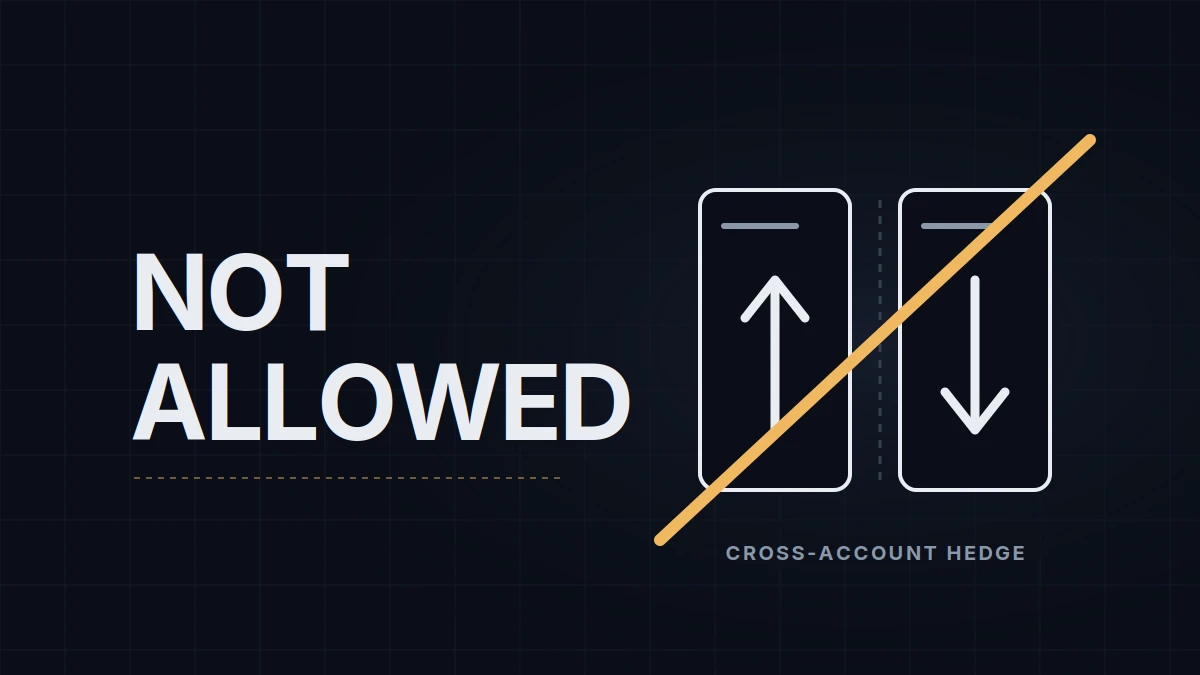
Cross-account hedging is the plainest case. Long NQ (the E-mini Nasdaq-100 future) on one account and short NQ on another means one of the two moves toward its target whatever the market does. All three firms prohibit it, and all three extend it to correlated instruments: long the mini against short the micro in separate accounts, long ES against short NQ. Lucid detects it automatically and resets the accounts involved to the previous day's balance, and a repeat is treated as a breach. How this interacts with a trade copier is covered in the copier rules post.
The same logic works inside one account and across time. Apex prohibits non-directional bracket trading: a buy stop above the market and a sell stop below it, left open so that a breakout, often a news release, picks the winning side. Topstep prohibits account stacking, which it describes as trading aggressively into the maximum loss limit, moving to the next account and repeating until one attempt lands a large win. Apex names the discount-season version, buying cheap evaluations in bulk to cycle through them for a windfall.
Letting someone else trade or pass your account, sharing an account, and copying another trader's fills belong in this group too, and all three firms close accounts for them. Apex adds shared computers, IP addresses and payment cards to its list.
Risk you wouldn't take with your own money
The third group covers trades that are perfectly legal in the market. Firms ban them because they pass evaluations at a high rate and then fail on funded accounts, where the firm is the one paying.
Apex spells out the most. Every trade needs a stop, placed or mental. The trailing threshold, the account's own liquidation level, may not serve as that stop. Its example of disproportionate risk is a five-tick target against a 150-tick stop: a win rate that looks excellent for weeks and one loss that takes all of it back. Topstep prohibits trading its full maximum position size directly into a scheduled major release, which turns the account into a single bet at the largest size it allows.
News rules differ more than anything else
On news, the firms disagree with each other, and plans inside one firm disagree too. The clause to read is the one for the exact plan you are buying.
Lucid treats trading red-folder releases as a hard breach on its LucidDaily plan and allows it on Flex, Pro and Direct, with the trader carrying any slippage. Topstep doesn't require traders to be flat for releases, but it restricts the window around the Consumer Price Index (CPI), the monthly inflation report published at 8:30 AM ET / 14:30 CEST. From five minutes before to five minutes after, simulated accounts can't open new positions in equity index minis such as NQ and ES, micros are capped at 1, 3, 6, 9 and 15 contracts on the $25K through $250K accounts, and pending orders don't fill inside the window. Apex allows news trading as part of your normal strategy and prohibits the two tactics that aren't a strategy: orders resting on both sides waiting for the number, and chasing the first move after it.
Release times and typical reactions are in the high-impact news tier list, and the news trading post compares the three ways traders handle them.
DCA, flipping and automation
Dollar-cost averaging (DCA), in this context adding to a position as it moves against you, is rarely named as a violation. Lucid allows scaling in and DCA in so many words and warns against martingaling, which means adding size to a loser in the hope of getting back to even. Apex's rules for its legacy Performance Accounts allow DCA as long as the open loss on the trade stays inside its 30% negative P&L limit. Topstep's prohibited-strategy list doesn't mention it.
What catches averaging down is the rest of the rulebook. A position that keeps growing against you turns into the trailing threshold used as a stop, or an open loss past a per-trade limit, or more contracts than the scaling plan allows yet. The entry method is permitted; the way it usually ends is not.
Two habits that people assume are banned mostly aren't. Flipping, a quick in-and-out trade to make a day count toward a minimum-days requirement, is allowed at Lucid and was allowed under Apex's legacy payout rules as long as each qualifying day made a set minimum. Automation splits the three: Lucid and Topstep allow it and hold the trader responsible for every malfunction, while Apex prohibits automation and algorithms outright, because its rewards are meant for human traders rather than preprogrammed logic.
The three rulebooks side by side
| Practice | Lucid | Topstep | Apex |
|---|---|---|---|
| Opposite positions across your own accounts, correlated markets included | prohibited; automated detection, reset to prior day's balance, repeat is a breach | prohibited | prohibited |
| Entry orders resting on both sides of the market | not named separately | not named separately | prohibited |
| Trading scheduled news | hard breach on LucidDaily; allowed on Flex, Pro, Direct | allowed; CPI window limits equity index entries; max size into a major release prohibited | allowed within your normal strategy; no chasing, no both sides |
| Very short holding times | flagged above 50% of profit from trades of 5 seconds or less; HFT prohibited | sim-fill exploitation and ultra-high-speed systems prohibited | HFT prohibited |
| Automation | allowed, trader responsible | allowed, no support and no exceptions for malfunctions | prohibited |
| Averaging down | allowed; martingale discouraged | not named | allowed on legacy PAs within the 30% open-loss limit |
| Trading with or for another person | prohibited | prohibited as coordinated trading | prohibited, including shared devices and copying |
The test I apply before a new tactic goes on an evaluation is one question: would it fill the same way, or at all, on a live account? If the answer is no, it stays off the simulator. I'm flat before the 8:30 AM ET releases anyway, so the news clauses rarely touch my sessions; the hedging clause is the one I reread whenever the way my accounts are connected changes.
Educational content, not investment advice. Futures trading involves substantial risk of loss. Examples are for illustration only. Read the full Risk Disclosure.