Trade Copiers and Prop Firm Rules: What's Allowed, What Isn't and Why Firms Care
A trade copier turns one click into a position on every account you run, and the firms don't mind, as long as the accounts are yours, they all point the same way and a follower's mistakes count as yours. The four rules, the firm-by-firm table and what copying does to your drawdown.
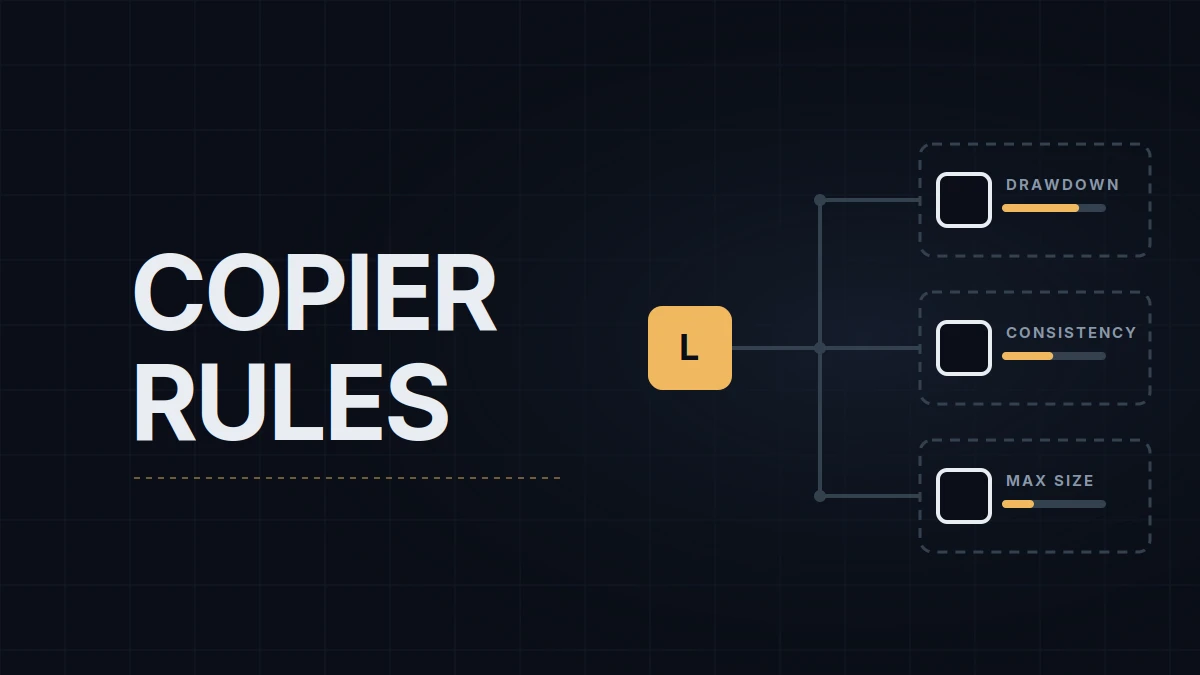
Is a trade copier allowed on a prop firm account? At the three firms most NQ traders ask about, yes: Lucid, Apex and Topstep all permit copying trades between accounts you own, and Topstep and Tradovate ship a copier of their own. What is not allowed is nearly identical everywhere, and it has little to do with the software. The rules are about hedging, about whose trades are being copied, and about the fact that every account keeps its own rulebook no matter how many of them move on one click. What follows covers what a copier does, the four rules every rulebook contains, how the three firms differ at the time of writing, and why firms tolerate a tool that lets one trader run several evaluations at once.
What a trade copier does
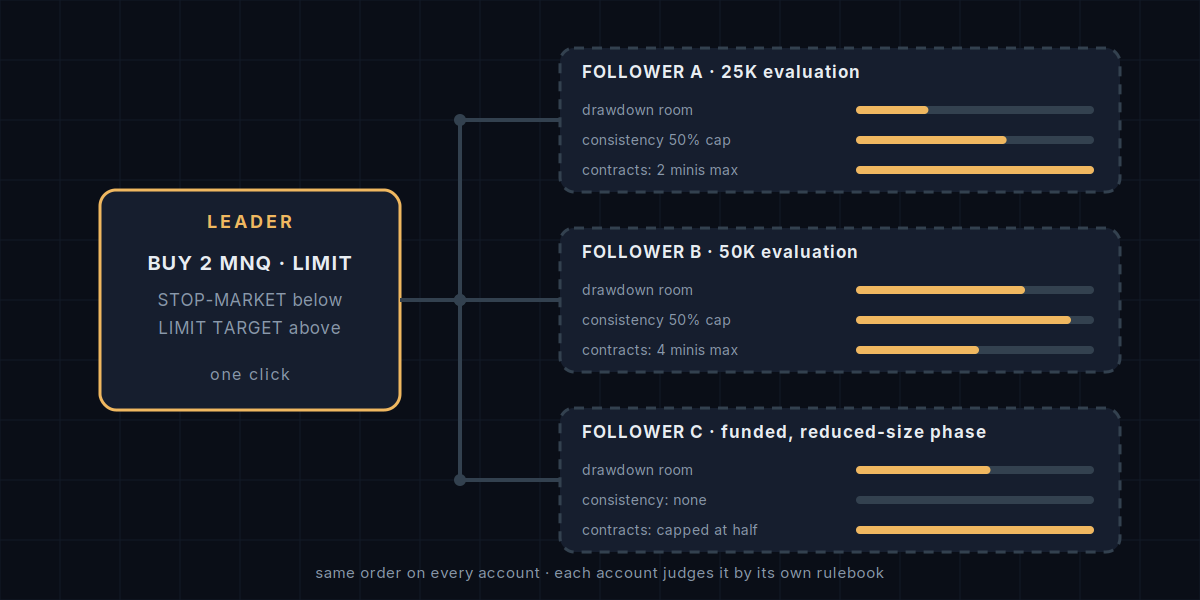
A trade copier is software that watches one account, the leader (some vendors say master), and repeats every order on one or more other accounts, the followers. You place a limit order on the leader; the copier submits the same order on each follower, then mirrors the stop, the target, every modification and the exit. Most copiers let you set a size multiplier per follower (a 50K follower at 2× a 25K leader) and some offer a "reverse" or "fade" mode that takes the opposite position on a follower.
Three kinds exist. Platform-native copiers are built into the trading platform and only reach accounts on that platform: Tradovate's Group Trading, TopstepX's Copy Trading. Local copiers run on your machine, inside or alongside NinjaTrader, and reach whatever your platform is connected to; the WotT Trade Copier is one of these, and like every local tool it stops when your PC does. Hosted copiers run on a vendor's server through the broker's API, keep copying when your machine is off, and charge a monthly fee for it.
All three replicate. None of them merge the followers into one account.
The four rules every firm applies
Only your own accounts. Copying from another person's account into yours, running a group where several traders share fills, or selling your fills as signals for others to copy is prohibited at every firm. Lucid lists hedging between different users' accounts among the banned forms; Topstep's wording is "coordinated trading with others". Apex draws the line at the household: its 20-account cap counts every person, company and platform at one address, and copying between your personal and business accounts is explicitly fine.
Every account on the same side. This is the hedging rule, and it is the one that ends accounts. Lucid's help center is the most explicit of the three: you cannot be long a contract in one account and short it in another; you cannot be long the mini and short the micro of the same index in separate accounts; you cannot be long ES in one account and short NQ in another, because correlated instruments count. Apex says all Performance Accounts must trade in the same direction and not hedge correlated assets. Topstep prohibits hedging across accounts, full stop. Lucid's enforcement is automated: a flagged trader gets an email and the involved accounts are reset to the previous day's balance; a repeat is a breach on all of them. A single-leader copier keeps you compliant by construction, since every follower is long or short together. A reverse mode switched on is a rule violation with a button on it.
The malfunction is yours. Every rulebook says some version of the same sentence. Lucid permits automated strategies and third-party copiers but holds the trader responsible for software errors and unintended outcomes. Topstep allows automation with conditions and states it will neither help set it up nor cover malfunctions. Apex applies its rules independently per account. In practice: a follower that missed the exit because the copier disconnected, and rode the position into the trailing drawdown, was your trade.
The rulebooks don't merge. Each follower has its own drawdown, its own consistency calculation, its own contract cap and its own payout eligibility. The copier sends the same order to all of them; the accounts then judge it separately. A fill one tick worse on a follower is a slightly different trade with a slightly different drawdown. A follower in a reduced-size phase gets capped at its own maximum while the leader trades full size. A follower that has just requested a payout may be disconnected from the copier by the firm without the leader noticing.
Where the three firms differ
Rules at the time of writing, from each firm's help center. Re-check before you connect anything; these pages change.
| Lucid | Apex | Topstep | |
|---|---|---|---|
| Copying between own accounts | Permitted, in-platform and third-party copiers, evaluations and funded | Permitted, evaluations and Performance Accounts | Permitted on Trading Combines and Express Funded Accounts; not on the Live Funded Account |
| Native copier | Tradovate Group Trading | none of its own (Tradovate Group Trading on Tradovate-routed accounts) | TopstepX Copy Trading, built in |
| Account cap | 10 active evaluations per household, 5 funded, 10 combined | 20 active Performance Accounts per household across all platforms; evaluations unlimited | 5 active Express Funded Accounts, up to $750K combined buying power |
| Hedging | Prohibited across accounts, users and firms, correlated instruments included; flagged accounts reset to prior day's balance, repeat = breach | Prohibited; all accounts same direction, no correlated hedges | Prohibited across accounts; coordinated trading with others prohibited |
| Copier gotcha | No overnight holding on sim accounts, so every follower must be flat before the maintenance window; the LucidFlex evaluation's 50% consistency rule is checked per account | New Performance Accounts trade half their maximum contracts until the trailing threshold is cleared, so a follower's fills get capped; only one direction at a time, and a non-directional strategy with orders resting on both sides of the market, most explicitly around news releases, is prohibited | The built-in copier is switched off while a payout is processing on a follower and has to be re-enabled by hand |
The Apex "both sides" clause deserves a sentence, because it catches a habit that is legal elsewhere. A stop and a target on an open position are closing orders and are fine. Two entry orders bracketing the market, a buy stop above and a sell stop below waiting for a breakout either way, are the non-directional strategy Apex prohibits, most explicitly around news releases, and a copier will place them on every account you have.
Why firms care
A copier by itself costs a firm nothing. What firms police is the evaluation's economics. An evaluation is a paid test with a loss limit; a trader who can guarantee that one account passes by sacrificing another has stopped taking the test, and the firm ends up paying for it. Hedging across accounts is exactly that, which is why the hedging clause is the sharpest one in every rulebook and why enforcement is automated rather than complaint-driven.
Same-direction copying, on the other hand, is the trader taking the same test several times with the same answers. Every account can fail. Every account pays its own fee and, on the funded side, its own activation. From the firm's side this is a customer who buys more evaluations and blows them together on a bad day, or passes them together and asks for several payouts at once; the account caps keep the second case bounded. Apex sets its cap at 20 and advertises it; Lucid and Topstep set theirs at 5 funded. The cap is the firm's own estimate of how much correlated payout risk it will carry per household.
What the copier changes at your desk
Sizing moves from "what can this account take" to "what can the tightest account take". Every follower loses the same points on the same trade; the one with the least room to its drawdown decides the size for all of them, or gets a smaller multiplier. Fills differ by a tick or two across accounts, so the stop that is exactly at the edge of the loss limit on the leader is a few dollars past it on a follower.
Brackets need to travel. A copier that mirrors the entry but not the stop leaves a naked position on the follower, the same problem an ATM strategy solves on a single account. Check, on a sim session, that a stop modification on the leader shows up on every follower before you trust the tool with an evaluation.
And the end-of-session check has as many lines as you have accounts. A follower that is still holding one contract because a rejected exit order never reached it is not a copier problem in the rulebook's eyes; it is your open position.
I copy between evaluations and the rules above are the reason the leader is always the account with the least room, never the biggest one. The reverse mode stays off, the followers get checked flat one by one after the session, and the copier is treated as a convenience for execution, not as a way to trade more size than any single account could hold.
Educational content, not investment advice. Futures trading involves substantial risk of loss. Examples are for illustration only. Read the full Risk Disclosure.