Prop Firm vs Personal Account: Cost, Leverage, Rules and Where the Risk Sits
The same MNQ contract, two very different deals. What a prop evaluation and a personal brokerage account cost, why the leverage looks identical until price gaps through a limit, the break-even between fees and your own drawdown, and the tax difference most traders learn about last.
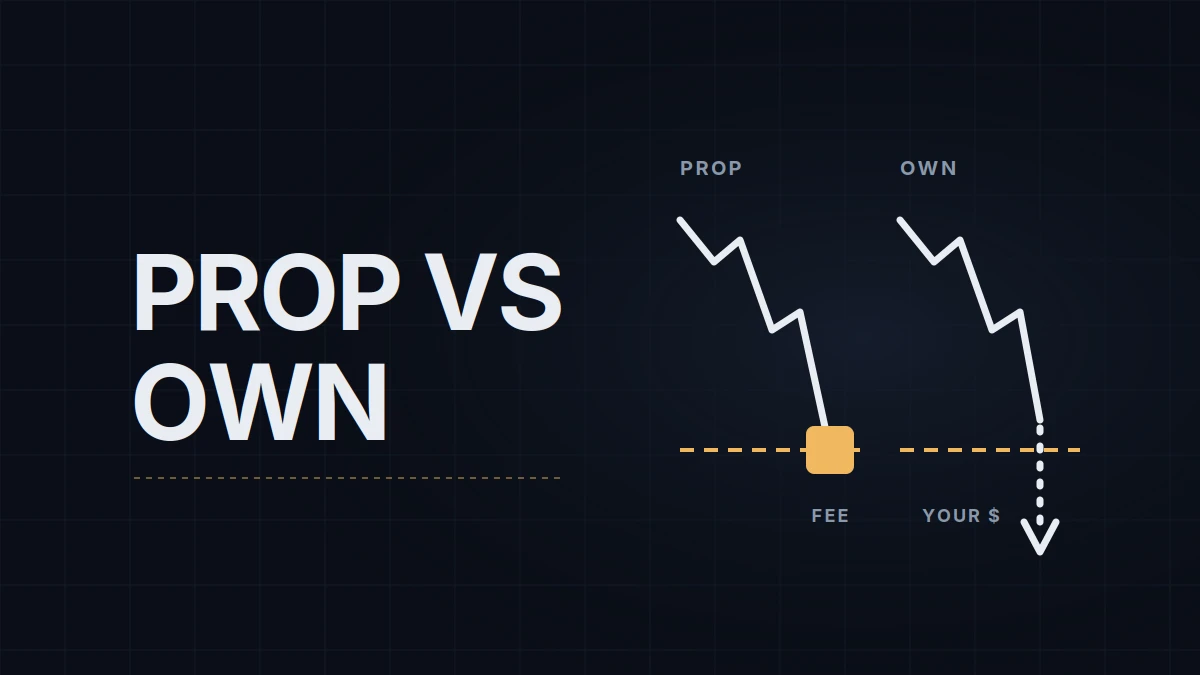
A prop evaluation and a personal futures account can put the same Micro E-mini Nasdaq-100 (MNQ) contract on the same chart. What changes is whose money moves when the trade loses, what you pay for the seat, and whose rules decide when you stop. Put briefly, the prop firm vs personal account question is a trade: the firm sells a capped, rule-bound seat for a fee, and a brokerage account gives you an uncapped seat with no rulebook in exchange for risking your own capital. If the evaluation model is new, the pillar post explains it, and the long-term paths post covers moving from one kind of account to the other. This one puts them side by side.
The prop column uses Lucid (affiliate link)'s LucidFlex 25K as the example and the personal column uses NinjaTrader's own brokerage, both at the time of writing.
| Prop evaluation or funded account | Personal brokerage account | |
|---|---|---|
| To start | A one-time evaluation fee, under $100 for a 25K at list price | A deposit; NinjaTrader publishes no minimum |
| What you can lose | The fee, then another fee to try again | The deposit, and more if price gaps past the point where the broker liquidates |
| Loss limit | Set by the firm ($1,000 max loss limit on the 25K) | None of your own unless you set one; the broker's margin check is the backstop |
| Size limit | Set per account size (2 NQ or 20 MNQ on a 25K) | Intraday margin, from $50 per micro contract |
| Commission, one MNQ round turn | $1.00 | $0.78 on the free plan, about $2 with exchange, clearing and NFA fees |
| Fills | Simulated against a live price feed | Real exchange queue, real slippage |
| Other rules | Consistency, payout cycles, prohibited practices, a forced flatten before the daily close | Margin requirements and exchange rules |
| Getting paid | 90% of profit, in cycles, with a cap per request | 100%, withdrawn when you choose |
| US tax on profit | Usually contractor income, reported on a 1099 | Section 1256 contracts: 60% long-term, 40% short-term |
Leverage looks the same until something breaks
Leverage is the notional value you control divided by the money you can lose. With the Nasdaq-100 at 30,000 (a round number for the arithmetic, not a quote), one MNQ controls $60,000 of the index, and twenty of them, the cap on a 25K evaluation, control $1.2 million against a $1,000 loss limit. A personal account holding $1,000 at a $50 intraday margin could technically carry the same twenty contracts. On paper the two setups are identical: a thousand dollars of risk steering seven figures of notional.
They part ways past the limit. The evaluation is simulated, the firm closes it when the balance touches the max loss limit, and a fast market that blows through that line costs you nothing beyond the fee. On a personal account the broker liquidates when equity no longer covers margin, but in a gap or a news spike the fill can land well past that point, and NinjaTrader's own risk disclosure states that a trader can lose more than the initial investment. The broker also moves the goalposts on purpose: NinjaTrader sets intraday margin to four times its standard rate 15 minutes before key economic releases, and anything still open 15 minutes before the session close has to meet the exchange's initial margin, roughly $4,650 per MNQ at the time of writing. The margin post walks through both numbers.
The break-even between fees and your own drawdown
On the losing side the comparison is simple. Say a trader needs $1,000 of room to survive an ordinary losing streak at their size and stop; the risk of ruin post shows how to work that number out. On a personal account the room is $1,000 of their own money. On a 25K evaluation it's a fee, and every time the room is used up, another fee. At $100 an attempt, it takes ten failed evaluations to spend what one blown $1,000 account costs, and discount codes push the count higher. For a trader still finding out whether a setup works, the evaluation is the cheaper place to be wrong.
On the winning side the prop account takes its share three ways. The split keeps 10% for the firm. Payouts arrive in cycles, with minimum profitable days and a cap on each request, so part of the profit waits; the payout rules post lists them. And the fills are simulated. A limit order in a simulator fills when price touches it, with no queue in front, which flatters any strategy that lives on exact-level limit fills. The same strategy on a personal account can earn less for reasons that have nothing to do with the trader, which is also the logic behind most of the practices prop firms prohibit.
Taxes are the difference people discover last. In the US, gains on regulated futures held in your own account are Section 1256 contracts: 60% is taxed as long-term and 40% as short-term capital gain, however long the trade lasted. A prop payout is usually paid to you as an independent contractor, which makes it ordinary income with self-employment tax (15.3% on most of it) on top. For a trader in the 24% federal bracket, that works out to roughly 19% on $10,000 of personal futures profit and roughly 36% on the same $10,000 received as payouts, before deductions and state tax. On the prop side, evaluation and reset fees are usually deductible as business expenses, which narrows the gap a little. This is general information rather than tax advice, and outside the US the rules are different again.
What traders do with the comparison
Some stay prop-only. The fee caps the downside while the process is unproven, and the split, the rulebook and the payout rhythm are the price. That price is highest for the trader who is already consistently profitable, because the cap, the split and the tax treatment all bite at once.
Some go straight to a personal account. They keep every dollar and every decision, and pay for the learning curve with real money, which on a small account can mean the whole account. The pattern day trader rule that pushes stock traders toward $25,000 accounts has never applied to futures, so the only floor is the broker's margin.
Many run both: prop accounts as the place where being wrong is cheap, and payouts moved into a personal account that grows alongside. The cost is living under two sets of rules, and noticing when a habit the prop firm enforced, such as the flat-before-close rule or a daily loss limit you didn't have to set yourself, is missing on the account that has no such rule.
I belong to the third group by intent and the first by practice. A setup that still has to prove itself should do it where a bad month costs a fee; personal capital is where the payouts are meant to end up.
Educational content, not investment advice. Futures trading involves substantial risk of loss. Examples are for illustration only. Read the full Risk Disclosure.