Prop Trading Around a Day Job: Session Choice, Time Budget and the Rules That Bite
A day job doesn't stop anyone from trading a prop account, but it changes which hours are tradeable and which rules become binding. Four NQ windows that fit around work in New York and in Europe, a realistic time budget, and the inactivity, minimum-day and evaluation-clock rules at four firms.
An Apex Trader Funding Intraday or EOD evaluation bought today runs for 30 calendar days. A trader who can trade two mornings a week gets eight or nine sessions inside that window; a full-time trader gets about 21. Prop trading with a full-time job is entirely possible, but the rules are written in trading days and calendar days, and a part-time schedule turns both into constraints a full-time trader never notices.
The structure of an evaluation is in prop firm evaluations explained. This post is about fitting one around work: which hours, how much time, and which rules decide the outcome.
Windows that fit around work
NQ, the E-mini Nasdaq-100 future, trades from 6:00 PM ET on Sunday to 5:00 PM ET on Friday, with a one-hour break each afternoon, so there is a session somewhere around most working days. The question is which part.
| Window | ET | Central Europe | Fits around | What it's like |
|---|---|---|---|---|
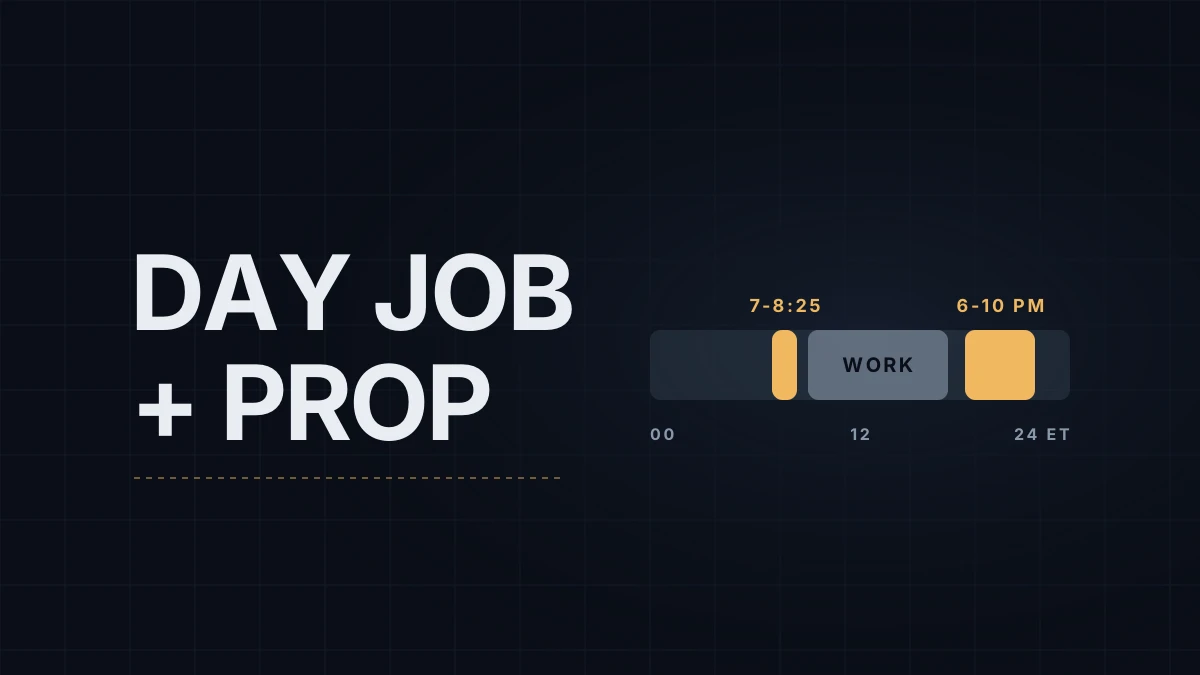
| Before US data | 7:00 to 8:25 AM | 13:00 to 14:25 | A US workday starting at 9 | Late in the European day; usually quiet, with the US data at 8:30 |
| US open | 9:30 to 11:00 AM | 15:30 to 17:00 | Flexible or remote hours, a European job ending early | The most volume and the widest ranges of the day |
| US afternoon | 12:00 to 4:00 PM | 18:00 to 22:00 | A European workday ending at 17:00 | A slow lunch period, then the last hour of the cash session |
| Globex evening | 6:00 to 10:00 PM | 00:00 to 04:00 | A US workday, after dinner | The Asia open; the thinnest of the four, with smaller ranges |
The Central European times hold in normal weeks; in the week of October 26 to 30, 2026 they are an hour earlier. Each window has a cost the table doesn't show. The early US window ends with the 8:30 AM ET data, so it's a session with a hard stop. The US afternoon ends close to the prop firms' flat-by times, between 4:10 and 4:59 PM ET depending on the firm, which the prop firm trading day lists, and on Fed meeting days it includes the 2:00 PM ET decision. The Globex evening starts a new trading day at 6:00 PM ET, so a trade at 7:00 PM counts toward tomorrow's daily limit and tomorrow's line in any consistency rule. A trader whose free hours are the European morning has the fullest set of options, and trading NQ from Europe lays out that day in detail.
The time budget
A session is more than the minutes with a position open. A realistic part-time cycle looks something like 20 minutes of preparation (levels, the day's calendar), a 60 to 90 minute session, and 15 minutes of review and journal. That's close to two hours per session, and three sessions a week is about six hours. A window shorter than the whole cycle tends to lose the review first, and the review is what makes a part-time schedule add up to progress over months.
Two calendar habits follow from a small number of sessions. A scheduled release inside your only window (CPI at 8:30 AM ET in the early US window, an FOMC decision in the European evening) can take the whole day's session, so check the economic calendar when planning the week, not on the morning. And a week with no session should be a decision made in advance, because several of the rules below count days without trades.
The rules that bite
At the time of writing, from each firm's help center:
| Topstep | Apex Trader Funding | Lucid (Flex) | MyFundedFutures | |
|---|---|---|---|---|
| Evaluation clock | Monthly subscription, no time limit | 30 calendar days, one-time fee (Intraday and EOD; the Legacy accounts back on sale for a limited time are monthly, with no time limit) | No time limit, one-time fee | One-time payment since August 25, 2026 |
| Days needed for a funded payout | 5 winning days of $150 or more (Standard path) | 5 qualifying days, $250 each on a 50K end-of-day account | 5 days of $150 or more on 50K | Rapid: no day count, daily payouts after a buffer |
| Inactivity | Funded accounts: no trading for over 30 days and the account may be closed | Funded accounts: at least 2 days of $50+ net profit in every rolling 30 days | Any account: a trade result of at least $1, profit or loss, every 30 calendar days, or the account is deleted | Evaluations and funded accounts: no trade for 7 calendar days and the account could be closed (accounts bought from August 25, 2026) |
| Flat by | 4:10 PM ET | Before 4:59 PM ET | 4:45 PM ET | 4:10 PM ET, closed automatically |
The Apex inactivity rule is the one most likely to catch a part-time trader. It asks for profit, not activity: two days with at least $50 of net profit in every rolling 30 days. With eight or nine sessions in that span, two of them have to clear $50, and a cold stretch without them closes the account, which Apex's help center says can't be reinstated. MyFundedFutures' seven-day rule can get to the same place by a different route: a one-week business trip without a trade, and without a note to support beforehand, is enough to put an evaluation or a funded account at risk.
Minimum-day rules stretch with the schedule. Five winning days of $150 or more take at least two and a half weeks at two sessions a week, and if half the sessions clear the bar, closer to five weeks. Those are payout rules on funded accounts, so a slow pace costs time to the first payout rather than the account. The evaluation clock is a separate question: Topstep and Lucid let an evaluation run as long as it takes (Topstep at a monthly fee), while Apex's 30-day Intraday and EOD evaluations at two sessions a week mean eight or nine sessions to reach the target. The prop firm evaluation timeline has the full arithmetic for how long an evaluation takes.
Consistency rules, which cap how much of the total profit one day may make, are written in percentages and don't care how many sessions you trade. They still bite harder part-time, because a single large day takes longer to dilute: under a 40% rule, the account needs total profit of at least 2.5 times its best day before a payout, and at two sessions a week that can be most of a month. The consistency rule explained covers the calculation.
The practical choice is between rulebooks rather than between firms' reputations. A trader with a fixed two-session week fits a subscription with no time limit and an inactivity rule based on any trade better than a fixed evaluation clock and an inactivity rule based on profit. A trader who can trade every weekday morning can ignore most of this table.
I trade NQ on a Lucid account alongside running a small software company, in two blocks that fit around client work: 7:00 to 9:00 and about 12:00 to 16:00 Central European time.
Educational content, not investment advice. Futures trading involves substantial risk of loss. Examples are for illustration only. Read the full Risk Disclosure.