Trading NQ From Europe: A Practical Day Plan Around the 8:30 ET Data and the US Open
A European trader gets five and a half hours of NQ before the main US data, then the US open an hour later. The day in CET, UK time and ET, three ways to cut it with the cost of each, what a data day changes, and the weeks when clocks or holidays on the two continents don't match.
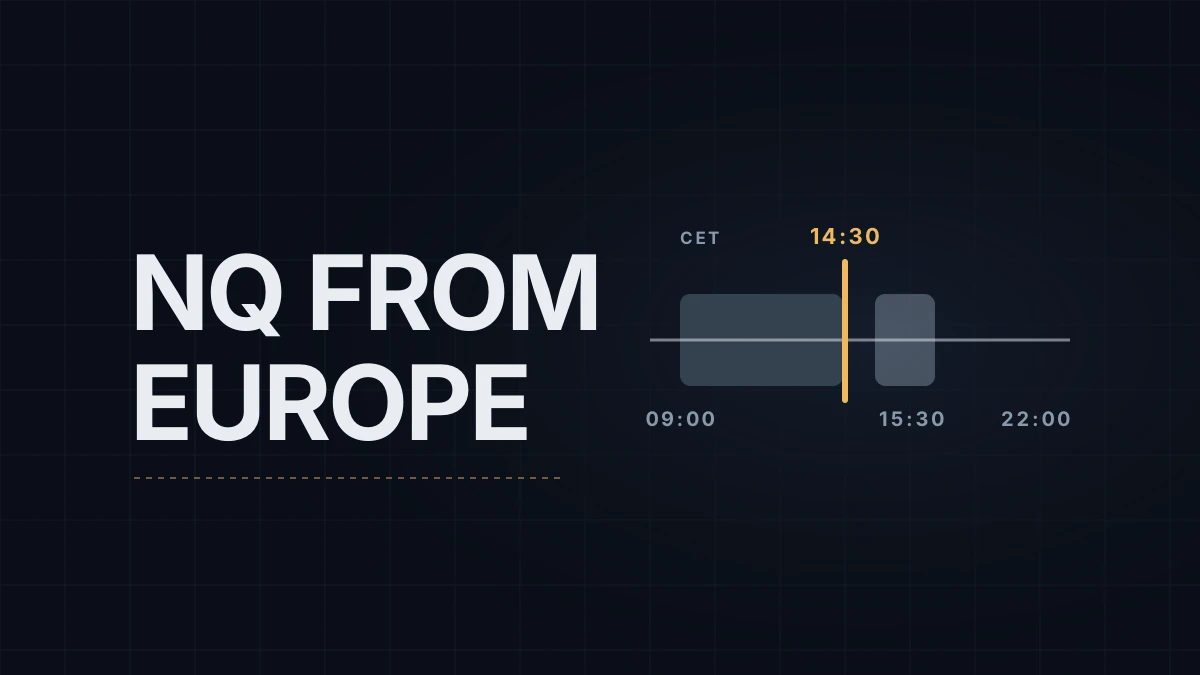
From Frankfurt, Warsaw or Paris, a trader has five and a half hours of NQ between the European cash open at 09:00 and the main US data at 14:30, and the US cash open follows an hour later. From London every one of those times is an hour earlier on the clock. That gives a European trader of NQ, the E-mini Nasdaq-100 future (tick and point value here), a choice a trader in New York doesn't face: trade the quiet morning, wait for the afternoon, or try to do both.
The session structure itself, from the Sunday open to the daily break, is in NQ trading hours, and the hours before Europe wakes up are in the overnight session. This post is about building a working day around them.
The day on a European clock
Normal weeks, with Europe and the US both on summer time or both on standard time (CEST in summer, CET in winter):
| Central Europe | UK | ET | What happens |
|---|---|---|---|
| 08:00 | 07:00 | 2:00 AM | Preparation: overnight high and low, previous day's levels, the day's calendar |
| 09:00 | 08:00 | 3:00 AM | European cash markets open |
| 10:00 | 09:00 | 4:00 AM | Eurozone flash PMIs, on release days |
| 10:30 | 09:30 | 4:30 AM | German Ifo index, on release days |
| 14:15 and 14:45 | 13:15 and 13:45 | 8:15 and 8:45 AM | ECB rate decision and press conference, on meeting days |
| 14:30 | 13:30 | 8:30 AM | US data: CPI, the jobs report, PPI, retail sales, weekly jobless claims |
| 15:30 | 14:30 | 9:30 AM | US cash open |
| 16:00 | 15:00 | 10:00 AM | Second round of US data: ISM surveys, JOLTS, consumer sentiment |
| 20:00 and 20:30 | 19:00 and 19:30 | 2:00 and 2:30 PM | FOMC statement and press conference, on meeting days |
| 22:00 | 21:00 | 4:00 PM | US cash close |
The levels that matter at 09:00 are mostly built before it: the previous day's high, low and value area, and the overnight range, as covered in key levels on NQ. Writing them down before the European open is what makes the morning tradeable at all.
Three ways to cut it
The European morning, flat before 14:30. The window from 09:00 to about 14:25 CET runs on European flows and overnight levels, with smaller moves than the US session and no scheduled US data. CME's figures for the micro contracts, from 2019 and 2020, put about 30% of MNQ volume outside the US day session, and the European morning is only part of that 30%. Price tends to approach levels more slowly, targets are smaller, and some mornings never reach the marked levels at all. It suits a trader whose afternoon belongs to something else.
The US open, 15:30 to about 17:30 CET. Most of the day's volume and the widest ranges, with the opening range and initial balance forming in the first hour. The cost is that it starts an hour after the most volatile number of the day, and for anyone with a European office job it lands in the late afternoon. A trader holding into the US afternoon also runs into the prop firms' closing times between 22:10 and 22:59 CET, listed in the prop firm trading day.
Both, with a gap around the data. Morning session, flat by 14:25, sit out the 14:30 release, come back for the open. The cost is length: about seven hours of screen time with a break in the middle is where the late, tired, unplanned trades come from, and a daily stop that covers both halves matters more than in either single window.
My own day doesn't match any of the three exactly: a first block from 7:00 to 9:00, before the European cash open, and a second from about 12:00 to 16:00 Central European time, flat before every 8:30 AM ET release. The levels go on the chart before the first block.
Data days
On a CPI or jobs-report day the morning has a deadline. The three common choices are to be flat before 14:30, to hold with a stop placed outside the move the release usually produces, or to stay out until the first minutes after the number have printed and trade the reaction. Each has its cost, covered in high-impact news on NQ; for a European trader the decision gets made around 14:00, which is late in a morning session and early in an afternoon one. The economic calendar shows the release times in your time zone.
The weeks that don't line up
Twice a year Europe and the US change clocks on different weekends, and the whole afternoon moves an hour earlier: US data at 13:30 CET, the cash open at 14:30. The next two windows are October 26 to 30, 2026 and March 15 to 26, 2027, and the NYSE is closed on the last of those days, Good Friday, March 26. NQ trading hours around daylight saving has the session-by-session table.
Thursday, October 29, 2026 shows how crowded that gets: US GDP and the PCE inflation report at 13:30 CET, the ECB decision at 14:15 CET, which doesn't move because it's set in European time, and the US cash open at 14:30 CET. Three scheduled events in an hour, the day after an FOMC decision at 19:00 CET.
Holidays don't line up either. On a US holiday such as Thanksgiving, Thursday, November 26, 2026, the US cash market is closed and NQ trades a shortened session while Europe works normally; NQ holiday trading hours has the times. The reverse happens on European holidays: Easter Monday, March 29, 2027 is a normal US trading day with most of Europe off, so the European morning is thinner than usual and the afternoon is a regular US session. National holidays add more of these days, and they're worth marking in the calendar at the start of the year.
Educational content, not investment advice. Futures trading involves substantial risk of loss. Examples are for illustration only. Read the full Risk Disclosure.