The 80% Rule on NQ: Value Area Re-Entry and What the Numbers Say
Open outside yesterday's value area, trade back inside for two 30-minute periods, and the market supposedly crosses to the other side 80% of the time. Where the 80% rule comes from, what the few published tests found, what a re-entry trade pays per point of risk, and how to define it before testing.
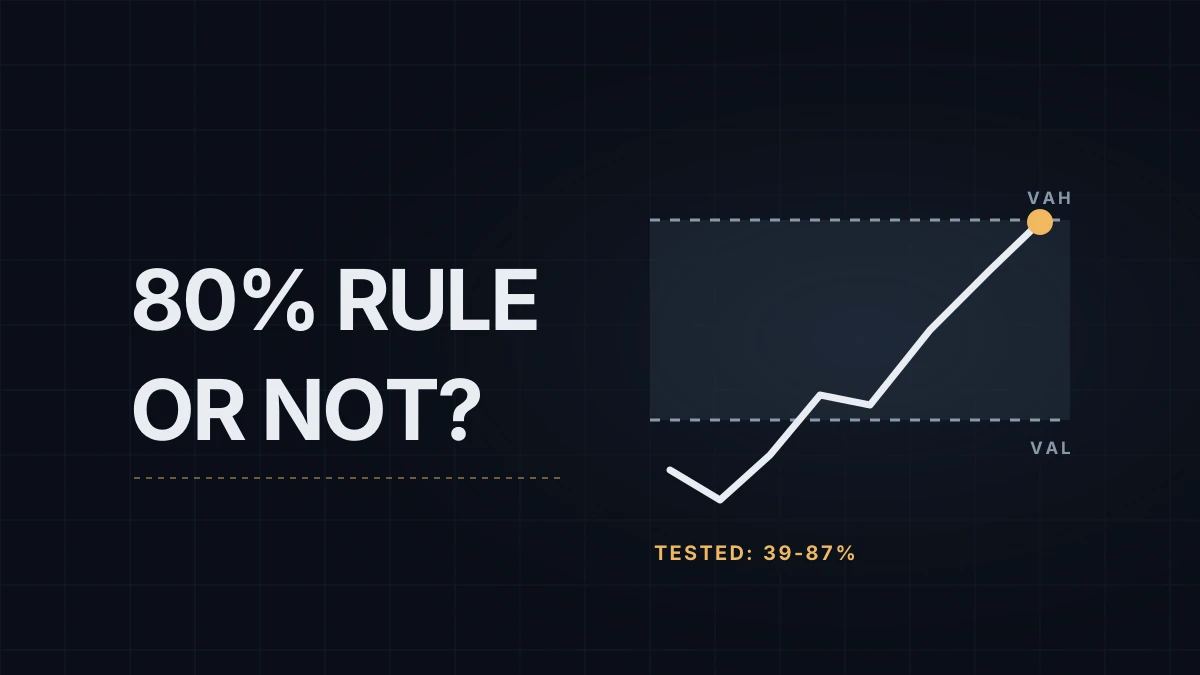
The 80% rule says that when a market opens outside the previous day's value area and then trades back inside it for two 30-minute periods, usually stated as consecutive, there's an 80% chance it will cross the whole value area to the other side. It's one of the best-known setups in Market Profile, and the number in its name is the part with the least support: no source traced for this post publishes data behind the 80%, and the few public tests mostly came out well below it, with one exception that has a catch.
The terms come from the letter-based TPO chart, covered in Market Profile (TPO) on NQ. The examples use NQ, the E-mini Nasdaq-100 future; tick and point value covers the contract.
The rule on one hypothetical NQ morning
The value area is the price range that holds 70% of a session's activity, counted from TPOs (time) or from volume, around the point of control (POC), the price with the most activity. Its top is the value area high (VAH), its bottom the value area low (VAL).
Say yesterday's value area on NQ ran from a VAL of 30,000 to a VAH of 30,150. This morning NQ opens at 29,950, 50 points below value, sets a low at 29,940 and climbs back above 30,000 during the first half hour. The second 30-minute period trades inside value too, and at its end NQ sits at 30,030. The rule is now triggered, with a target at the VAH, 30,150.
The trade the rule implies: long at 30,030, target 120 points away at 30,150, stop under the morning low at 29,935, 95 points away. That pays 1.26 times the risk, and at that ratio the trade breaks even at a win rate of about 44%, before commissions. The 80% claim matters because the trade isn't cheap: by the time two periods have confirmed the re-entry, price is already partway into value and the logical stop is on the far side of the morning's excursion.
Where it comes from
The rule is usually traced to James Dalton. A MarketDelta handout attributes its first appearance to Dalton's market letters, The Profile Reports, from 1987 to 1991, and Mind Over Markets (Dalton, Jones and Dalton; updated edition 2013) has a short section titled "The Value-Area Rule" among its special situations. Dalton lists what to weigh before taking it: how far price is from value, how wide the value area is, and the market's direction. An older edition, as quoted by a trading blog in 2008, warns that taken without that context, the odds of price crossing all of value are not much better than a coin flip.
Versions differ in details that change the count:
- Two consecutive periods or any two periods inside value
- Whether a period has to close inside or only trade there
- Whether an open inside value that leaves and comes back counts
- Regular-hours or full-session value area, and value from TPOs or from volume
What the numbers say
| Test | Market and sample | Trigger | Reached the far edge |
|---|---|---|---|
| TeamLBR blog, 2008 | ES, day session, 119 days from April 2008 | Open outside, two half-hour periods inside | 16 of 41 days (39%); 16 of 40 with consecutive periods (40%) |
| NexusFi member test, as summarized by NexusFi | ES, regular hours, about 1,000 days | Long side: open below value, first period back above VAL, second stays above | 20 of 23 (87%) |
| Same test | Same | Short side: second period entirely inside value | 6 of 12 (50%) |
| Traders Laboratory backtest, as quoted on NexusFi (then futures.io) in 2014 | Market and period not stated | Open outside, first 30 minutes close inside | 75 of 120 (62.5%) |
The 87% looks like a confirmation, and the summary of that test adds the catch: on most of those days the far edge was reached during the second 30-minute period itself, before a trader waiting for two full periods would have been in. A count that starts at the open includes moves the rule never let anyone trade.
The samples are the other problem. With 41 days, a measured 39% fits a true rate anywhere from about 26% to 54%; with 23 days, 87% fits anything from about 68% to 95%; with 12 days, 50% fits 25% to 75%. Sample size for traders explains where those ranges come from. None of the tests is documented as run on NQ, all of them come from blogs and forums rather than published research, and no two use the same definition.
Taken together, the public tests run from worse than a coin flip to well above one, depending on the definition and on when the count starts. Around the 44% breakeven of the example above, that range covers both a losing setup and a decent one.
Defining it before testing it on NQ
A test is only as good as the definition written down before the first day is counted:
- Which value area: regular hours or full session, TPO or volume, and the row size of the profile.
- What counts as "outside": the open, or any trade outside in the first period.
- What counts as acceptance: one period or two, consecutive or not, trading inside or closing inside.
- Where the entry is: the moment the trigger completes, at the price available then.
- What counts as success: a touch of the far edge, by the close of the same session.
- Where the stop is, and whether it was hit before the target.
Item 4 is the one most informal tests skip, and it's the one that separated 87% from a tradeable number above. Item 6 turns a fill rate into an expectancy, which is what decides whether a 1.26-to-1 trade is worth taking; expectancy and risk of ruin has the formula. Days can be replayed bar by bar in NinjaTrader's Market Replay, and the same caution about results that look better than live trading applies here as in backtest vs live results.
The previous day's value area edges are among the levels I mark before every session, taken from a volume profile, so re-entries into value come up often on my chart. I've never counted them to this definition.
Educational content, not investment advice. Futures trading involves substantial risk of loss. Examples are for illustration only. Read the full Risk Disclosure.