FOMC Day on NQ: The 2:00 PM Statement, the 2:30 Press Conference and Meetings Without Projections
An FOMC day follows a fixed script: a blackout, a statement at 2:00 PM ET, a press conference half an hour later, minutes three weeks on. The timeline for the October 28, 2026 meeting in ET and Central European time, what moves NQ at each step, and what changes when a meeting has no projections.
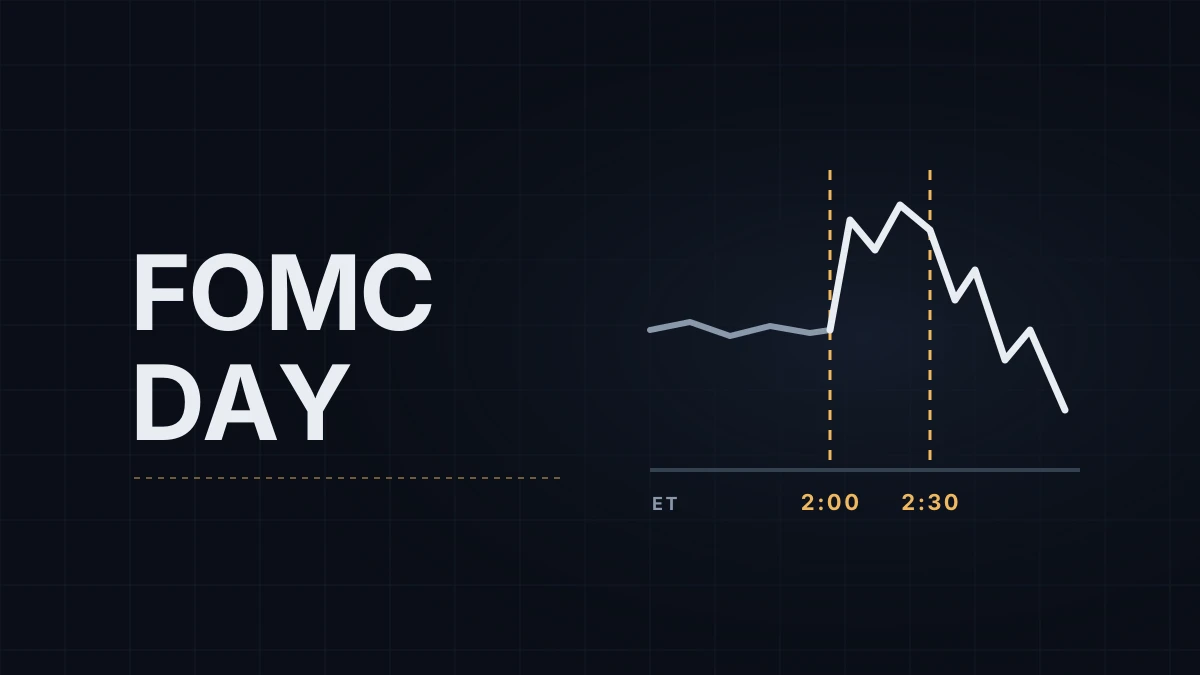
The Federal Reserve announces its next rate decision on Wednesday, October 28, 2026, at 2:00 PM ET. In Central Europe that's 19:00 rather than the usual 20:00, because Europe set its clocks back on October 25 and the US doesn't until November 1. An FOMC day on NQ, the E-mini Nasdaq-100 future, follows a fixed script, and most of what matters about it is the timing of two releases half an hour apart.
The FOMC, the Federal Open Market Committee, sets the target range for the federal funds rate at eight scheduled meetings a year. Where it ranks among other US releases is covered in high-impact news on NQ; this post is about the meeting day itself. For the contract, tick and point value comes first.
The timeline for October 27 and 28
| Date | ET | Central Europe | What happens |
|---|---|---|---|
| Sat, Oct 17 | 12:00 AM | 06:00 | Blackout begins: Fed officials stop public comment on policy |
| Tue, Oct 27 | First day of the meeting; nothing is released | ||
| Wed, Oct 28 | 2:00 PM | 19:00 | Policy statement and implementation note |
| Wed, Oct 28 | 2:30 PM | 19:30 | Chair's press conference |
| Wed, Oct 28 | 4:00 PM | 21:00 | US stock market close; NQ trades on until 5:00 PM ET |
| Thu, Oct 29 | 11:59 PM | 04:59 Fri | Blackout ends |
| Wed, Nov 18 | 2:00 PM | 20:00 | Minutes of this meeting, released three weeks after the decision |
The schedule barely changes from one meeting to the next: a two-day meeting that almost always ends on a Wednesday (since 2019 the only exceptions were the November meetings in 2020 and 2024, which ended on a Thursday after US elections), the statement at 2:00 PM, the press conference at 2:30, minutes three weeks after the decision. Only the European times move, by an hour in the weeks when the two continents change clocks on different dates; NQ trading hours around daylight saving has the full table. The next meeting after this one is December 8 to 9, 2026.
Two releases, thirty minutes apart
The statement is a short text published at 2:00 PM sharp: the decision, the vote and the committee's reasoning, with an implementation note listing the technical rates. NQ reacts within seconds, mostly to two things: whether the decision matches what futures markets had priced in, and what changed in the wording since the last statement. The vote belongs to the wording. At the July 29, 2026 meeting the committee held rates while three members dissented in favor of a hike, and a dissent count like that tells the market which way the next change may go.
At 2:30 PM the Chair starts taking questions, and the answers arrive one at a time, so the second reaction tends to come in waves rather than as a single move. It can extend the 2:00 PM move or reverse it. A move in the first minutes after the statement is a first reading, and the press conference can rewrite it before the cash close.
Press conferences have followed every regularly scheduled meeting since January 2019. Under Chair Kevin Warsh, who took office on May 22, 2026, the format has shifted in smaller ways: at his June press conference he said the committee had dropped forward guidance, its signals about where policy is likely to go next, as unsuited to current conditions, and had made the statement shorter and simpler. In July he committed to press conferences for the rest of 2026. A Fed communications task force, announced at the June press conference with its leaders named on July 9, 2026, hasn't published findings at the time of writing, so the format for 2027 is still open.
Meetings with projections and without
Four of the eight meetings come with the Summary of Economic Projections: participants' forecasts for growth, unemployment, inflation and the policy rate, including the dot plot of where each of them sees the rate in coming years. In 2026 those meetings are in March, June, September and December. October has none, so the projections from September 16 remain the latest until December 9.
That changes what can surprise the market at 2:00 PM. On a projections day there are three sources: the decision, the statement and the dots. On a day without them there are two, and the press conference carries more of the weight. For context at the time of writing, the target range is 3.75% to 4.00%, after a 25 basis point increase at the September meeting.
How traders handle it
There are three common approaches, each with its cost; trading news events on NQ goes through them in more detail.
- Flat before 2:00 PM. No exposure to the statement or the press conference. The cost is missing the move on the days it runs.
- Fade the first move. Trade against the first spike near a level, on the idea that the press conference often takes part of it back. The cost is the days it doesn't, with wider spreads and stops that can slip in the first seconds.
- Follow after the press conference. Wait until the Chair has spoken and trade in the direction the market settles. The cost is a late entry and a wider stop.
On a prop account, the firm's flat-by time limits the window. With flat-by times between 4:10 and 4:59 PM ET depending on the firm, as listed in the prop firm trading day, a position opened on the decision has between a little over two hours and just under three hours to work.
The rest of this particular week is busy too. Microsoft reports after the close on October 28, Alphabet holds its results call at 4:30 PM ET the same day, and on Thursday, October 29, third-quarter GDP and the September PCE inflation data come out at 8:30 AM ET, which is 13:30 in Central Europe that week. The economic calendar has the full list.
On FOMC days I don't hold a position through the 2:00 PM ET statement, and if I trade that evening at all, it's after the first rotation rather than through the release.
Educational content, not investment advice. Futures trading involves substantial risk of loss. Examples are for illustration only. Read the full Risk Disclosure.